

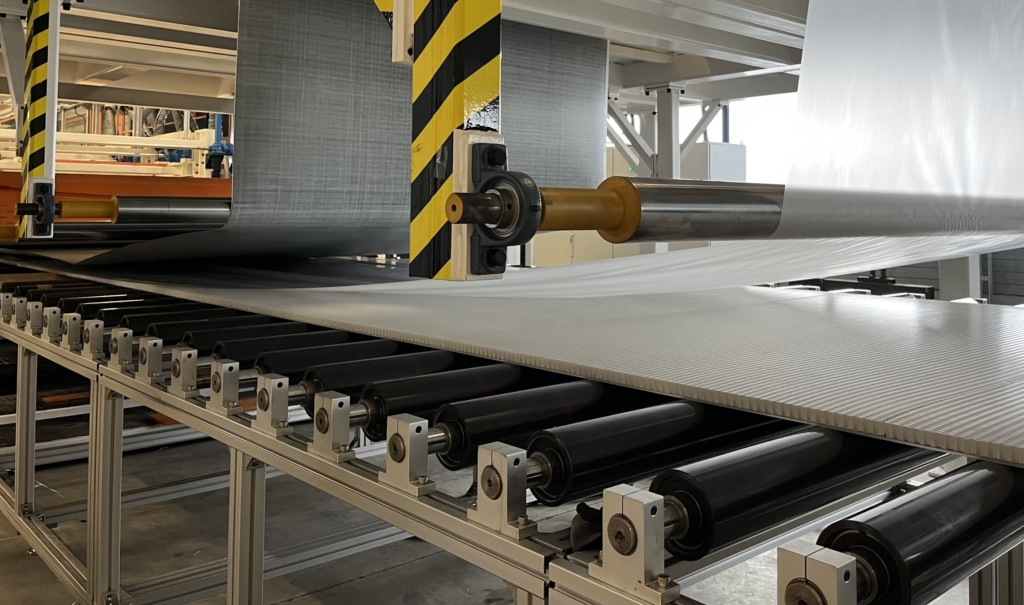
Composite formwork panels are highly resistant to long-term outdoor storage. Unlike plywood, thermoplastic composite panels do not absorb moisture, shrink or rot when exposed to rain, frost or UV radiation. This makes them particularly well suited to construction companies and formwork manufacturers that store panels outdoors between projects. The questions below look more closely at the specific properties that make this possible and how composite compares with traditional materials.
What happens to composite formwork panels during long-term outdoor storage?
Composite formwork panels remain dimensionally stable during long-term outdoor storage. They do not absorb moisture, show no shrinkage or expansion caused by temperature fluctuations, and are resistant to UV radiation. Whereas plywood delaminates and warps under repeated exposure to rain and frost, composite panels retain their shape and mechanical properties.
The core of this behaviour lies in the material itself. Thermoplastic sandwich panels with a PP honeycomb or PET foam core are inherently waterproof. There is no open cell structure that takes up moisture, and the thermoplastic skins seal the core completely. This means that a panel that has been stored outdoors for months is ready for use immediately after cleaning, without drying time, repainting or structural inspection.
Frost poses a particular risk to traditional materials: water absorbed into the material expands when it freezes and breaks down the internal structure. Composite panels do not have this problem. They withstand freeze-thaw cycles without measurable loss of strength or stiffness. For formwork rental companies and contractors who store panels seasonally, this is a tangible advantage that reduces maintenance and replacement costs.
How does moisture affect the strength of composite formwork?
Moisture has no measurable effect on the strength of composite formwork panels made from thermoplastic materials. The panels are fully waterproof and do not absorb moisture into the core or the skins. This stands in direct contrast to plywood, where moisture absorption leads to swelling, loss of bending stiffness and ultimately delamination.
With plywood formwork, moisture absorption is one of the main causes of premature failure. After a limited number of use cycles in wet conditions, bending strength noticeably decreases, which compromises the safety and dimensional accuracy of concrete pouring. Composite formwork structurally avoids this problem: its mechanical properties remain stable regardless of how long the panel has been exposed to rain or high humidity.
It is nevertheless advisable to check the edge finish of composite panels. With damaged or unfinished edges, moisture can theoretically come into contact with the core. Good edge sealing, such as an applied edge band or folded edges, prevents this completely. This is a design measure that is already built in during the production phase for applications in wet environments.
Which composite materials are best suited to outdoor conditions?
For outdoor conditions, thermoplastic sandwich panels with a PP honeycomb or PET foam core are the most suitable. These materials are inherently water-resistant, UV-resistant and chemically resistant. They do not age through moisture absorption and retain their mechanical properties over a long service life, even when directly exposed to the elements.
PP honeycomb as a core
A PP honeycomb core offers an excellent ratio of weight to compressive strength. The closed cell structure completely excludes moisture, and polypropylene is inherently resistant to a wide range of chemicals and cleaning agents. This makes PP honeycomb particularly suitable for formwork panels that are cleaned regularly with water or mild solvents.
PET foam as a core
A PET foam core offers higher stiffness per unit of weight and is likewise fully closed-cell. PET foam performs well at varying temperatures and retains its properties even after prolonged UV exposure. For applications where dimensional accuracy over multiple seasons is important, PET foam is a strong choice.
The skins play an equally important role. Glass fibre-reinforced PP skins offer high impact resistance and resistance to mechanical damage on the construction site. A UV-resistant surface layer, such as a PET film finish, further extends the service life of the panel by preventing discolouration and surface degradation. Compoform’s wall panels with white PET film surfaces have been tested for more than 22,000 hours of UV resistance, which gives a concrete indication of durability in outdoor conditions.
How does the service life of composite formwork compare with plywood?
Composite formwork panels last considerably longer than plywood. Whereas plywood formwork in intensive use lasts an average of three to five years before replacement is necessary, thermoplastic composite panels achieve a service life of twelve years or more under comparable use. Over a project period of fifteen years, this means you eliminate two to three replacement cycles.
That calculation has direct financial consequences. Suppose a set of plywood formwork panels has to be replaced every four years. Over fifteen years, you would then pay three times the panel costs, plus the labour costs for dismantling, disposal and reinstallation. Composite has a higher purchase price per panel, but when you add up panel costs, installation labour and downtime, the composite solution is cheaper per year of use.
Then there are the indirect benefits. Plywood panels at the end of their service life produce a less smooth concrete surface, which requires finishing work. Composite panels retain their surface quality over their entire service life, which keeps the quality of concrete pouring consistent. For precast concrete producers, where surface quality directly affects the end product, this is a relevant advantage.
Which maintenance steps extend the service life of composite formwork panels?
Composite formwork panels require minimal maintenance. Cleaning with water or a mild cleaning agent is sufficient in most cases. Painting, drying or structural repairs are not necessary. Even so, there are a number of practical steps that further extend service life and keep performance at the required level.
- Regular cleaning: Remove concrete residue and dirt after each use. Composite adheres less strongly to concrete than plywood, which makes cleaning easier. Rinsing with water is usually sufficient.
- Edge inspection: Inspect the edges for damage after intensive use. Damaged edge banding or an exposed core can easily be repaired with suitable sealants before moisture reaches the core.
- Storage on a flat surface: Store panels horizontally or upright on a stable surface. Prolonged storage in a bent position can lead to permanent deformation in any panel, including composite.
- Avoid point loads during storage: Stack panels evenly and avoid heavy objects on a small surface area. This protects the skins from unnecessary mechanical damage.
- Use suitable release agents: Check that the release agent used is compatible with the surface finish of the panel. Aggressive solvents can attack the surface layer.
Because composite panels do not rot, do not delaminate and need no drying time, the maintenance burden per cycle is considerably lower than with plywood. This reduces not only direct maintenance costs but also the time between use and redeployment at the next construction site.
How we help with durable formwork panels
We develop and produce thermoplastic sandwich panels for formwork manufacturers and precast concrete producers looking for a durable alternative to plywood. Our approach is that of an application partner: we assess your specific formwork design, advise on the right core construction and skin lamination, and flag potential bottlenecks before production starts.
What we can do for you:
- Tailor panel configurations to your load requirements and dimensions
- Specify edge finishing and surface treatment for wet outdoor conditions
- Supply samples and prototypes for technical evaluation in your own production environment
- Contribute ideas on integration into existing formwork systems or modular constructions
- Provide support with certification and technical documentation
Specifications vary by application and customer requirement. We always discuss your specific project first before making technical recommendations. Get in touch via our contact page to discuss how composite formwork panels fit your application, or take a look at our application overviews for more context on what we develop.
Related Articles
- How do lightweight sandwich panels improve driver safety through better handling?
- How to calculate the true lifetime cost of your sandwich panels?
- How are sandwich panel manufacturers reducing waste in production?
- Why is traditional material weight hurting your vehicle's fuel costs?
- Can sandwich panels be printed or branded?