

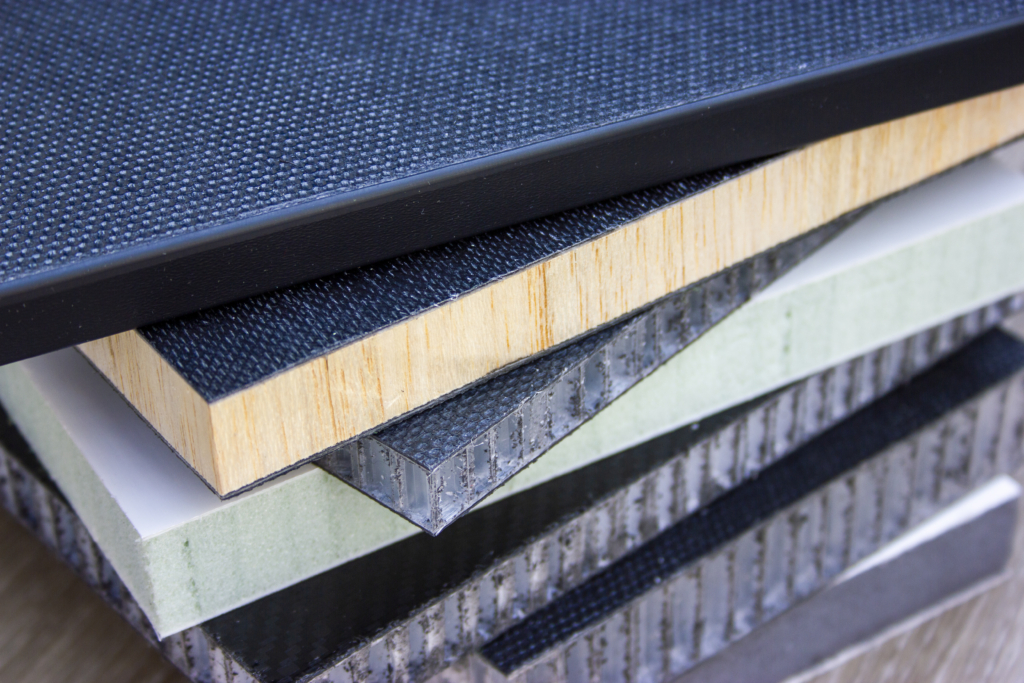
Sandwich panel manufacturers reduce production waste primarily through continuous lamination processes, precision cutting technology, and custom panel sizing that eliminates off-cuts before they occur. Thermoplastic composite panels add a further advantage: scrap material from PP-foam and PP-honeycomb cores is fully recyclable, unlike thermoset alternatives that go to landfill. The questions below unpack each of these mechanisms in detail.
What production processes generate the most waste in sandwich panel manufacturing?
The highest-waste stages in sandwich panel manufacturing are trimming and cutting, adhesive application, and skin lamination. Trimming panels to final dimensions after bonding generates off-cuts that cannot be reused if the adhesive is a thermoset resin. Inconsistent adhesive application also creates panels that fail quality checks and must be scrapped entirely.
Batch lamination processes compound this problem. When panels are bonded in discrete press cycles, each cycle requires setup material, and any misalignment between skin and core produces a reject. The more manual the process, the higher the reject rate. Skin-to-core bonding failures are particularly costly because both materials are lost simultaneously.
Cutting waste is often underestimated. When manufacturers produce panels in fixed standard sizes and customers cut them to fit, the off-cuts generated at the customer’s facility represent material that was manufactured, transported, and then discarded. This is a systemic inefficiency that starts with the panel manufacturer’s inability to produce custom dimensions.
How does continuous production technology reduce material scrap?
Continuous lamination lines reduce scrap by eliminating the setup losses and reject rates associated with batch pressing. In a continuous process, skins and core feed through the line simultaneously at a controlled rate, producing a consistent bond across the full panel length without discrete press cycles. This removes the edge and setup waste that batch processes generate at the start and end of each press run.
Precision tension and temperature control across the line also reduces skin wrinkling and delamination, which are the two most common causes of reject panels in lamination. Fewer rejects mean less raw material lost to quality failures.
Semi-automatic continuous lines add a further benefit: consistent process parameters are logged and repeatable, so the line can be adjusted quickly when a specification changes rather than running trial panels until the output stabilises. For high-volume production, this translates directly into less material consumed per saleable square metre of panel.
What role do custom panel dimensions play in reducing off-cuts?
Custom panel dimensions eliminate the single largest source of downstream waste in sandwich panel supply chains. When a truck body builder or trailer manufacturer receives panels cut to their exact assembly dimensions, there are no off-cuts to dispose of at their facility. Every square metre delivered becomes part of the finished structure.
Standard-size panels force customers to cut, and cutting generates waste that the customer pays for twice: once in the panel price and again in disposal cost. For large structures such as trailer sidewalls or cargo box floors, the off-cut percentage from standard panels can be significant depending on the geometry of the design.
The ability to produce panels up to 13,500 mm in length is particularly relevant here. A single full-length panel can span an entire trailer sidewall without a join, removing the need to cut and butt two shorter panels together. This reduces both material waste and the labour cost of joining.
Are thermoplastic composite panels easier to recycle than thermoset alternatives?
Yes. Thermoplastic composite panels are substantially easier to recycle than thermoset alternatives. Thermoplastic matrices such as polypropylene can be remelted and reprocessed at end of life, whereas thermoset resins such as epoxy or polyester undergo an irreversible chemical cure that makes them impossible to remelt. Thermoset composite scrap typically goes to landfill or energy recovery, not material recycling.
For European OEMs, this distinction is increasingly a compliance matter rather than a preference. The EU End-of-Life Vehicles (ELV) Directive sets recycling and recovery targets for vehicles, and manufacturers sourcing structural materials need to account for how those materials are handled at end of life. Thermoplastic panels support compliance with these targets in a way that thermoset panels cannot.
Production scrap from thermoplastic panels is also recyclable. Off-cuts and trim waste from PP-foam or PP-honeycomb core panels can be returned to the material stream rather than sent to landfill. This closes the loop within the manufacturing process itself, not just at the vehicle’s end of life.
How do manufacturers reduce energy waste during composite panel production?
Energy waste in composite panel production is reduced primarily by optimising heating and cooling cycles, running continuous rather than batch processes, and matching production line speed to material throughput. Batch press operations consume energy heating and cooling the press platens for every cycle, including the idle time between cycles. Continuous lines maintain a steady thermal state, which is more energy-efficient per square metre of output.
Material selection also affects energy consumption. Thermoplastic composites process at lower temperatures than some thermoset systems and do not require the extended cure times that epoxy-based panels demand. Shorter thermal exposure per panel means less energy per unit of production.
Production scheduling plays a practical role too. Running a production line at consistent capacity rather than in short bursts reduces the energy cost of startup and shutdown cycles. For manufacturers producing at scale, aligning production runs to customer order volumes rather than building to stock reduces both energy waste and inventory holding costs.
What certifications or standards indicate low-waste composite manufacturing?
ISO 14001 environmental management certification is the primary indicator that a composite manufacturer has a structured approach to reducing waste, energy use, and environmental impact across its production operations. ISO 14001 requires manufacturers to set measurable environmental objectives and demonstrate continuous improvement, which includes waste reduction targets.
For product-level sustainability, the EU’s Corporate Sustainability Reporting Directive (CSRD) is increasingly shaping what European OEMs require from their suppliers. Manufacturers supplying into CSRD-reporting companies need to provide lifecycle and environmental data on their products, which incentivises low-waste production processes and recyclable material choices.
For scaffolding applications specifically, EN 12811 load class certification confirms that a panel meets structural performance requirements at a given thickness. A panel that achieves EN 12811 load class 4 at 10.5 mm thickness uses less material per board than a thicker alternative achieving the same load class, which is itself a form of material efficiency.
How Compoform Approaches Waste Reduction in Panel Manufacturing
We operate a 72-metre semi-automatic continuous lamination line at our facilities in Beek and Ospel, the Netherlands. The continuous process removes the batch press losses described above and allows us to maintain consistent lamination quality across panels up to 13,500 mm long and 2,950 mm wide. Every panel we produce is 100% European-made and manufactured under ISO-certified quality control.
Here is how our production approach directly reduces waste at your facility and ours:
- Custom dimensions to your exact specification. Panels are cut to the dimensions your assembly process requires, eliminating off-cuts at your end. You receive material you use, not material you trim.
- Thermoplastic cores throughout. We work exclusively with PP-honeycomb and PP-foam cores. Both are fully recyclable at end of life, supporting your compliance with the EU ELV Directive and CSRD reporting obligations.
- Production scrap recycled, not landfilled. Trim waste from thermoplastic panels re-enters the material stream rather than going to waste disposal.
- Longer service life reduces replacement waste. A thermoplastic composite floor panel lasts 12 or more years in heavy transport use, compared to three to five years for plywood. Over a 15-year vehicle life, that eliminates two to three replacement cycles, each of which generates its own disposal waste and replacement material consumption.
For truck body builders and trailer manufacturers, the structural efficiency matters too. A 30 mm PP sandwich panel floor is self-supporting without an aluminium subframe, removing a production step and the material that step consumes.
We work with you as an application partner from the start: reviewing your design, optimising panel configuration for your assembly process, and identifying potential issues before production begins. If you are evaluating composite panels for a truck body floor, trailer sidewall, or scaffolding board application, speak with our engineering team about the specific configuration that fits your load requirements and production workflow.