

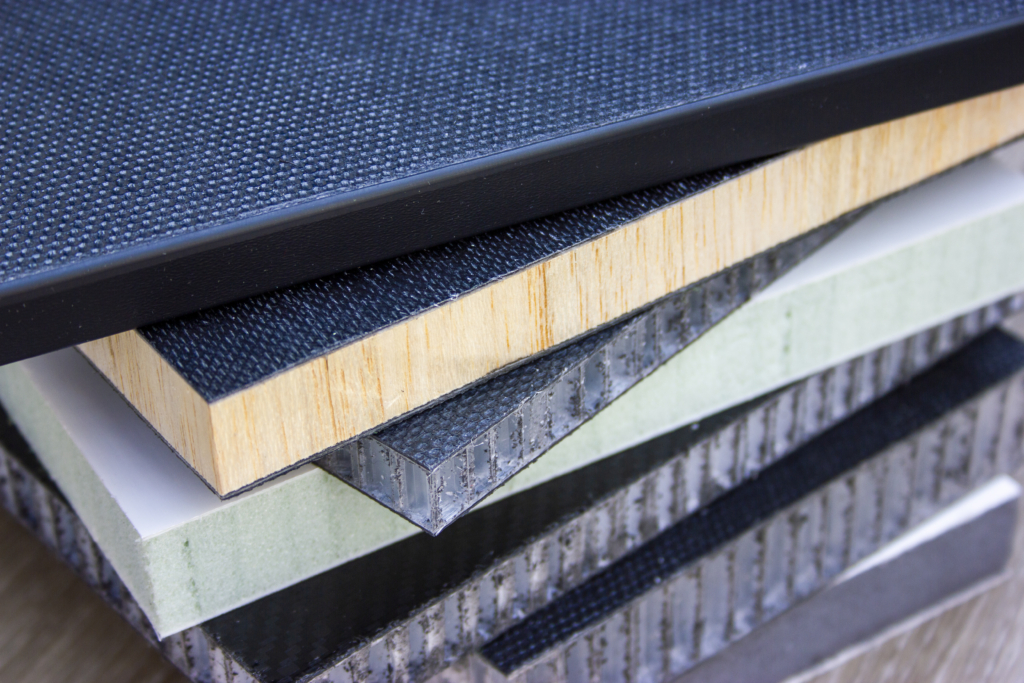
A PP honeycomb core distributes load across a sandwich panel by acting as a shear-transferring medium between two stiff face skins. When a force is applied to the panel surface, the skins carry bending stress in tension and compression while the honeycomb core resists the shear forces that develop between them. This division of labour is what gives a sandwich panel its structural efficiency relative to its weight.
The geometry of the honeycomb cells, the density of the core, and the quality of the bond between core and skin all determine how effectively load spreads across the panel area rather than concentrating at the point of application. The sections below work through each of these mechanisms in sequence.
What happens to a load when it enters a sandwich panel?
When a load contacts the surface of a sandwich panel, it is first received by the face skin, which spreads the force laterally before passing it into the core. The two face skins act like the flanges of an I-beam: the skin on the loaded side goes into compression, the skin on the opposite side goes into tension, and the core between them carries the shear that connects the two. This beam analogy explains why sandwich panels achieve high bending stiffness without requiring solid material throughout their thickness.
The separation distance between the two skins is the primary driver of bending performance. Increasing panel thickness moves the skins further apart, raising the second moment of area and dramatically increasing resistance to deflection under load. A 30 mm floor panel, for example, sustains a substantially higher maximum load than a 15 mm panel of the same construction, even though the skin material is identical. This is the structural logic behind specifying thicker panels for high-load floor applications in truck bodies and trailers.
Point loads, such as a pallet corner or a forklift tine, create concentrated stress at the contact zone. The skin distributes this locally before the core takes over, which is why skin thickness and fibre content matter for puncture and indentation resistance, not just overall bending performance.
How does a PP honeycomb core transfer shear forces?
A PP honeycomb core transfers shear forces through its cell walls, which run perpendicular to the panel face. When the panel bends, the face skins try to slide relative to each other. The honeycomb cell walls resist this sliding by carrying shear stress along their length, transmitting force from one skin to the other without allowing the panel to collapse inward. The efficiency of this transfer depends on the cell wall thickness, cell size, and core density.
In Compoform’s floor panels, the PP honeycomb core runs at 140 kg/m3. At this density, the core achieves a compression strength of 3.63 MPa and an E-modulus of 123 MPa (tested to EN ISO 844). These values reflect a core stiff enough to prevent local buckling under concentrated loads while remaining light enough to keep the panel’s areal weight well below that of steel or plywood alternatives.
The polypropylene material itself contributes to shear performance through its toughness rather than its stiffness alone. PP absorbs energy before fracturing, which means the core can accommodate dynamic loading, vibration, and impact without sudden failure. In transport applications, where panels are subject to repeated loading cycles over years of service, this toughness is a meaningful durability advantage over brittle core materials.
Why does cell geometry affect load distribution in honeycomb panels?
Cell geometry determines how evenly shear stress is distributed across the core cross-section. A regular hexagonal cell pattern spreads load in multiple directions simultaneously, preventing stress from concentrating along a single axis. Smaller cell diameters increase the number of cell walls per unit area, which raises the core’s effective shear stiffness and improves resistance to localised indentation.
In Compoform’s PP honeycomb, individual tube diameters measure 8 mm. This cell size balances load distribution area against core weight. Larger cells would reduce weight further but create longer unsupported spans between cell walls, increasing the risk of skin dimpling under point loads. Smaller cells add weight without proportional structural gain. The 8 mm diameter reflects an engineered compromise tuned for floor and structural panel applications.
Cell orientation also matters. In a standard through-thickness honeycomb, the cell walls run vertically between the two skins, which maximises compression resistance perpendicular to the panel face. This is the correct orientation for floor panels carrying vertical loads from cargo, equipment, or foot traffic. If the core were oriented differently, the same material would deliver significantly lower compression performance.
What’s the difference between PP honeycomb and foam core in load distribution?
The key distinction is that PP honeycomb distributes load through discrete cell walls arranged in a regular geometric pattern, while foam core distributes load through a continuous cellular matrix. Honeycomb cores deliver higher compression strength and shear stiffness per unit weight, making them the preferred choice for floor panels and structural applications. Foam cores offer more uniform through-thickness properties and are better suited to wall panels where compressive loads are not dominant.
In practical terms, a PP honeycomb core at 140 kg/m3 achieves a panel compression strength of 4.50 MPa. A PP foam core at 60 kg/m3, used in wall panel configurations, delivers a thickness-wise compressive strength of 0.75 MPa. That difference is not a quality gap; it reflects the different load environments each core type is designed for. Wall panels rarely carry significant perpendicular compression, so the foam core’s lower compressive strength is not a limitation in that context.
For load distribution across the panel plane, foam cores perform well because their continuous structure spreads point loads smoothly without the discrete cell boundaries present in honeycomb. Honeycomb cores, by contrast, can create slight stress concentrations at cell wall junctions under very localised loads, though this effect is largely mitigated by the face skins, which bridge across individual cells before transferring load into the core.
The choice between the two core types should follow the load case, not a general preference. Floor panels in truck bodies and trailers demand honeycomb. Interior wall panels in the same vehicle can use foam cores effectively, saving weight where structural demands are lower.
How does skin-to-core bond quality affect load transfer in PP sandwich panels?
The bond between skin and core is the most critical interface in a sandwich panel. If this bond fails, the skin and core act as independent layers rather than a composite system, and the panel loses most of its bending stiffness. Load transfer across the panel depends entirely on the skin and core remaining mechanically coupled throughout the panel’s service life.
In thermoplastic sandwich panels, the skin-to-core bond is achieved through thermal fusion rather than adhesive. The PP honeycomb core and the thermoplastic face skins are bonded under heat and pressure during continuous production, creating a weld rather than a glue line. This eliminates the adhesive degradation that can occur in bonded panels exposed to moisture, temperature cycling, or chemical cleaning agents, all of which are routine in truck body and trailer environments.
Bond quality also determines how well the panel handles peel forces at its edges. In applications where panels are fastened, routed, or edge-sealed, the skin-to-core interface at the cut edge is exposed. Edge sealing protects this zone from moisture ingress and UV degradation, which is relevant for scaffolding boards and truck floors that are regularly washed down. A compromised edge bond allows moisture to wick into the core, reducing shear transfer capacity over time.
When does a PP honeycomb panel reach its load distribution limits?
A PP honeycomb sandwich panel reaches its load distribution limits when one of three failure modes occurs: skin failure in tension or compression, core shear failure, or skin-to-core delamination. Which mode governs depends on the span, the load type, and the panel configuration. In well-designed panels, all three limits are reached at similar load levels, meaning no single component is significantly over-engineered relative to the others.
For floor panels in commercial vehicle applications, the governing limit is typically bending strength at the panel face skin. Compoform’s 15 mm floor panel, tested to ISO 14125 on a 250 mm span, records an average maximum load of 3,240 N. The 30 mm variant of the same construction sustains an average maximum load of 5,647 N under the same test geometry. These figures reflect tested performance from Compoform’s own laboratory data, not theoretical calculations, and the stated TDS minimum values carry a meaningful safety margin below the average test results.
Panels also have thermal limits. All Compoform products operate within a range of minus 40 to plus 80 degrees Celsius (ISO 75). Beyond this range, the PP matrix softens and the core’s ability to transfer shear forces reduces. In practice, this limit is rarely approached in European commercial vehicle or scaffolding applications, but it is relevant when specifying panels for environments near heat sources or in direct sun exposure in southern climates.
Dynamic and fatigue loading introduce a different failure pathway. Repeated loading below the static limit can degrade the skin-to-core bond over time if the panel is not correctly supported or if fastener points concentrate stress. Correct panel specification, support spacing, and edge treatment all extend the point at which these limits become relevant in service.
How Compoform Helps with PP Honeycomb Load Distribution
We engineer PP honeycomb sandwich panels for specific load environments, not generic structural requirements. For truck body floors, trailer decks, and scaffolding boards, the panel configuration, core density, skin layup, and thickness are all selected to match the actual load case your application presents. This means you are not paying for over-specified material where it is not needed, and you are not exposed to under-specified panels where loads are highest.
- Application-matched core density: We work with 140 kg/m3 PP honeycomb for floor and structural panels where compression and shear performance are the governing requirements.
- Tested performance data: Panel performance figures come from our own laboratory testing to ISO 14125 and EN ISO 844, not from theoretical models. You receive actual test results, not datasheet estimates.
- Custom panel dimensions: Panels are available in custom dimensions cut to your exact specification, up to 13,500 mm x 2,950 mm, removing the need to join standard-format sheets in your assembly.
- Edge protection as standard: Edge sealing and edge bending protect the skin-to-core bond from moisture and UV at cut edges, which is relevant for any panel exposed to wash-down cycles or outdoor conditions.
- Self-supporting floor panels: A 30 mm PP honeycomb floor panel is self-supporting across standard truck body spans, removing the aluminium subframe from your build process and reducing both weight and production steps.
- EV fleet compatibility: Every kilogram removed from a truck body structure extends battery range in electric trucks. Lighter body panels are a range argument as much as a payload argument, and this is a standard procurement question from EV fleet buyers in 2026.
Before production, we review your design, check support spacing against the panel’s tested load limits, and flag any configuration that could create stress concentrations at fastener points or panel edges. If your load case sits at the boundary of a standard configuration, we work through the options with you before you commit to a specification. See how our floor panels perform in truck body and trailer applications. To discuss your specific load requirements with our engineering team, contact us about your panel specification.
Related Articles
- What is the carbon footprint of producing a sandwich panel?
- How does the choice of face sheet affect sandwich panel stiffness and weight?
- What density of PP foam is used in structural sandwich panels?
- Why is recyclability becoming a key factor in sandwich panel selection?
- Why are contractors replacing plywood scaffold boards with sandwich panels?