

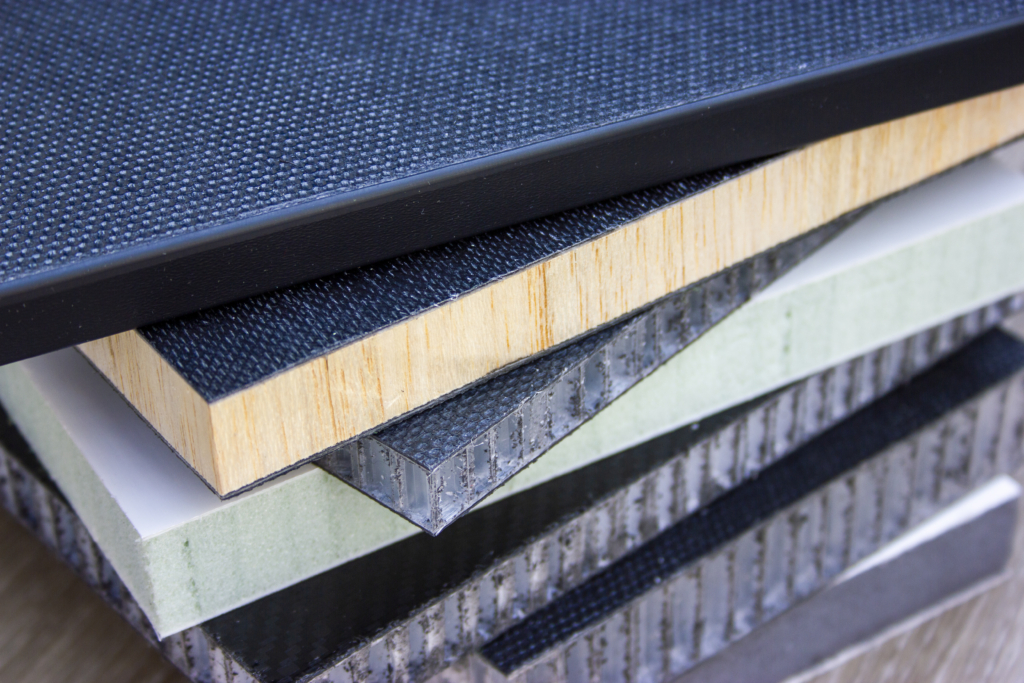
Recyclability is becoming a key factor in sandwich panel selection because European regulations now require manufacturers to account for end-of-life material recovery across their supply chains. For OEMs in commercial vehicles and transport, this is no longer a preference; it is a compliance requirement under frameworks like the EU End-of-Life Vehicles Directive. The questions below unpack what drives this shift and what it means for panel material choices.
What makes a sandwich panel recyclable or non-recyclable?
A sandwich panel is recyclable when its core and skin materials can be separated and reprocessed at end of life without destroying their material value. The defining factor is whether the matrix binding the composite together is thermoplastic or thermoset. Thermoplastic panels can be remelted and reformed; thermoset panels cannot.
Most sandwich panels combine a lightweight core with reinforced skins bonded under heat and pressure. What determines recyclability is the chemistry of that bond and the compatibility of the materials involved:
- Thermoplastic composites (such as glass-fibre-PP or glass-PET) use a polymer matrix that softens when reheated, allowing the material to be granulated and reprocessed into secondary products.
- Thermoset composites (such as fibre-reinforced polyester or epoxy-based laminates) cure irreversibly. Once set, the polymer cannot be remelted, which means end-of-life options are limited to downcycling or landfill.
- Mixed-material panels — for example, a thermoplastic skin bonded to a dissimilar core with adhesive — create separation challenges that reduce recyclability even when individual components are technically recyclable.
Single-material-family panels, where both core and skins share the same polymer base (such as a PP foam core with glass-fibre-PP skins), are the most straightforward to recycle because the entire panel can enter the same processing stream without pre-sorting or chemical separation.
Why are European regulations pushing manufacturers toward recyclable panels?
European regulations are pushing manufacturers toward recyclable sandwich panels because end-of-life material recovery is now a legal obligation, not a voluntary commitment. The EU End-of-Life Vehicles (ELV) Directive requires that vehicles achieve high rates of reusability and recyclability by weight, which directly affects the materials used in body structures, floors, and panels.
For truck body builders, trailer manufacturers, and vehicle assemblers, this creates a clear procurement signal. If the panels fitted to a vehicle cannot be recovered and recycled at end of life, they contribute to a compliance gap that falls on the OEM, not the panel supplier. As vehicle regulations tighten through 2026 and beyond, that gap carries increasing legal and reputational risk.
The Corporate Sustainability Reporting Directive (CSRD) adds another layer. European manufacturers above certain size thresholds must now report on the environmental impact of their supply chains, including material choices. Selecting panels with documented recyclability supports that reporting obligation with verifiable data rather than estimates.
Taken together, the ELV Directive and CSRD are converting recyclability from a marketing claim into a procurement specification. Buyers who previously selected panels on price and performance alone now need to factor in end-of-life documentation as part of their supplier qualification process.
How does thermoplastic composite recyclability compare to thermoset and metal alternatives?
Thermoplastic composites offer the strongest recyclability profile among structural panel materials. Unlike thermoset composites, which cannot be remelted, thermoplastic panels can be granulated and reprocessed into secondary applications. Compared to metal panels, thermoplastics avoid the energy-intensive smelting process and the corrosion-related material degradation that reduces metal recovery value over time.
Thermoplastic versus thermoset composites
Thermoset composites — including panels made with fibre-reinforced polyester or epoxy matrices — cure through an irreversible chemical reaction. Once cured, the polymer cannot be remelted or reformed. End-of-life options are typically limited to mechanical shredding for low-grade filler material or incineration for energy recovery. Neither route preserves material value in the way that thermoplastic reprocessing does.
Thermoplastic composites, by contrast, retain their polymer matrix in a recoverable state. A glass-fibre-PP panel, for example, can be granulated and the resulting material used in injection-moulded secondary parts. The glass fibre content is shortened in this process, which reduces mechanical performance in the recycled product, but the material stays in productive use rather than going to landfill.
Thermoplastic composites versus metal panels
Steel and aluminium panels are often described as highly recyclable, and in terms of established infrastructure, that is accurate. However, metal recycling requires significant energy input for smelting, and panels that have corroded, been treated with coatings, or been bonded to dissimilar materials present sorting and contamination challenges. Metal panels also add substantial dead weight to vehicle structures, which has a compounding effect on fuel consumption and, in electric trucks and vans, on battery range. Every kilogram of structural dead weight reduces range per charge, making weight reduction a range argument, not just a payload argument. This is a standard procurement question from EV fleet buyers in 2026.
Thermoplastic composite panels are lighter, corrosion-free, and do not require protective coatings that complicate end-of-life processing. Their recyclability pathway is less mature than metal in terms of industrial infrastructure, but the material compatibility of single-polymer-family panels makes the process more straightforward as collection systems develop.
What role does recyclability play in total cost of ownership for OEMs?
Recyclability affects total cost of ownership for OEMs in two concrete ways: it reduces end-of-life disposal costs and it protects against regulatory compliance costs that are rising across Europe. For manufacturers reporting under CSRD or supplying to fleet operators with sustainability procurement requirements, non-recyclable panels carry a hidden cost that does not appear on the initial invoice.
On the disposal side, panels that cannot be recycled must be landfilled or incinerated. Landfill costs vary by country but are increasing across Europe as governments apply higher levies to non-recoverable waste. For a truck body builder replacing floors across a fleet, the volume of waste material is significant, and the cost of disposing of thermoset or mixed-material panels adds up over a vehicle’s operating life.
Thermoplastic panels also tend to outlast the alternatives in heavy transport use. In demanding applications such as truck floors and trailer decking, thermoplastic composite panels last considerably longer than plywood, eliminating two to three replacement cycles over a vehicle’s life. Over a 15-year vehicle life, that means fewer panels purchased, less installation labour, and less downtime for refits. When you factor in panel cost, installation, and vehicle downtime across those cycles, the composite is cheaper per year of service even at a higher unit price.
Recyclability strengthens this TCO argument further. At end of vehicle life, panels with documented recyclability can be returned to a material stream rather than disposed of as waste, which reduces the net cost of the final decommissioning step.
Which sandwich panel materials offer the best recyclability for transport applications?
For transport applications, sandwich panels built entirely within the polypropylene (PP) material family offer the best recyclability. A PP foam or PP honeycomb core combined with glass-fibre-PP skins creates a panel where all structural components share the same polymer base, simplifying end-of-life processing and avoiding the separation challenges that arise with mixed-material constructions.
Glass-PET panels represent a strong alternative where surface finish and UV resistance are priorities. PET (polyethylene terephthalate) is a well-established recyclable polymer with existing collection and reprocessing infrastructure across Europe, which supports end-of-life recovery in practice rather than just in principle.
The materials that perform least well on recyclability in transport applications are thermoset-based panels — including those using fibre-reinforced polyester skins — and panels that combine thermoplastic skins with adhesive-bonded dissimilar cores. Both create end-of-life separation problems that reduce recovery rates and increase disposal costs.
For truck body builders and trailer manufacturers specifically, the relevant selection criteria are:
- Single-polymer-family construction — core and skins from the same polymer base for clean end-of-life processing
- No adhesive bonding between dissimilar materials — thermoplastic panels produced by heat lamination avoid the contamination that adhesives introduce into recycling streams
- Documented recyclability — supplier-provided material declarations that support ELV Directive compliance reporting
- Durability in service — panels that last longer generate less waste volume over a vehicle’s operating life, which is itself a sustainability and cost argument
How Compoform Supports Recyclable Panel Selection
We build our sandwich panels around PP honeycomb and PET foam cores, combined with glass-fibre-PP or glass-PET skins. This single-polymer-family construction is not a marketing position; it is a deliberate engineering choice that makes end-of-life material recovery straightforward and supports your compliance obligations under the EU ELV Directive and CSRD reporting requirements.
Here is what that means in practice for truck body builders and trailer manufacturers:
- No mixed-material separation problem at end of life — our panels are produced by heat lamination within the same polymer family, avoiding the adhesive contamination that complicates recycling in mixed-material panels.
- Longer service life reduces total waste volume — thermoplastic composite floors last considerably longer than plywood in heavy transport, eliminating two to three replacement cycles over a vehicle’s life and reducing the total material that needs to be recovered.
- Self-supporting 30mm PP floor panels — our 30mm PP sandwich panel floors are self-supporting with no aluminium subframe required, removing a production step, reducing vehicle weight, and simplifying end-of-life disassembly.
- Material documentation for compliance reporting — we provide the technical documentation you need to support ELV Directive compliance and CSRD supply chain reporting, so recyclability is verifiable, not just claimed.
We review your panel application before recommending a configuration. That means looking at your assembly process, load requirements, and end-of-life obligations together, not shipping panels to a generic specification and leaving integration to you. If you are specifying panels for a truck body floor, trailer wall, or scaffolding application and need to demonstrate recyclability to your customers or regulators, speak with our engineering team about the right panel configuration for your project.
Related Articles
- How does PP honeycomb compare to aluminium honeycomb in transport sandwich panels?
- How thick should sandwich panels be in a motorhome build?
- What are the best sandwich panels for truck body construction?
- Why are motorhome manufacturers switching to sandwich panel walls?
- How thick can a sandwich panel be?