

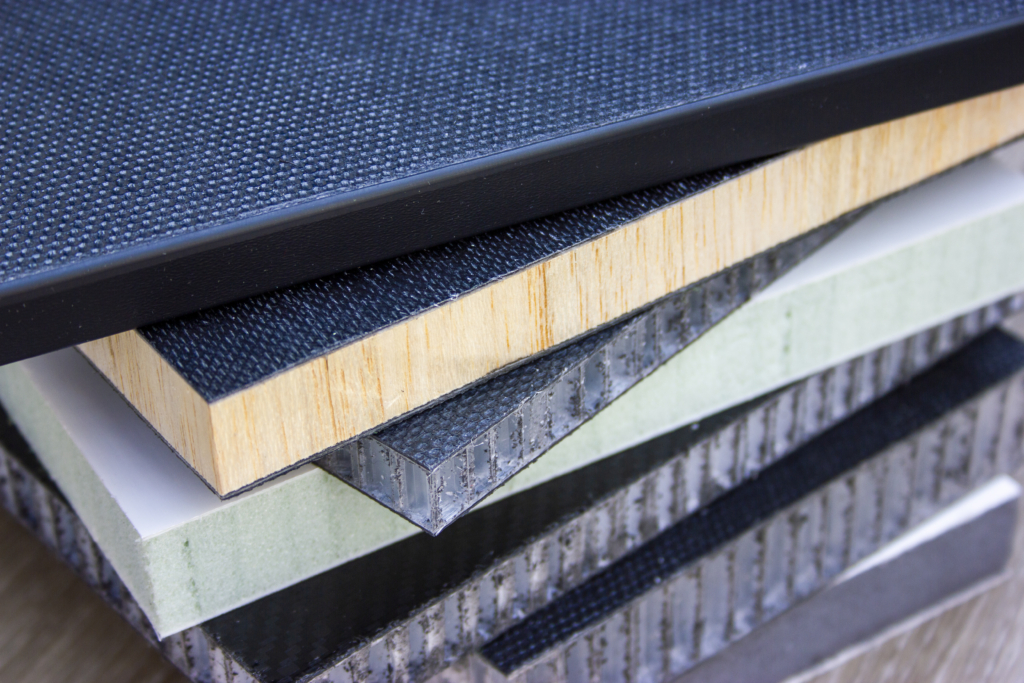
Producing a sandwich panel generates a lower carbon footprint than producing an equivalent steel or aluminum structure, primarily because composite panels are significantly lighter and require less energy-intensive raw material processing per unit of structural performance. The exact CO2 figure varies by panel configuration, core material, skin architecture, and where the panel is manufactured. The questions below unpack the key drivers, material comparisons, and lifecycle considerations that matter most for procurement and sustainability teams.
What factors drive the carbon footprint of sandwich panel production?
The carbon footprint of sandwich panel production is driven by four main factors: the embodied carbon of the raw materials, the energy consumed during manufacturing, the transport distance from factory to customer, and the panel’s weight relative to its structural output. Of these, raw material selection typically accounts for the largest share of total emissions.
Glass fibre reinforcement is the most carbon-intensive input in a thermoplastic composite panel. Producing glass fibre requires high-temperature melting of raw minerals, which consumes substantial energy. The polymer matrix — polypropylene in most thermoplastic panels — carries a lower embodied carbon than thermoset resins, partly because it can be processed at lower temperatures and does not require chemical curing agents.
Manufacturing process efficiency also plays a significant role. Continuous production lines, like the 72-metre semi-automatic line used to produce panels up to 13,500 mm × 2,950 mm, reduce per-unit energy consumption compared to batch processes. Producing panels in Europe rather than importing from Asia eliminates the carbon cost of long-distance ocean freight, which is a meaningful factor when panels are large and heavy.
Finally, panel density directly affects the carbon cost per unit of structural performance. A thicker panel with a lower-density PP-foam core can achieve the same bending performance as a thinner, denser panel while using less material overall, which reduces embodied carbon per square metre of finished structure.
How do thermoplastic composite panels compare to steel and aluminum in CO2 emissions?
Thermoplastic sandwich panels produce lower lifecycle CO2 emissions than steel or aluminum panels of equivalent structural performance, primarily because they are far lighter. Steel carries an embodied carbon of roughly 1.5 to 2.5 kg CO2 per kilogram of material, and primary aluminum is significantly higher. A glass-fibre-reinforced PP panel delivers comparable stiffness at a fraction of the mass, so the total embodied carbon per unit of load-bearing capacity is lower even before operational savings are counted.
The comparison becomes more decisive when you account for the full vehicle or structure lifecycle. Every kilogram of dead weight in a truck body or trailer structure generates CO2 over the entire operational life of the vehicle, through higher fuel consumption or, in electric vehicles, reduced battery range per charge. In 2026, this is a standard procurement question from EV fleet buyers: lighter body structures extend battery range directly, making weight reduction a range argument as much as a payload argument.
Steel also requires surface treatment — painting, galvanising, or coating — to resist corrosion. Each of these steps adds process energy and chemical inputs. Thermoplastic composite panels do not corrode, eliminating those treatment steps and their associated emissions entirely.
Aluminum sits between steel and composites in this comparison. It is lighter than steel but still significantly heavier than a well-specified sandwich panel, and primary aluminum production is among the most energy-intensive industrial processes. Recycled aluminum reduces this gap, but the structural weight disadvantage remains.
Does the core material affect a sandwich panel’s carbon footprint?
Yes, core material choice has a measurable effect on a sandwich panel’s carbon footprint, both through embodied carbon in the core itself and through the panel’s overall weight, which drives operational emissions across its service life. PP-foam cores and PP-honeycomb cores have different density profiles, and that difference flows directly into the panel’s areal weight and transport emissions.
PP-foam cores are available across a wide density range. Lower-density foam cores use less polypropylene per cubic metre, which reduces the embodied carbon of the core. A wall panel using a 60 kg/m³ PP-foam core weighs between roughly 2,760 and 3,670 g/m² depending on skin architecture, making it one of the lightest panel configurations available for cladding applications.
PP-honeycomb cores, used in floor panels and scaffolding applications, are denser and heavier. A 30 mm floor panel with a 140 kg/m³ PP-honeycomb core reaches approximately 7,600 g/m² — more than double the areal weight of a lightweight wall panel. That additional mass is justified by the substantially higher compressive and bending performance required for floor loading, but it does mean the floor panel carries a higher embodied carbon per square metre than a wall panel.
The important framing here is performance per kilogram, not absolute weight. A PP-honeycomb floor panel that replaces a steel-reinforced plywood floor eliminates far more mass from the vehicle than it adds, even accounting for its own weight. The net carbon effect across the vehicle’s operational life is strongly positive.
How does panel weight reduction lower lifetime CO2 emissions in transport?
Every kilogram removed from a truck body, trailer, or van structure reduces the fuel or energy consumed on every loaded journey that vehicle makes across its operational life. In diesel vehicles, lighter structures reduce fuel burn directly. In electric trucks and vans, lighter body structures extend battery range per charge — making structural weight reduction a range argument, not just a payload argument, for EV fleet operators in 2026.
The compounding effect of weight savings is significant. A truck body that saves 200 kg through composite panel construction instead of steel or plywood carries that advantage on every trip, across every year of its service life. Over a 15-year vehicle life, the cumulative fuel or energy saving is substantial, and the associated CO2 reduction scales accordingly.
Thermoplastic sandwich panels last considerably longer than the materials they replace in heavy transport applications. Industry experience with composite floors in commercial vehicles shows service lives of 12 years or more, compared to 3 to 5 years for plywood floors under equivalent loading. Over a 15-year vehicle life, a composite floor eliminates two to three plywood replacement cycles. Once you factor in panel cost, installation labour, and vehicle downtime for each replacement, the composite floor is cheaper per year of service — even at a higher unit price — and generates less cumulative CO2 from manufacturing replacement panels.
For EV fleet buyers, the weight argument carries additional force. Battery range is a hard operational constraint, and every kilogram of structural dead weight reduces the distance the vehicle can travel per charge. Specifying lightweight composite panels for body structures is increasingly a range optimisation decision, not just a payload decision.
Are thermoplastic sandwich panels recyclable at end of life?
Thermoplastic sandwich panels are recyclable at end of life, which distinguishes them from thermoset composite panels, which cannot be melted and reprocessed. Because the matrix material is polypropylene — a thermoplastic — the panels can in principle be shredded and the material recovered for reuse in lower-grade applications. This recyclability is relevant to European OEMs subject to the EU End-of-Life Vehicles (ELV) Directive, which sets mandatory recycling and recovery targets for vehicle components.
The practical recyclability of a glass-fibre-reinforced thermoplastic panel depends on the ability to separate or co-process the glass fibre and polymer matrix at end of life. Unlike thermoset panels, thermoplastic panels do not require chemical breakdown — they can be mechanically processed. The recovered material typically finds use in non-structural applications where the mixed glass-PP composition is acceptable.
For European manufacturers reporting under the Corporate Sustainability Reporting Directive (CSRD), the recyclability of structural components is increasingly a documented requirement, not just a preference. Specifying thermoplastic composite panels over thermoset alternatives or steel-plywood hybrids supports compliance with both the ELV Directive and broader sustainability reporting obligations.
It is worth noting that the longest sustainability benefit of thermoplastic panels comes not from end-of-life recycling alone, but from the combination of long service life, weight-driven operational savings, and recyclability at the end of that extended service life. All three factors together define the full environmental case for thermoplastic composites in transport and industrial applications.
How Compoform Supports Your Sustainability and Carbon Reduction Goals
We manufacture thermoplastic sandwich panels at our facilities in Beek and Ospel, the Netherlands, using PP-honeycomb and PP-foam cores with glass-fibre-reinforced skins. Every panel is 100% European-made, which eliminates the carbon cost of long-distance ocean freight and gives you a traceable, auditable supply chain for CSRD reporting.
Here is what we bring to sustainability-focused procurement decisions:
- Lightweight panel configurations across a wide density range: PP-foam cores are available from 40 to 140 kg/m³, allowing us to optimise panel weight for your specific load requirements rather than defaulting to a heavier standard specification.
- Self-supporting floor panels that eliminate subframes: A 30 mm PP sandwich panel floor is self-supporting — no aluminium subframe required. This removes a production step, reduces total vehicle weight further, and lowers your assembly cost.
- Long service life that reduces replacement cycle emissions: Thermoplastic composite floors last 12 or more years in heavy transport applications, eliminating two to three plywood replacement cycles over a vehicle’s life and the associated manufacturing and installation emissions.
- Recyclable at end of life: Thermoplastic panels support compliance with the EU ELV Directive and provide documented recyclability for CSRD reporting.
- Custom dimensions cut to your specification: Panels are available up to 13,500 mm × 2,950 mm, cut to your exact requirements — no off-cuts, no material waste from trimming oversized standard sheets.
We review your design before production, optimise the panel configuration for your assembly process, and flag potential issues early, so you are not solving integration problems after the panels arrive. If you are specifying composite panels for truck bodies, trailers, or scaffolding and want to understand which configuration delivers the best weight and carbon outcome for your application, speak with our engineering team directly.
Related Articles
- How do thermoplastic sandwich panels compare to thermoset on sustainability?
- What makes thermoplastic sandwich panels 100% recyclable?
- How do sandwich panels hold up in outdoor and off-road RV use?
- Why are European manufacturers switching to composite sandwich panels in 2026?
- What are sandwich panels used for?