

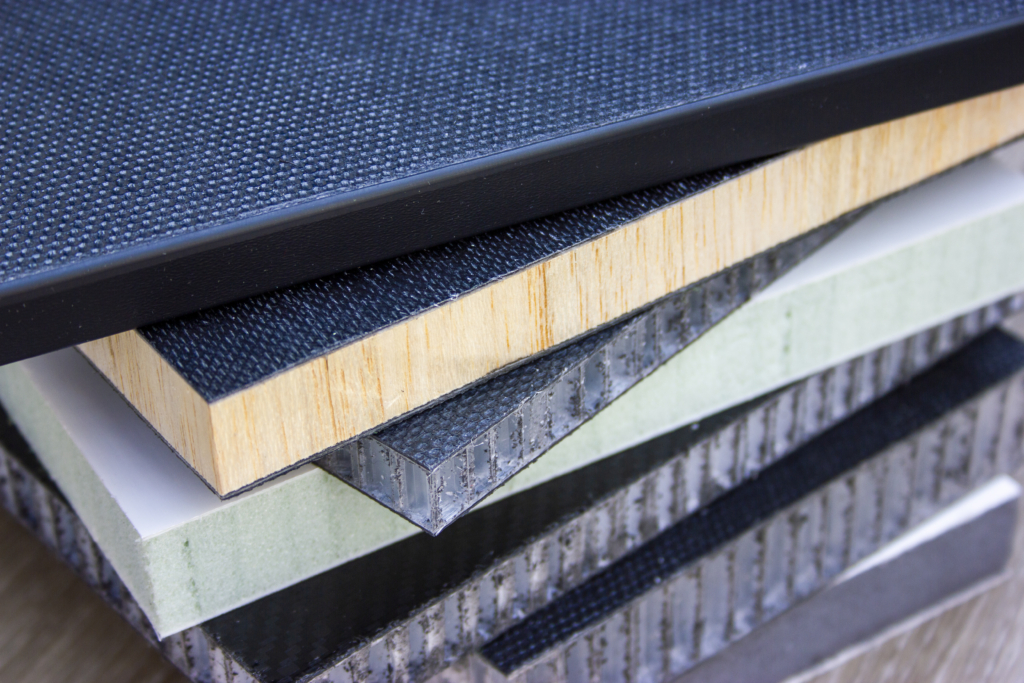
The choice of face sheet directly determines both the stiffness and the weight of a sandwich panel. Stiffer, thicker, or higher-modulus skins increase bending resistance significantly, while heavier skin materials add mass that compounds across a structure. For manufacturers specifying panels for truck bodies, trailers, or scaffolding, getting this balance right has a direct impact on payload capacity, structural performance, and total cost of ownership.
The sections below work through the most common questions engineers and procurement teams ask when selecting face sheet materials for thermoplastic sandwich panels.
Which face sheet materials are used in sandwich panels?
The most widely used face sheet materials in thermoplastic sandwich panels are glass-fibre-reinforced polypropylene (glass-PP), carbon-fibre-reinforced PP, and glass-fibre-reinforced PET. Each combines a polymer matrix with a reinforcing fibre to produce a skin that is light, stiff, and bondable to a thermoplastic core. Metal skins such as steel or aluminium sheet are also used in some configurations, though they carry a significant weight penalty.
Within glass-fibre skins, the fibre architecture matters as much as the material itself. A cross-ply (CP) layup orients fibres at 0° and 90° in alternating layers, which distributes stiffness and strength equally in both directions. This makes cross-ply skins well suited to wall panels that may be installed in either orientation. A 2-ply or 4-ply unidirectional layup concentrates fibre in one or two directions, which can deliver higher performance along the primary load axis but at the cost of isotropy.
Glass content within the skin also varies by design. Higher glass content, typically in the range of 66 to 67% by weight, increases both tensile strength and stiffness. The specific layup sequence, for example a 90-0-90 arrangement used in scaffolding panels, can be tuned to maximise performance in the direction where loads are highest, such as across the width of a plank under foot traffic.
How does face sheet material directly affect panel stiffness?
Face sheet material affects sandwich panel stiffness through two mechanisms: the elastic modulus of the skin material itself, and the distance of the skin from the panel’s neutral axis. A stiffer skin material resists bending more effectively, and placing that stiff material further from the centre of the panel amplifies the effect, following the same principle as an I-beam.
In practical terms, this means that a thin, high-modulus glass-fibre skin bonded to a lightweight foam core can produce a panel that is far stiffer in bending than a thicker panel made from a lower-modulus material. Carbon-fibre skins offer a higher elastic modulus than glass-fibre skins of equivalent thickness, which is why carbon-PP laminates are specified where maximum stiffness-to-weight performance is the priority.
The fibre architecture within the skin also shapes how stiffness is distributed. A cross-ply skin delivers balanced stiffness in both the longitudinal and transverse directions. A unidirectional skin concentrates stiffness along the fibre axis, which suits applications with a clearly dominant load direction. For floor panels in truck bodies, where bending loads run primarily across the floor width, a directionally optimised skin can be more efficient than an isotropic one.
What is the relationship between face sheet thickness and panel weight?
Increasing face sheet thickness adds weight directly and proportionally. Because the skin is the densest component in a thermoplastic sandwich panel, even small increases in skin thickness have a measurable effect on the panel’s areal weight. Thicker skins also raise the panel’s bending stiffness, so the design task is always to find the minimum skin thickness that meets the structural requirement.
The weight difference between skin architectures is visible in real panel data. A 17 mm wall panel with symmetric 2-ply skins on both faces weighs around 2,763 g/m², while the same 17 mm panel with a heavier 4-ply skin on one face rises to approximately 3,638 g/m², an increase of roughly 32% for a panel of identical thickness. The core contributes relatively little to this difference because PP foam at 60 kg/m³ is far lighter than the glass-fibre laminate.
For truck body builders and trailer manufacturers, this relationship has a direct commercial consequence. Every gram per square metre of unnecessary skin weight multiplies across the full panel area of a vehicle body. On a large trailer floor or a full set of side walls, over-specified skins can add tens of kilograms of structural dead weight that would otherwise be available as revenue-generating payload. In 2026, this argument extends beyond payload to battery range: lighter body structures extend the range of electric trucks and vans, making skin weight a range argument for EV fleet buyers, not just a payload one.
How do thermoplastic face sheets compare to metal skins for stiffness-to-weight ratio?
Thermoplastic face sheets reinforced with glass or carbon fibre deliver a significantly better stiffness-to-weight ratio than steel skins, and a competitive ratio compared to aluminium. Steel is dense enough that even thin sheet adds substantial mass, while a glass-fibre-PP skin achieves useful bending stiffness at a fraction of the weight. Aluminium is lighter than steel but still heavier than a well-designed glass-fibre laminate of equivalent structural contribution.
The advantage of thermoplastic skins becomes clearest when you consider the full sandwich system. A glass-fibre-PP skin bonded to a PP-foam or PP-honeycomb core creates a panel that is self-supporting over long spans without a metal subframe. A 30 mm PP sandwich floor panel, for example, is self-supporting without an aluminium subframe, which removes a production step for truck body builders and reduces the total weight of the floor assembly further still.
Metal skins do offer advantages in some situations, particularly where surface hardness, weldability, or resistance to point loads is the primary concern. But for applications where weight, corrosion resistance, and ease of fabrication matter, thermoplastic composite skins consistently outperform metal alternatives on a stiffness-per-kilogram basis.
Does the face sheet choice affect impact resistance as well as stiffness?
Yes. The face sheet material and architecture have a strong influence on impact resistance, and the relationship is not always the same as for stiffness. A skin that is optimised purely for bending stiffness may be more brittle under impact than one designed to absorb and distribute energy. The fibre type, fibre architecture, and the way the skin bonds to the core all affect how a panel responds to sudden loads.
Continuous fibre-reinforced thermoplastic tapes, where fibres run uninterrupted through the laminate, offer higher impact resistance than chopped or woven alternatives of similar areal weight. This is because continuous fibres distribute impact energy along their length rather than concentrating it at a failure point. Panels built with this type of skin can absorb significantly more energy before delamination or fracture occurs compared to conventional composite skins.
For scaffolding boards and truck floors, where dropped tools, pallet edges, and fork tines are routine hazards, impact resistance is not a secondary consideration. A skin that performs well in bending but fails under point impact creates a maintenance liability. Specifying a skin architecture that balances both properties, rather than optimising for stiffness alone, produces a panel with a longer service life and lower replacement frequency.
What face sheet should you specify for lightweight, high-stiffness panels?
For lightweight, high-stiffness sandwich panels, specify a glass-fibre-PP or carbon-PP skin with a layup architecture matched to your dominant load direction, bonded to a low-density thermoplastic core. Use the minimum skin thickness that meets your structural requirement, and consider a directional layup rather than a symmetric cross-ply if your load case is clearly one-directional.
The practical decision depends on three factors:
- Load direction: If bending loads run primarily in one direction, a unidirectional or 90-0-90 layup concentrates fibre where it does the most work and avoids carrying unnecessary weight in the transverse direction.
- Surface requirements: A PET-film surface finish adds minimal weight while providing UV resistance and a clean aesthetic. An anti-skid finish adds slightly more but is necessary for floor and scaffolding applications where slip resistance is a safety requirement.
- Core density: The skin and core work together. A stiffer, denser core allows a thinner skin to achieve the same panel stiffness, which can reduce overall weight. PP-foam is available across a wide density range, giving significant flexibility in how the stiffness budget is split between skin and core.
For most commercial vehicle and scaffolding applications, a glass-fibre-PP skin with 66 to 67% glass content, in a 2-ply or 4-ply configuration depending on load demands, paired with a PP-foam or PP-honeycomb core, represents the most practical balance of weight, stiffness, impact resistance, and cost.
How Compoform Helps You Specify the Right Face Sheet
We manufacture thermoplastic sandwich panels with PP-honeycomb and PET-foam cores, with glass-fibre-PP skins in cross-ply, 2-ply, and 4-ply architectures. Every panel configuration we produce is designed around a specific application, not a generic catalogue entry.
When you bring us a panel requirement, we review your load case, installation constraints, and surface requirements before recommending a skin architecture. Specifically, we:
- Assess your dominant load direction and recommend a layup that concentrates stiffness where you need it
- Calculate the minimum skin thickness that meets your structural requirement, avoiding over-specification and unnecessary weight
- Advise on surface finish options, including PET-film for wall applications and anti-skid for floors and scaffolding boards
- Flag integration issues, such as edge sealing requirements for panels exposed to washdown or outdoor conditions, before production begins
- Produce panels in custom dimensions up to 13,500 mm × 2,950 mm, cut to your exact specification
Over a 15-year vehicle life, a correctly specified composite floor eliminates two to three plywood replacement cycles. When you account for panel cost, installation labour, and vehicle downtime, the composite floor is cheaper per year of service, even at a higher unit price. For EV fleet operators, the weight saving also translates directly into extended range per charge, which is an increasingly standard procurement question in 2026.
We work as an application partner, not a panel supplier. That means reviewing your design, optimising the configuration for your assembly process, and staying involved through integration and iteration. See how our scaffolding panels are specified or get in touch to discuss your panel requirement with our engineering team.