

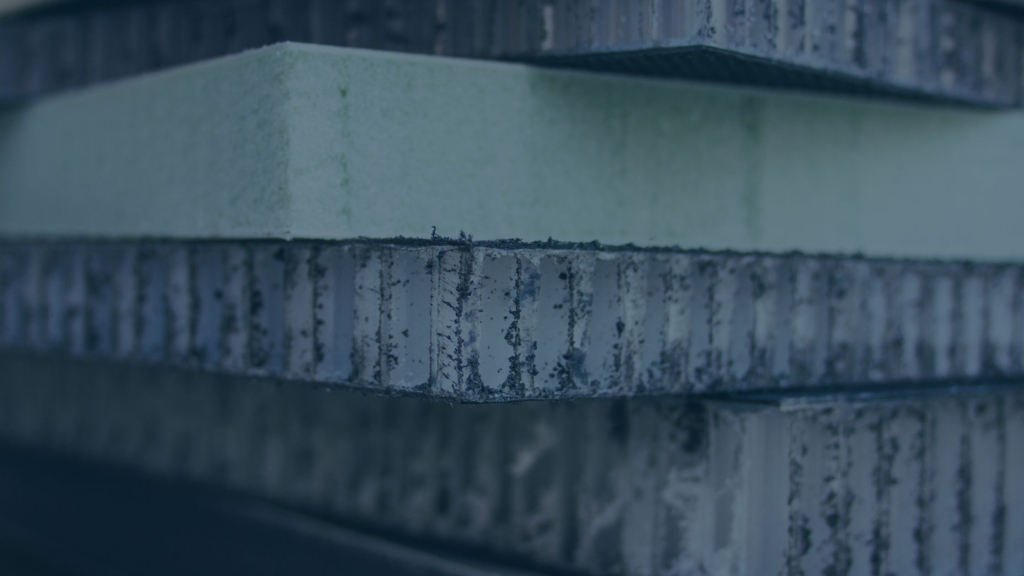
Sandwich panels perform well under repeated loading cycles when the panel is correctly specified for the application. Thermoplastic composite panels with glass-fibre skins and PP honeycomb or PP foam cores distribute cyclic stress across a large surface area, which limits localised strain accumulation. The sections below answer the most common technical questions about fatigue behaviour, failure modes, and material selection for cyclically loaded applications.
What happens to sandwich panel core materials under cyclic stress?
Under repeated loading cycles, sandwich panel core materials experience gradual accumulation of micro-damage, small deformations within the cell walls or foam structure that compound over time. In well-specified panels, this process is slow and the panel retains its structural function across thousands of cycles. The critical variable is whether the core density and type match the load magnitude and frequency of the application.
PP foam cores respond to cyclic compression by distributing stress through the foam matrix. Higher-density foam grades, 100 kg/m³ and above, resist permanent deformation more effectively than lower-density grades under repeated point loads. This makes density selection important for floor panels in truck bodies or trailers, where forklift wheels and pallet loads apply concentrated, repetitive forces.
PP honeycomb cores behave differently. The tubular cell geometry channels compressive loads axially through the cell walls, which makes the honeycomb highly efficient under out-of-plane cyclic compression. At 140 kg/m³, PP honeycomb cores used in floor panels carry substantial repeated loads without measurable cell collapse. The geometry also means that damage, when it does occur, tends to be localised rather than propagating across the panel face.
In both core types, the key risk under cyclic stress is not sudden fracture but gradual stiffness reduction. If a panel deflects progressively more under the same load over time, that is a sign the core is accumulating damage. Correct specification, matching core type, density, and panel thickness to the actual load cycle, prevents this from becoming a service problem.
How does skin-to-core bonding hold up over thousands of load cycles?
Skin-to-core bonding in thermoplastic sandwich panels holds up reliably under cyclic loading when the panel is manufactured using a continuous lamination process that creates a true thermoplastic weld between skin and core. Unlike adhesive bonding, which can creep or degrade under repeated shear stress, a thermoplastic bond shares the same polymer matrix as both the skin and core, giving it inherent resistance to delamination under fatigue.
The bond line between a glass-fibre skin and a PP core is the interface most exposed to shear stress during bending cycles. Each time the panel deflects, the skins experience tension and compression while the core resists shear. Over thousands of cycles, a poorly bonded interface accumulates micro-cracks that eventually lead to delamination, visible as a blister or soft spot on the panel surface.
In thermoplastic panels, the continuous fibre-reinforced skin and the PP core are fused under heat and pressure during production. This creates a bond that does not rely on a separate adhesive layer and does not have a distinct failure plane at the interface. Industry experience with thermoplastic composite panels in truck body and trailer applications shows that delamination failures are rare when panels are correctly specified and installed; failures more commonly originate at fastener points or panel edges where the core is exposed.
Edge sealing is relevant here. Unsealed edges allow moisture ingress into the core, which weakens the skin-to-core interface over time, particularly in applications where panels are washed down regularly, such as trailer floors and scaffolding boards. Sealed and edge-bent panels maintain bond integrity significantly longer in wet environments.
What’s the difference between fatigue failure and static failure in composite panels?
Static failure in a sandwich panel occurs when a single applied load exceeds the panel’s ultimate strength, the panel breaks or permanently deforms in one event. Fatigue failure occurs at loads well below the static limit, through the gradual accumulation of damage across many load cycles. The distinction matters because a panel that passes a static load test can still fail prematurely in service if the cyclic load frequency and magnitude are not accounted for in the specification.
Static failure: what it looks like
Static failure in sandwich panels typically presents as skin fracture, core crushing, or sudden delamination when an overload is applied. Bending tests conducted to ISO 14125 measure the maximum load a panel can carry before failure, this is the static strength figure quoted in technical data sheets. It represents a single-event limit, not a service life prediction.
Fatigue failure: what it looks like
Fatigue failure develops gradually. Early signs include increased deflection under the same load, localised surface deformation, or audible cracking at the skin-to-core interface. The panel may continue to carry load for some time after the first signs appear, but structural integrity is compromised. In floor panel applications, trailer decks, truck body floors, fatigue failure often initiates at high-stress zones: around fastener holes, at panel joints, or beneath repeated point loads from forklift tyres.
For specifiers, the practical implication is that static strength data alone is not sufficient for cyclically loaded applications. The load cycle frequency, the ratio of cyclic load to static capacity, and the environmental conditions all influence how quickly fatigue damage accumulates.
Which sandwich panel materials offer the best fatigue resistance?
Glass-fibre-reinforced thermoplastic skins bonded to PP honeycomb cores offer strong fatigue resistance for structural sandwich panel applications. The combination of stiff, high-tensile skins with a geometrically efficient core distributes cyclic stress effectively and limits the strain at any single point in the panel. Cross-ply and multi-ply skin architectures, where fibres run in multiple directions, perform better under fatigue than unidirectional layups because they resist damage accumulation from loads applied at varying angles.
Skin architecture has a direct effect on fatigue performance. A cross-ply laminate with fibres oriented at 0° and 90° in alternating layers resists both longitudinal and transverse cyclic loads. A 4-ply skin with fibres in multiple orientations extends this further, making the panel less sensitive to the direction of the applied load cycle. For floor panels in commercial vehicles, where loads arrive from multiple directions as cargo shifts, multi-ply skins are the more durable choice.
Core density also plays a role. Higher-density PP honeycomb (140 kg/m³) resists cyclic compression more effectively than lower-density grades. For scaffolding applications, where panels carry repeated dynamic loads from workers and equipment, a correctly specified honeycomb core maintains its compressive stiffness across the service life of the board.
One specific advantage of continuous fibre-reinforced thermoplastic skins is impact resistance. Panels built with continuous fibre-reinforced tape deliver significantly higher impact resistance compared to chopped-fibre alternatives, which matters in fatigue terms because impact events create localised damage that accelerates fatigue crack propagation. Reducing impact damage at the skin surface extends the panel’s fatigue life in service.
How are sandwich panels tested for long-term cyclic load performance?
Sandwich panels are tested for cyclic load performance through a combination of static mechanical tests, fatigue cycling protocols, and environmental exposure tests. Static tests, bending strength to ISO 14125 and tensile testing to EN ISO 527, establish the baseline mechanical properties. Fatigue testing then applies repeated loads at a defined fraction of the static limit and measures how many cycles the panel sustains before defined failure criteria are reached.
In practice, full fatigue test programmes are conducted for specific applications rather than as standard product qualification. A trailer floor panel destined for high-cycle forklift loading would be tested differently from a scaffolding board designed for pedestrian dynamic loads. The test parameters, load magnitude, cycle frequency, span, and failure criterion, are set to replicate the actual service conditions as closely as possible.
Environmental conditioning is part of long-term performance assessment. Panels intended for outdoor use are evaluated for UV weathering resistance to ISO 4892 and thermal cycling performance across the operating temperature range. Moisture absorption testing is relevant for floor and scaffolding panels that will be exposed to rain or wash-down. These tests do not directly measure fatigue life, but they establish whether the panel’s mechanical properties remain stable in the conditions where cyclic loading will occur.
For European commercial vehicle and scaffolding applications, EN 12811 provides the structural load framework for scaffolding boards, including dynamic load requirements. A Compoform 10.5 mm panel has achieved EN 12811 load class 4 with no support underneath, a result that reflects both static strength and the panel’s ability to carry the specified loads without permanent deformation.
When should repeated loading performance influence panel specification?
Repeated loading performance should influence panel specification whenever the panel will experience the same load applied many times over its service life, rather than a single or occasional overload event. The most common applications where this applies are trailer and truck body floors, scaffolding boards, and cargo box floors. In all of these, the panel carries cyclic loads from forklifts, pedestrian traffic, or road vibration throughout a service life measured in years.
A useful rule of thumb: if the panel will experience more than a few hundred load cycles from the same source over its service life, fatigue behaviour should be part of the specification conversation. For a trailer floor carrying forklift loads on every loading cycle, that threshold is reached within weeks of service. For a wall panel in a cargo box that carries only static pressure from cargo, fatigue is rarely the governing design criterion.
Weight also connects to fatigue specification in commercial vehicle applications. A lighter panel structure reduces the inertial loads transmitted through the panel during road travel, which are themselves a source of cyclic stress. Thermoplastic composite panels are substantially lighter than steel or hardwood alternatives, which means the panel experiences lower self-generated cyclic stress over its service life. In electric trucks and vans, this weight reduction carries an additional argument: lighter body structures extend battery range per charge, and EV fleet buyers in 2026 routinely raise range as a procurement criterion alongside payload. Every kilogram saved in the body structure is a range argument, not just a payload argument.
Over a 15-year vehicle life, a composite floor eliminates two to three plywood replacement cycles. Once you account for panel cost, installation labour, and vehicle downtime, the composite option is cheaper per year of service, even at a higher unit price. That calculation becomes more compelling when the fatigue life of the composite panel is matched to the vehicle’s operating cycle from the start.
How We Help You Specify for Cyclic Load Performance
We work with truck body builders, trailer manufacturers, and scaffolding companies to match panel configuration to the actual load cycles their products will experience in service. That means reviewing your application before recommending a panel, not shipping a standard product and leaving integration to you.
Here is what that looks like in practice:
- Core selection: We review your load magnitude and frequency to recommend the right core type (PP honeycomb or PP foam) and density for your application. A floor panel carrying forklift loads needs a different core specification than a wall panel carrying static cargo pressure.
- Skin architecture: We select the skin layup, cross-ply, 2-ply, or 4-ply, based on the direction and nature of the cyclic loads your panel will carry. Multi-directional loads call for multi-directional fibre orientations.
- Panel thickness and self-supporting design: A 30 mm PP honeycomb floor panel is self-supporting, no aluminium subframe required. This removes a production step and reduces cost for truck body builders, while also reducing the total weight of the structure.
- Edge protection: For panels exposed to wash-down or outdoor conditions, we specify edge sealing and edge bending to protect the core from moisture ingress, which directly affects long-term bond integrity under cyclic loading.
- Custom dimensions: Panels are available in custom dimensions cut to your exact specification, up to 13,500 mm × 2,950 mm, so you are not adapting your design around standard sheet sizes.
If you are specifying panels for a floor, scaffolding board, or structural body component that will carry repeated loads, bring us into the design conversation early. We review your load requirements, flag potential issues before production, and optimise the panel configuration for your assembly process. Talk to our engineering team about your application.