

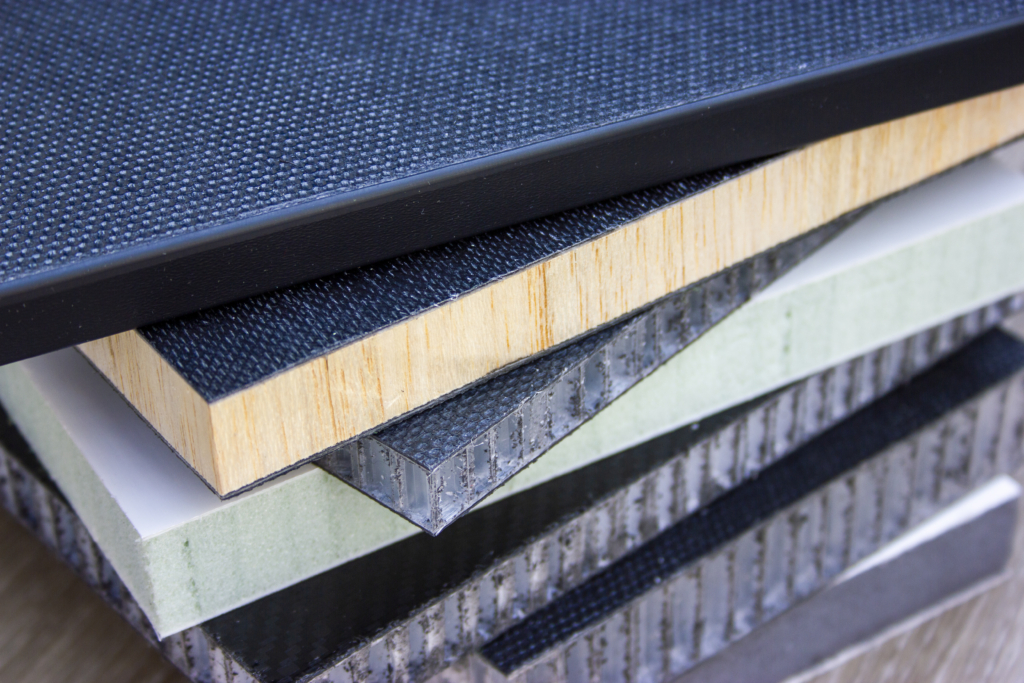
Sandwich panels sold into European commercial vehicle and scaffolding markets should carry a combination of material safety compliance, environmental management certification, and product-level declarations. The most relevant are REACH compliance documentation, ISO 14001 certification at the manufacturer level, and an Environmental Product Declaration (EPD) at the product level. Which certifications matter most depends on your application, your end customers, and the regulatory requirements your OEM clients must meet.
In 2026, European OEMs face increasing pressure from the Corporate Sustainability Reporting Directive (CSRD) and end-of-life vehicle regulations to document the environmental credentials of every major component they source. That pressure flows directly to panel suppliers. The questions below unpack each certification category so you can assess what your supply chain actually needs.
Which certifications actually apply to sandwich panel materials?
The certifications that apply to sandwich panel materials fall into three categories: chemical safety compliance (primarily REACH), environmental management systems (ISO 14001), and product-level environmental declarations (EPDs). For thermoplastic composite panels used in commercial vehicle and scaffolding applications, REACH compliance is a legal baseline, while EPDs and ISO 14001 are increasingly required by OEM procurement teams rather than being optional extras.
Beyond those three, specific applications bring additional requirements. Scaffolding panels must meet structural load standards such as EN 12811. Truck body panels may need to satisfy fire classification under EN 13501-1 depending on the vehicle type and cargo. These are performance certifications rather than sustainability certifications, but procurement engineers often group them together when qualifying a supplier.
It is worth separating certifications that apply to the manufacturer from those that apply to the product. ISO 14001 certifies that a manufacturer operates an environmental management system. An EPD certifies what a specific product’s lifecycle impact actually is. Both are useful, but they answer different questions for a buyer.
What is an Environmental Product Declaration and why does it matter?
An Environmental Product Declaration (EPD) is a standardised document that quantifies the environmental impact of a specific product across its lifecycle, from raw material extraction through manufacturing, use, and end of life. EPDs follow ISO 14044 and EN 15804 and are independently verified. They give buyers a consistent, comparable basis for assessing the environmental footprint of competing materials.
For OEM procurement teams, an EPD matters because it converts a supplier’s sustainability claims into verifiable data. Rather than accepting a manufacturer’s assertion that their panels are “environmentally friendly,” a buyer can review the EPD’s lifecycle assessment figures and compare them against alternative materials or competing suppliers using the same methodology.
In the commercial vehicle sector, EPDs are becoming a standard part of supplier qualification. Fleet operators and logistics companies increasingly specify low-embodied-carbon components, and they expect their body builders and trailer manufacturers to provide documentation that supports those claims. If your panel supplier cannot provide an EPD, you are left making sustainability arguments without evidence, which is a growing liability under CSRD reporting requirements.
For thermoplastic sandwich panels specifically, an EPD should cover the glass-fibre-reinforced skins, the core material (PP honeycomb or PET foam), and any surface finishes. The declared unit is typically one square metre of panel at a defined thickness, which allows direct comparison across configurations.
How does REACH compliance affect composite panel sourcing?
REACH (Registration, Evaluation, Authorisation and Restriction of Chemicals) compliance means that all chemical substances used in a panel’s production must be registered with the European Chemicals Agency and must not include substances of very high concern (SVHCs) above threshold concentrations. For composite panel buyers in Europe, REACH compliance is not optional – it is a legal requirement for placing products on the EU market.
For thermoplastic sandwich panels, REACH compliance primarily concerns the resins, adhesives, surface treatments, and any additives used in skin or core production. Polypropylene and PET-based materials are generally low-risk under REACH, but the full supply chain must be documented. A supplier who cannot provide a REACH compliance declaration for their panels creates a legal exposure for the OEM buying them.
In practice, REACH compliance affects sourcing decisions in two ways. First, it eliminates suppliers who cannot demonstrate full chemical traceability through their supply chain. Second, it creates a documentation requirement that must be maintained and updated as the SVHC candidate list is revised. Buyers should request a current REACH compliance statement, not a document dated several years ago, because the list of regulated substances changes regularly.
For European OEMs sourcing from outside the EU, REACH compliance becomes even more important to verify. Panels imported from non-EU manufacturers may not have been produced under REACH-equivalent chemical controls, and the importer bears legal responsibility for compliance.
What’s the difference between ISO 14001 and product-level eco-certifications?
ISO 14001 certifies that a manufacturer has implemented and maintains an environmental management system (EMS) – a structured approach to identifying, monitoring, and reducing the environmental impacts of its operations. It says nothing about the environmental performance of any specific product. A product-level eco-certification or EPD, by contrast, measures the actual environmental impact of a defined product, independently of how well the factory is managed.
The distinction matters for procurement because the two certifications answer different questions:
- ISO 14001 answers: Does this supplier manage its environmental responsibilities systematically? Is there a credible process for continuous improvement?
- EPD / product-level declaration answers: What is the measured carbon footprint, energy use, and end-of-life impact of this specific panel configuration?
For a truck body builder or trailer manufacturer reporting under CSRD, ISO 14001 from a supplier is useful background evidence of good practice, but it will not satisfy a requirement to report Scope 3 emissions from purchased materials. For that, you need product-level data, which only an EPD or equivalent lifecycle assessment document provides.
The practical recommendation is to require both. ISO 14001 gives you confidence in the supplier’s operational standards. An EPD gives you the product data you need for your own environmental reporting. Neither replaces the other.
Should sandwich panels carry recycled content or recyclability claims?
Recycled content and recyclability claims are worth pursuing, but they need to be grounded in specific regulatory frameworks rather than general marketing language. For European OEMs, the most relevant reference point is the EU End-of-Life Vehicles (ELV) Directive, which sets targets for vehicle recyclability and recoverability. Panels used in truck bodies and trailers that fall within ELV scope must contribute to those targets, which means recyclability is a compliance question, not just a preference.
Thermoplastic sandwich panels have a genuine advantage here over thermoset composites. Thermoplastic skins and cores can, in principle, be reprocessed at end of life, whereas thermoset materials cannot be melted and reformed. However, “recyclable in principle” and “recycled in practice” are different claims, and buyers should ask suppliers to specify which they mean.
Recycled content claims require documentation of the proportion of pre- or post-consumer recycled material used in the panel, typically verified by a third party. Recyclability claims require evidence that the material can be processed through an existing recycling stream at end of life, not just that the polymer is theoretically recyclable.
In 2026, the regulatory direction is clearly toward greater accountability for both claims. The EU’s Green Claims Directive, currently progressing through the legislative process, will require that environmental claims be substantiated and independently verified before they can be used in business-to-business communications. OEMs who accept unverified recyclability claims from suppliers today may face compliance issues as that directive takes effect.
Which certifications do European OEMs most commonly require from panel suppliers?
European OEMs in the commercial vehicle and scaffolding sectors most commonly require REACH compliance documentation, ISO 9001 quality management certification, and increasingly an EPD or lifecycle assessment data. ISO 14001 is frequently requested as a secondary environmental credential. For scaffolding applications, structural test reports demonstrating compliance with EN 12811 load classes are standard. Fire classification under EN 13501-1 is required for specific vehicle types and cargo categories.
The weighting of these requirements has shifted in recent years. Quality and chemical safety certifications (ISO 9001, REACH) remain the baseline that no supplier can skip. Environmental credentials (ISO 14001, EPDs) have moved from “nice to have” to a standard part of supplier qualification forms at larger OEMs, driven by their own CSRD reporting obligations.
Procurement engineers at truck body builders and trailer manufacturers increasingly ask for:
- A current REACH compliance statement covering the full panel construction
- ISO 9001 certification covering the manufacturing facility
- ISO 14001 certification or equivalent environmental management evidence
- An EPD or lifecycle assessment for the specific panel configuration being sourced
- Test reports for the relevant structural or fire performance standards
- A declaration of recyclability or recycled content where ELV Directive compliance is relevant
Smaller OEMs may not yet request all of these, but the direction of travel is clear. Suppliers who can provide the full set are better positioned for long-term qualification than those who can only satisfy the minimum.
How Compoform Supports Certification Requirements
We manufacture thermoplastic sandwich panels with PP honeycomb and PET foam cores at our facilities in Beek and Ospel, the Netherlands. Because all production is European-made, our panels are produced under EU chemical regulations from the outset, which simplifies REACH compliance documentation for your procurement team.
Here is how we support customers through the certification process:
- REACH compliance documentation is available for our panel configurations, covering skins, core materials, and surface finishes including PET film and anti-skid surfaces.
- Technical data sheets for each panel configuration provide the product-level data you need to support EPD preparation or lifecycle assessment work at your end.
- Structural test reports are available for scaffolding panels tested against EN 12811 load requirements. Our 10.5mm panel achieves EN 12811 load class 4 with no support underneath, which is documented and available for your qualification file.
- Custom panel configurations can be specified to your exact dimensions and load requirements, with supporting technical documentation for each configuration rather than generic datasheet references.
We treat certification support as part of the supply relationship, not a separate service. When you are qualifying a new panel configuration, we review your application requirements, confirm which test reports and compliance documents apply, and flag any gaps before production starts. If your OEM customers are asking questions about recyclability under the ELV Directive or requesting lifecycle data for CSRD reporting, we work through those requirements with you directly.
To discuss the documentation your specific application requires, speak with our application team about your panel specification and qualification timeline.
Related Articles
- What sandwich panels are used in swap body and container construction?
- What is the lifespan of a sandwich panel in outdoor infrastructure use?
- How do sandwich panels handle forklift and pallet truck loads?
- What makes thermoplastic sandwich panels easier to recycle?
- What should OEM manufacturers look for in a sandwich panel supplier?