

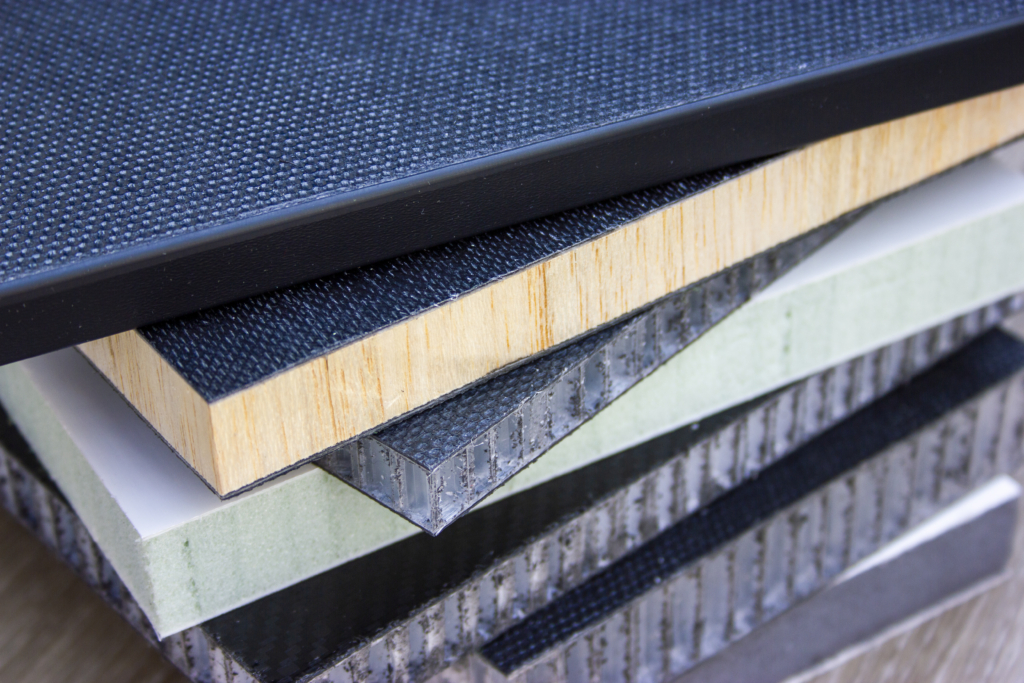
PP foam is a closed-cell polypropylene foam used as the core material in thermoplastic sandwich panels. It separates two stiff face skins, giving the panel structural depth without adding significant weight. In sandwich panel construction, PP foam cores are valued for their low density, moisture resistance, and full thermoplastic recyclability. The sections below answer the most common questions about how PP foam performs, where it is used, and why it is increasingly specified over metal and wood in transport applications.
What makes PP foam different from other foam core materials?
PP foam is a closed-cell polypropylene foam, meaning its cellular structure traps air in sealed pockets rather than open channels. This makes it inherently resistant to water absorption, which distinguishes it from open-cell foams that can retain moisture and degrade over time. As a thermoplastic material, PP foam can be remelted and reprocessed at end of life, which separates it from thermoset alternatives that cannot be recycled once cured.
The density of PP foam can be varied across a wide range, typically from around 40 kg/m³ up to 200 kg/m³, and each density grade delivers a different balance of weight, compressive strength, and shear resistance. At 60 kg/m³, for example, PP foam offers a compressive strength of around 1.29 MPa, which is sufficient for wall panel applications in vehicle body construction. Higher-density grades step up both strength and stiffness for more demanding structural roles.
Compared to PU foam, PP foam is fully thermoplastic, which matters for recyclability compliance under European regulations. Compared to honeycomb cores, PP foam provides a more uniform, isotropic structure that is easier to bond consistently across large panel surfaces. It also handles edge machining and routing cleanly, which simplifies fabrication for manufacturers working with custom panel dimensions.
How does PP foam perform as a sandwich panel core?
As a sandwich panel core, PP foam transfers shear loads between the two face skins, keeping them working together as a composite unit rather than bending independently. This is the fundamental mechanism that gives a sandwich panel its stiffness-to-weight advantage over solid sheet materials. PP foam achieves this efficiently at low areal weights, making it well suited to applications where structural performance and mass reduction must be balanced.
In wall panel configurations, a 60 kg/m³ PP foam core delivers consistent shear strength in both the length and width directions. Shear strength increases predictably with density, so engineers can select the grade that matches the load case without overspecifying. Thermal conductivity across all density grades sits at approximately 0.040 to 0.043 W/m·K, which provides useful insulation performance in vehicle body panels without requiring a separate insulation layer.
PP foam also shows low moisture uptake over extended periods, which is important in transport applications where panels are exposed to wash-down cycles, rain, and humidity. The closed-cell structure prevents capillary absorption, so the core does not soften or delaminate from prolonged moisture exposure in the way that wood-based cores can.
One practical consideration is that PP foam cores are typically used in wall and roof panel applications rather than floor panels, where higher-density honeycomb cores are specified to handle concentrated point loads from foot traffic or pallet handling equipment. Selecting the right core for the load case is a design decision, not a default.
What are the main applications of PP foam sandwich panels?
PP foam sandwich panels are used primarily in vehicle body construction and transport applications, including truck bodies, trailers, cargo boxes, horse vans, and refrigerated transport. They are also used in caravans, mobile homes, and coachbuilding, where lightweight wall and roof panels reduce total vehicle weight without sacrificing structural integrity. In 2026, commercial vehicle body building and trailer manufacturing represent the strongest demand segments in Europe.
In truck and trailer body construction, PP foam panels are specified for side walls, roof panels, and internal partitions. The panels replace steel or aluminium sheet assemblies, reducing the structural dead weight of the body and freeing up legally permitted payload capacity. A lighter body means more cargo can be carried on every run, which has a direct effect on operating economics for fleet operators.
Beyond transport, PP foam sandwich panels are used in façade cladding and modular construction applications where a flat, dimensionally stable panel with good thermal performance is needed. The ability to produce panels in large formats, up to several metres in length and width, makes them practical for architectural and industrial cladding without requiring multiple joints.
Scaffolding is a separate application category where the core specification changes, but the thermoplastic sandwich panel principle remains the same. For scaffolding boards, higher-density honeycomb cores are used to meet EN 12811 load class requirements, while PP foam cores are more commonly found in the wall and roof panel segments described above.
Why do vehicle and trailer manufacturers choose PP foam panels over metal or wood?
Vehicle and trailer manufacturers choose PP foam sandwich panels over steel, aluminium, and plywood primarily because of the weight reduction they deliver without structural compromise. Every kilogram removed from the body structure is a kilogram that can be converted into revenue-generating payload. At scale, across a fleet, this weight saving compounds into significant commercial advantage.
Plywood is the most common alternative in trailer and truck body floors and walls, but it has a short service life in heavy transport conditions. In demanding applications, plywood panels typically require replacement every three to five years due to delamination, moisture ingress, and mechanical wear. A thermoplastic composite panel, by contrast, can last twelve years or more in the same environment, eliminating two or three replacement cycles over the vehicle’s working life. When you factor in panel cost, installation labour, and vehicle downtime for each replacement, the composite panel is cheaper per year of service even at a higher initial unit price.
Steel and aluminium add structural dead weight that directly reduces payload capacity. They also require subframe systems in many body configurations, adding cost and complexity to the build. A self-supporting composite panel can eliminate the need for an aluminium subframe entirely, removing a production step and reducing the total bill of materials for the body builder.
There is also a growing EV-specific argument that procurement teams are raising in 2026. Lighter body structures extend battery range in electric trucks and vans. Every kilogram of structural dead weight reduces range per charge, making weight reduction a range argument, not just a payload argument. For fleet operators transitioning to electric vehicles, specifying lightweight composite panels is a direct lever on operational range, and it is becoming a standard question in EV fleet procurement conversations.
Is PP foam sandwich panel material recyclable?
Yes, PP foam sandwich panels with thermoplastic skins are fully recyclable. Because both the core and the face skins are thermoplastic materials, the entire panel can be remelted and reprocessed at end of life. This is a meaningful distinction from thermoset composite panels, which cannot be recycled once the resin has cured and must be landfilled or incinerated.
For European OEMs and body builders, recyclability is increasingly a compliance requirement rather than a preference. The EU End-of-Life Vehicles (ELV) Directive sets recycling and recovery targets for vehicles placed on the European market, and manufacturers must demonstrate that materials used in vehicle construction meet these requirements. Specifying thermoplastic composite panels supports compliance with the ELV Directive and simplifies end-of-life material reporting under the Corporate Sustainability Reporting Directive (CSRD), which now applies to a growing number of European manufacturers.
The recyclability of PP foam panels also supports circular economy commitments that fleet operators and logistics companies are increasingly required to report against. Specifying a recyclable panel material is a documentable sustainability decision, not just a marketing claim, and it carries weight in supplier qualification processes where environmental criteria are assessed alongside price and performance.
How Compoform Helps with PP Foam Sandwich Panels
We manufacture thermoplastic sandwich panels with PP foam cores at our production facilities in Beek and Ospel, the Netherlands. All panels are 100% European-made, and our production line is capable of producing up to 1.5 million square metres of thermoplastic composite sheet material per year. Panels can be produced in formats up to 13,500 mm × 2,950 mm × 150 mm, covering the full dimensional range needed for truck body, trailer, and vehicle body applications.
Here is what working with us looks like in practice:
- Custom panel dimensions: Panels are available in custom dimensions cut to your exact specification, including non-standard lengths and widths that are not available off-the-shelf elsewhere in Europe.
- Core and skin configuration: We work with you to select the right PP foam density and skin layup for your specific load case, whether that is a lightweight wall panel at 60 kg/m³ or a configuration requiring higher compressive performance.
- Edge protection: Edge sealing and edge bending are available to protect the core from UV exposure and moisture ingress, which is relevant for panels used in truck bodies and trailers that are washed down regularly.
- Application engineering support: Before production, we review your design, check the panel configuration against your assembly process, and flag any issues that could affect fit, performance, or integration. We do not ship panels to spec and leave you to resolve integration problems on your own.
- ELV and CSRD compliance: We can provide material documentation to support your recyclability reporting obligations under the EU ELV Directive and CSRD.
If you are evaluating PP foam sandwich panels for a truck body, trailer, or vehicle body application, speak with our engineering team about your requirements. We will review your design and recommend the panel configuration that fits your load case, production process, and commercial targets.
Related Articles
- How much does one kilogram of dead weight cost a fleet over 10 years?
- What are the fire and smoke requirements for aerospace sandwich panels?
- What load ratings should a truck floor sandwich panel meet?
- What is the minimum order quantity for custom sandwich panel production?
- What is the difference between sandwich panels and conventional composite sheets?