

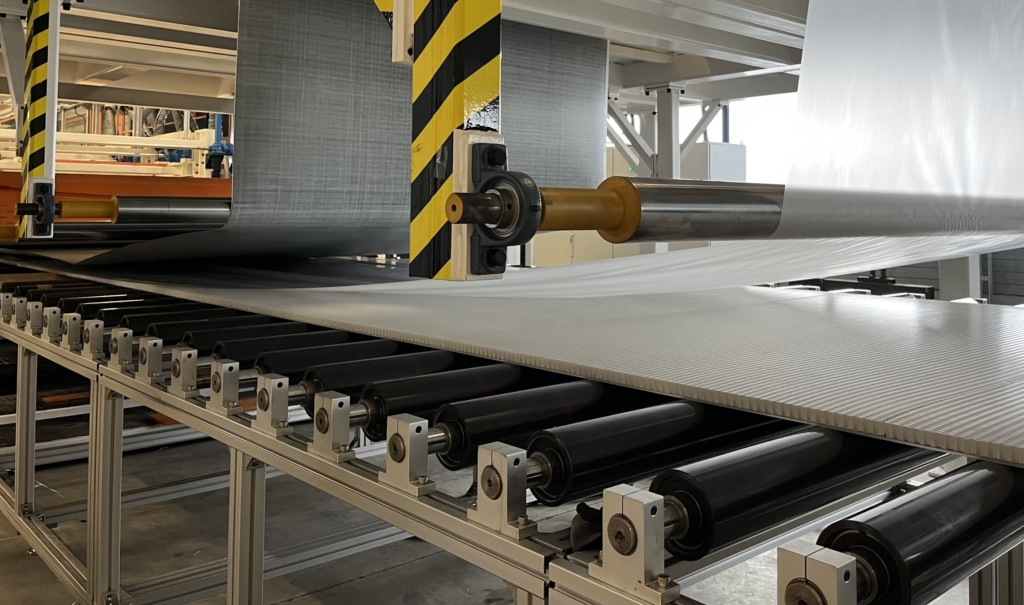
Composite formwork panels are considerably easier to clean than plywood. The closed, non-porous surface layer of composite does not absorb concrete residue, so dirt comes off with a simple rinse or wipe. Plywood has an open wood structure that allows concrete to bond and soak in, which requires more intensive cleaning work. The following sections answer the most frequently asked questions about cleaning, release oil and the effect on the overall service life of formwork.
Why does concrete bond differently to composite than to plywood?
Concrete bonds more strongly to plywood because wood has a porous, fibrous structure that absorbs moisture and cement particles. Composite has a closed thermoplastic surface layer that does not absorb. As a result, concrete forms a thin, loose layer on composite that releases easily, whereas on plywood it penetrates deeper and anchors mechanically in the wood fibre.
This difference in bonding behaviour can be traced directly to the material properties. Plywood consists of wood layers that, despite a surface treatment, absorb moisture as soon as the coating is damaged or worn. Once moisture has been absorbed, it draws cement into the pores. After the concrete has hardened, the bond is therefore not only chemical but also mechanical in nature.
Composite behaves fundamentally differently. The thermoplastic outer layer, such as glass-fibre PP or glass-fibre PET, is naturally smooth and non-absorbent. Concrete cannot gain grip on the surface structure and bonds solely through surface tension. That bond is weak and breaks during stripping without any material being pulled from the panel.
An additional advantage is that composite retains its dimensional stability under varying humidity and temperature. Plywood swells and shrinks with its moisture content, causing the surface to become rough and uneven. That roughness increases the contact area with concrete and strengthens the bond further. Composite remains flat, which benefits both concrete quality and cleanability.
How much time does it take to clean composite formwork panels?
Cleaning composite formwork panels takes considerably less time than cleaning plywood. In practice, a rinse with water or a quick sweep is enough to remove concrete residue. Plywood often requires mechanical sanding, scraping or soaking, which takes several times as long and demands more labour.
The time saving is a direct consequence of the non-porous surface layer. Concrete residue does not bond into the material and releases without force. A worker can quickly clean a composite panel between two concrete pours without interrupting the production process for long.
With plywood, cleaning time increases as the panel goes through more use cycles. The surface becomes damaged, the coating wears, and concrete bonds ever more strongly. Composite retains its surface quality over its entire service life, so the cleaning time per cycle remains stable and does not increase with use.
For companies that use formwork intensively, this difference adds up quickly. Less cleaning time per panel means lower labour costs per concreting cycle and higher availability of the formwork on site.
Which cleaning agents are suitable for composite formwork?
For composite formwork panels, water and a soft brush or cloth are sufficient in most situations. For stubborn concrete residue, a mild alkaline cleaner can be used. Aggressive solvents, acids or abrasive agents are not necessary and may put unnecessary strain on the surface layer.
This is an important practical advantage over plywood, where more aggressive agents or mechanical cleaning are sometimes needed to remove concrete. The simple cleaning requirements of composite lower the cost of cleaning agents and protect the health of workers who handle the panels every day.
Composite is naturally chemically resistant. The thermoplastic outer layer withstands the alkaline environment of fresh concrete, cleaning agents and the chemicals found in release oil. This means the surface is not attacked by the substances it regularly comes into contact with on a construction site.
One point to note is that the type of cleaning agent should always be matched to the specific panel build-up and surface treatment. Specifications vary by customer and application, so it is advisable to confirm with the manufacturer which agents are suitable for the supplied configuration.
How does ease of cleaning affect the total service life of formwork?
Easier cleaning directly extends the service life of formwork panels. Aggressive sanding, scraping or chemical cleaning damages the surface of plywood and accelerates degradation. Composite requires no mechanical cleaning, so the surface stays intact and the panels withstand more use cycles without loss of quality.
With plywood, the cleaning process itself is a wear factor. Every time a panel is sanded or scraped to remove concrete, a layer of material is lost. Over time the surface becomes too rough for reuse, concrete quality declines and the panel has to be replaced. This pattern repeats every three to five years under intensive use.
Composite formwork panels have a considerably longer service life. The non-porous surface layer does not wear from cleaning and retains its geometric accuracy over many use cycles. That translates directly into fewer replacements over the lifetime of a formwork system.
In concrete terms, one life cycle of a composite panel can replace several plywood replacement cycles. Over a period of ten to fifteen years, that yields a substantially lower total cost, even if the initial purchase price of composite is higher. When you add the labour costs for cleaning, transport and installation, the balance shifts further in favour of composite.
Does composite formwork need release oil?
Composite formwork panels need less release oil than plywood, and in some applications the quantity can be reduced considerably. The non-porous surface layer already ensures that concrete bonds poorly, which makes the primary function of release oil partly redundant. Whether and how much oil is needed depends on the specific panel build-up and the concrete composition.
With plywood, release oil is indispensable. Without oil, concrete bonds so strongly to the wood surface that stripping damages both the panel and the concrete surface. The oil forms a barrier that limits bonding and makes cleaning easier. As the plywood wears, more oil is needed to achieve the same effect.
Composite does not require this compensating mechanism. The material itself acts as the barrier. A thin layer of release oil can still be used in certain applications to improve the concrete finish or to further optimise the service life of the panel, but the quantity and frequency are structurally lower than with plywood.
Less release oil also has practical benefits for the construction site. It lowers material costs, reduces workers’ exposure to chemicals and limits the amount of oil that ends up in the environment. For companies that work with sustainability targets or must comply with environmental requirements, this is a relevant additional advantage of composite formwork over plywood.
How we help you with composite formwork panels
We develop and produce thermoplastic sandwich panels for companies looking for a durable alternative to plywood formwork. Our panels combine a closed, non-porous surface layer with a lightweight core, resulting in easy cleaning, a longer service life and lower total costs over the period of use.
What we offer for formwork applications:
- Reusable composite formwork panels that replace multiple plywood replacement cycles
- Custom dimensions and configurations tailored to your specific formwork system
- Technical support in evaluating panel build-up, surface treatment and suitability for your concrete application
- ISO-certified production with strict quality control on every production batch
- Panels up to 13,500 mm × 2,950 mm, fully European-made in the Netherlands
We approach every project as a collaboration. This means we review your design, optimise the panel build-up for your assembly procedure and flag any points of attention before production starts. That way you avoid surprises in practice and get the maximum return from switching to composite.
View our applications for composite panels or get in touch to discuss your formwork project with our technical team.
Related Articles
- When should contractors replace plywood with composite formwork?
- Why is panel weight important in concrete construction?
- What payload gains are realistic when switching to sandwich panels?
- What are the slip resistance properties of sandwich panel scaffold boards?
- Can sandwich panels be custom-cut to non-standard dimensions?