

Contractors should consider switching from plywood to composite formwork as soon as the total cost over the service life comes out lower than with plywood, or when working conditions structurally shorten the lifespan of plywood. For projects with intensive reuse, damp conditions or high labour demands, composite formwork is in most cases the more financially attractive option. The questions below help you determine whether and when that switch makes sense for your situation.
What are the disadvantages of plywood formwork under intensive use?
Under intensive use, plywood formwork quickly loses its mechanical properties through moisture absorption, delamination and surface wear. After a limited number of pours, the panel can no longer be reliably reused, which leads to higher replacement costs and more downtime on site.
In practice, this means that plywood formwork panels under intensive use must be inspected, repaired or replaced regularly. Moisture penetrates the edges and the core, causing the wood to swell, shrink and eventually delaminate. This process accelerates with repeated contact with concrete, cleaning agents and fluctuating temperatures.
Besides the material costs, plywood also brings indirect costs:
- Higher labour costs due to more frequent panel replacement on site
- Inconsistent concrete surfaces because worn panels no longer form a flat, closed mould
- Weight problems with wet panels, which are heavier than dry ones and therefore reduce handling efficiency
- Waste costs due to the limited recyclability of damaged plywood
For contractors who use formwork systems intensively, these factors add up to a total cost of ownership that is not immediately visible when purchasing plywood, but that weighs heavily over the service life.
How does composite formwork differ from plywood in terms of performance?
Under intensive use, composite formwork panels structurally outperform plywood in terms of dimensional stability, moisture resistance and service life. Whereas plywood delaminates and deforms over time, a composite sandwich panel retains its geometry and surface quality over a far greater number of pour cycles.
The performance difference is a direct result of the choice of material. Composite panels are built from a fibre-reinforced thermoplastic core with hard outer layers. They do not absorb moisture, do not rot and are resistant to the chemical load of fresh concrete and cleaning agents. Plywood is naturally hygroscopic: it absorbs moisture, which leads to dimensional change and loss of surface quality.
Dimensional stability and surface quality
Composite panels remain dimensionally stable under varying humidity, freeze-thaw cycles and prolonged contact with water. This is relevant for formwork where a flat, closed surface determines the quality of the concrete finish. Over time, plywood develops unevenness that becomes visible in the poured concrete.
Service life and reuse
Composite formwork panels are designed for long-term reuse. In comparable applications in the transport sector, such as floor panels in trucks, thermoplastic sandwich panels achieve a service life of twelve years or more, compared with three to five years for plywood. Translated to formwork, this means that over the service life composite eliminates two to three plywood replacement cycles, including the associated material and labour costs.
When is switching to composite formwork financially advantageous?
Switching to composite formwork is financially advantageous when the higher purchase price per panel is recovered through a longer service life, lower replacement frequency and reduced labour costs for maintenance and handling. You typically reach this break-even point faster with high reuse, harsh conditions or a large fleet.
A concrete calculation makes this clear. Suppose a plywood panel lasts three to five years and a composite panel twelve years or longer. Over a period of fifteen years, you replace plywood two to three times. Add to that: the panel cost per replacement, the labour cost for dismantling and installation, and any downtime costs. In most intensive applications, composite is then cheaper per year of use, even if the initial purchase price is higher.
The financial case works most clearly in your favour under the following circumstances:
- High frequency of use: panels that are deployed and cleaned several times a week
- Damp or chemically aggressive environments: where plywood degrades quickly
- Large fleets: where the cumulative replacement costs of plywood mount up quickly
- High labour rates: where less handling work per panel translates directly into cost savings
- Quality requirements for the concrete surface: where consistently flat panels are essential
For one-off or occasional use, where panels are disposed of after the project, the higher purchase price of composite is harder to recover. In that case, plywood is preferable on purely financial grounds.
Which applications benefit most from composite formwork panels?
The applications that benefit most from composite formwork panels are reusable formwork systems, precast concrete production and formwork for industrial environments where moisture, chemicals or extreme temperatures greatly shorten the service life of plywood.
For modular formwork systems that are used repeatedly by contractors or rental companies, the longer service life of composite is directly valuable. Every panel that lasts longer lowers total fleet costs and reduces the logistical burden of replacements.
In precast concrete production, the dimensional stability and surface quality of the mould determine the quality of the end product. Composite panels deliver a more consistent surface over a greater number of pour cycles, which simplifies quality control and reduces rejects.
In industrial environments, such as refineries, chemical plants or projects where formwork is regularly cleaned with aggressive agents, the chemical resistance of composite offers a tangible advantage. Plywood degrades quickly in such conditions, while composite retains its properties.
Applications where weight reduction delivers an operational benefit also profit from composite. Lighter panels reduce the physical strain on workers, speed up assembly and dismantling, and reduce the structural load on the formwork construction.
How are composite panels integrated into existing formwork systems?
In most cases, composite formwork panels can be used directly as a replacement for plywood in existing formwork systems, provided the dimensions and connection points match. Integration requires no modifications to the supporting system, but it does call for attention to fastening methods and edge finishing.
Composite panels are produced to size, so that they match the exact dimensions of your existing formwork frames. Edge finishing protects the core against moisture and mechanical damage at the cut edges, which further extends the life of the panel. This is a step that is rarely taken with plywood, but with composite it is a standard part of the production process.
The following practical points are relevant during integration:
- Fastening technique: composite requires fastening methods matched to the material properties, such as embedded inserts or specific screw connections
- Weight difference: lighter panels can simplify handling procedures, but sometimes require adjustments to stacking and storage logistics
- Surface treatment: composite panels require no painting or impregnation; simple cleaning is sufficient for reuse
- Custom solutions: for non-standard sizes or special applications, customised dimensions, edge profiles and surface finishes are available
The transition goes most smoothly when you start with a pilot project on part of your fleet, so that you can validate the integration before switching the entire production line.
How we help you switch to composite formwork
We develop and produce composite sandwich panels for contractors, formwork manufacturers and precast concrete producers who are looking for a durable alternative to plywood. Our approach is that of a technical partner: we assess your specific application, optimise the panel configuration for your production process and flag bottlenecks before production starts.
What we do for you in concrete terms:
- Assessment of your current formwork system and the requirements your application places on the panel
- Advice on the right core and skin combination for your specific loads and conditions
- Custom production, including customised dimensions, edge finishing and surface finishing
- Support with the technical validation of the panels for your application
- Guidance on integration into your existing formwork system or production line
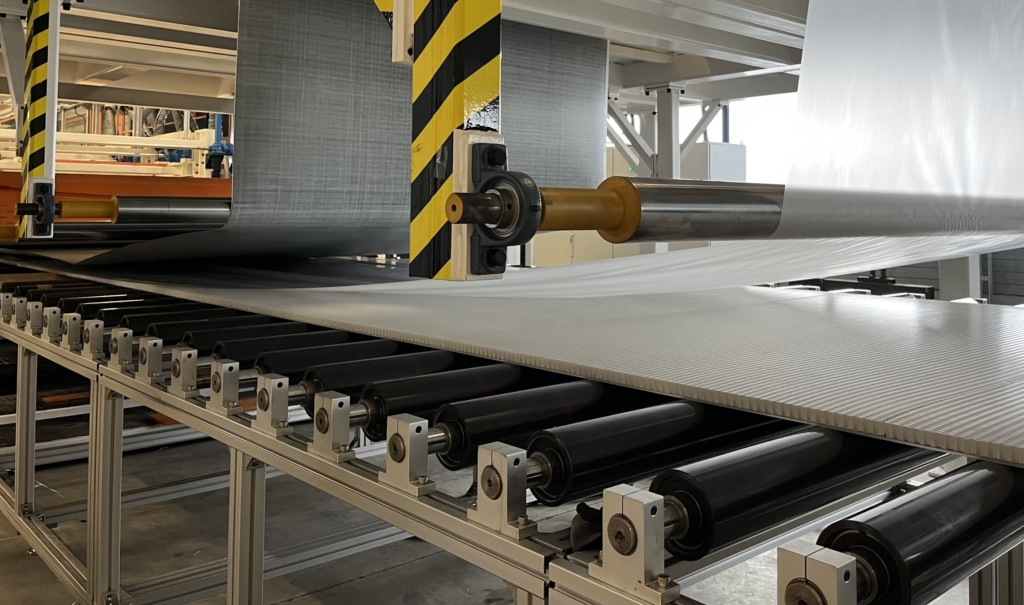
Our production capacity is 1.5 million square metres of thermoplastic composite material per year, with maximum panel sizes of up to 13,500 mm x 2,950 mm. All panels are produced in the Netherlands, in our factories in Beek and Ospel.
Would you like to know whether composite formwork panels are suitable for your application? Contact us for a technical discussion. Together with you, we will look at feasibility, specifications and payback period, so that you can make a well-founded decision.