

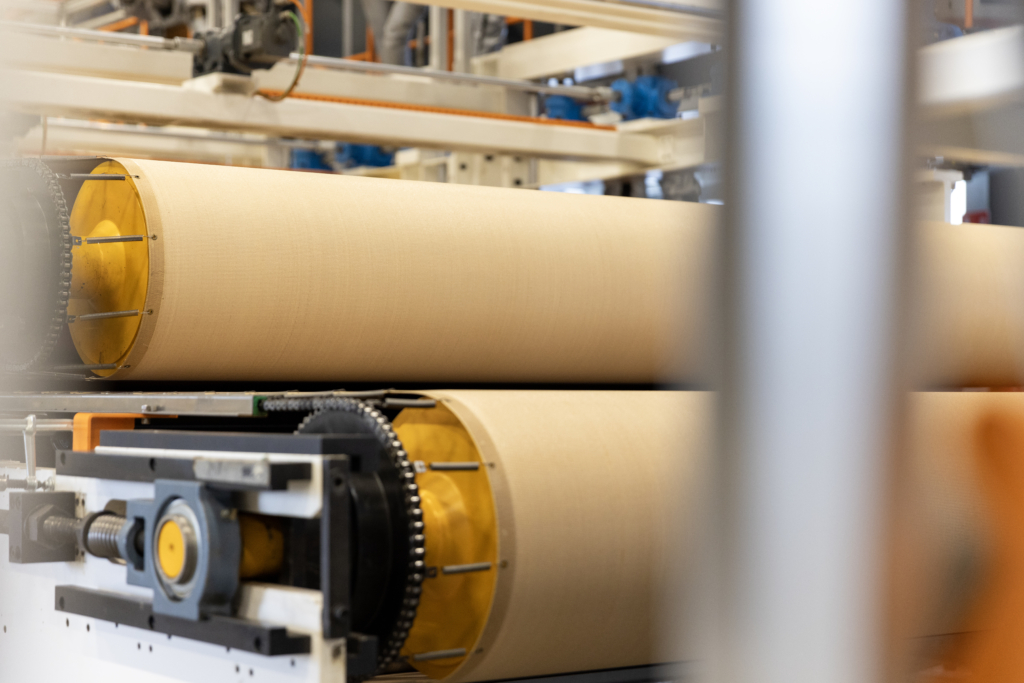
Composite sandwich panel scaffold boards deliver slip resistance through an inherent anti-skid surface finish built directly into the skin during manufacturing. Unlike timber boards that rely on surface coatings or steel boards that depend on pressed patterns, the grip on a composite scaffold board is part of the material itself. The sections below answer the most common technical questions buyers and specifiers ask before committing to composite boards on site.
How is slip resistance measured in scaffold boards?
Slip resistance in scaffold boards is measured by determining the coefficient of friction (CoF) between the board surface and a standardised test foot under controlled conditions. European scaffold boards are assessed against EN 12811, which sets out performance requirements for temporary works equipment, including working platforms. A higher CoF indicates greater grip and lower slip risk under foot traffic.
Testing typically distinguishes between dry and wet conditions, since a surface that performs well in dry weather may behave very differently when wet. Pendulum testing (using a device that swings a rubber slider across the surface) and ramp testing (where a person walks across a surface at increasing angles until they slip) are both used in European practice. The pendulum test produces a Pendulum Test Value (PTV), where a PTV above 36 is generally considered low-slip risk in wet conditions.
For scaffold boards specifically, EN 12811 also specifies load class requirements that interact with surface performance. A board that flexes excessively under load can create dynamic instability that compounds any surface slip risk. This is why structural stiffness and surface grip are evaluated together when specifying scaffold boards for professional use.
What surface treatments give sandwich panels their grip?
Sandwich panels used in scaffolding and construction platform applications achieve grip through an anti-skid surface integrated into the outer skin during the lamination process. This is not a coating applied after manufacture. The texture is formed as the skin is produced, which means it cannot peel, flake, or wear away in the way that painted or coated surfaces can.
In thermoplastic composite panels, the anti-skid finish is typically achieved by incorporating a structured texture into the glass-fibre-reinforced skin. The result is a surface with consistent micro-relief across the entire panel face. Because the texture is part of the skin material rather than a separate layer, it maintains its grip properties throughout the working life of the board.
The black pigmented skin common to this product category also serves a practical purpose beyond aesthetics. The black surface does not show contamination as readily as lighter surfaces, and the pigmentation is carried through the full skin thickness rather than applied as a surface treatment. This matters on construction sites where boards are regularly exposed to mud, concrete residue, and cleaning chemicals.
Some manufacturers offer additional surface options such as grit strips or bonded abrasive layers for extreme-duty applications. These can increase CoF further but introduce a separate bonded element that may degrade over time. For most scaffolding applications, the inherent anti-skid skin provides sufficient grip without the maintenance liability of a secondary surface treatment.
How do composite scaffold boards compare to timber and steel for slip resistance?
Composite scaffold boards offer more consistent slip resistance than timber and more reliable grip than bare steel, particularly in wet conditions. Timber grip degrades as the surface wears, absorbs moisture, and develops algae or biofilm. Steel grip depends entirely on the pressed pattern, which can become clogged with debris or polished smooth through repeated foot traffic. Composite boards maintain their surface texture throughout their service life.
Timber boards present a particular problem in sustained outdoor use. A new timber scaffold board may have reasonable grip when dry, but wet timber, especially when contaminated with mud or algae, becomes significantly more hazardous. The surface also degrades unevenly as the board weathers, creating inconsistent grip across the same plank.
Steel scaffold boards are durable but heavy, and their slip resistance depends on the depth and pattern of the pressed surface. In practice, steel boards used in construction environments accumulate debris in the pattern recesses, reducing effective grip. Steel also becomes extremely slippery when wet and contaminated with oils or concrete slurry.
Composite boards address both problems. The anti-skid texture is not a pressed pattern that can fill with debris, and the thermoplastic surface does not absorb moisture or support biological growth in the way timber does. From a weight perspective, an 11 mm thermoplastic composite scaffold panel is significantly lighter than a timber board of equivalent load-bearing capacity, which reduces handler fatigue and the risk of manual handling injuries during installation and repositioning.
Does weather affect the slip resistance of composite scaffold boards?
Weather has significantly less effect on the slip resistance of composite scaffold boards than on timber or steel alternatives. The anti-skid surface on thermoplastic composite boards does not absorb water, does not swell or warp in rain, and does not develop the biofilm that makes wet timber hazardous. Grip performance in wet conditions is therefore much closer to dry-condition performance than it is for timber.
UV exposure is a relevant concern for any outdoor material. Thermoplastic composite panels used in scaffolding applications are tested for UV resistance, with Compoform’s panels passing UV-ageing testing per ISO 4892-2:2006 at 2,000 hours of direct UV exposure. This level of UV resistance means the surface properties, including the anti-skid texture, remain stable over extended outdoor service without the surface degradation that causes grip loss in UV-sensitive materials.
Cold and freezing conditions introduce a different challenge. Any surface can become slippery when ice forms on it, and composite boards are no exception. However, the textured surface of a composite board provides more mechanical grip against ice than a smooth surface, and the thermoplastic material does not become brittle at typical European winter temperatures in the way that some materials do.
Rain, in the absence of contamination, has minimal effect on composite board grip. The surface texture continues to channel water away from the contact area between boot and board, maintaining friction. The more significant weather-related risk is contamination carried onto the board surface by foot traffic, such as mud, concrete, or oil, which reduces grip on any surface type. Regular site housekeeping remains important regardless of board material.
What certifications should composite scaffold boards carry for slip resistance?
Composite scaffold boards used in European construction must comply with EN 12811, the European standard for temporary works equipment. This standard defines load classes, deflection limits, and surface performance requirements for working platforms. A board carrying EN 12811 certification has been tested against defined load and performance criteria, not just assessed against a manufacturer’s internal specification.
For slip resistance specifically, boards should demonstrate compliance with the surface requirements set out in EN 12811, which includes provisions for grip under the conditions the board will encounter in use. Buyers should request test documentation that shows the specific load class achieved and the surface conditions under which testing was conducted.
Beyond EN 12811, relevant certifications and standards include:
- EN 13501-1 for fire classification, relevant where boards are used in enclosed or partially enclosed structures
- ISO 4892-2 for UV resistance, confirming surface stability under prolonged outdoor exposure
- Alkaline resistance testing, relevant for environments where boards are exposed to concrete or cleaning chemicals
Buyers should be cautious about boards that carry only a manufacturer’s declaration of conformity without independent test data. For professional scaffolding applications, third-party test reports that document actual measured performance against EN 12811 load classes provide a much stronger basis for specification decisions than self-certified claims.
How Compoform Supports Scaffold Board Specification
We manufacture thermoplastic composite scaffold panels with an inherent anti-skid surface finish built into the glass-fibre skin. The anti-skid texture is not a secondary coating. It is part of the panel construction, which means it does not delaminate, peel, or require reapplication over the board’s service life.
Our 11 mm scaffolding panel uses a directionally optimised 90-0-90 layup that maximises transverse strength, which is the relevant load direction for plank-style scaffolding where the dominant load runs across the panel width. This structural approach means the board resists the bending forces it actually encounters in use, not just the forces that are easiest to test.
A 10.5 mm Compoform panel has achieved EN 12811 load class 4 with no support underneath, based on our own testing. That is a concrete performance reference point, not a general claim about composite materials.
When you work with us on a scaffold board application, we do not simply ship panels to a generic specification. We review your application requirements, confirm the load class you need to achieve, and configure the panel layup and surface finish accordingly. If your application involves unusual spans, chemical exposure, or specific fire classification requirements, we flag those before production rather than after delivery.
- Anti-skid surface finish inherent to the panel skin, not a coating
- EN 12811 load class 4 achieved in Compoform testing at 10.5 mm
- UV resistance tested to 2,000 hours per ISO 4892-2:2006
- Fire classification to EN 13501-1 available on request
- Custom panel dimensions cut to your exact specification
If you are specifying composite scaffold boards and want to confirm the right panel configuration for your load class and site conditions, speak with our engineering team before finalising your design. We will review your requirements and confirm whether our standard scaffold panel meets your specification or whether a modified configuration is needed.