

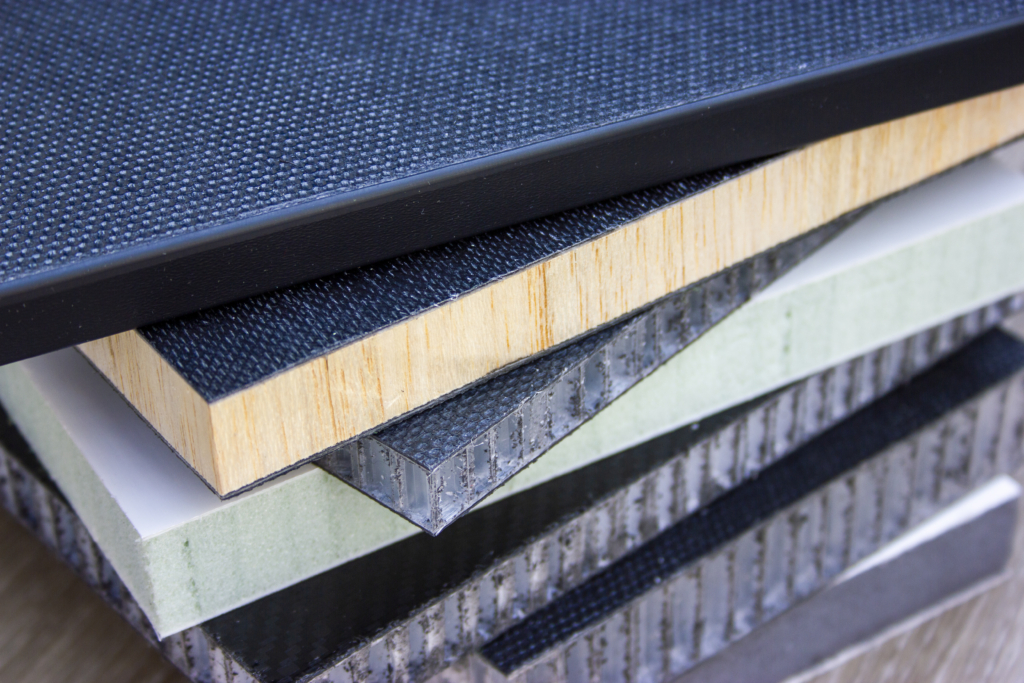
Sandwich panels play a direct role in green fleet programmes by reducing the structural weight of truck bodies and trailers, which lowers fuel consumption in diesel vehicles and extends battery range in electric ones. For fleet operators and the body builders who supply them, this weight reduction translates into measurable environmental and commercial gains. The questions below unpack the specific mechanisms, the fleet segments that benefit most, and what green specifications now require from panel materials.
This article covers the broader sandwich panel market. Our range at Compoform is limited to PP honeycomb and PET foam cores for commercial vehicles and scaffolding.
How do sandwich panels reduce vehicle weight in commercial fleets?
Sandwich panels reduce vehicle weight by replacing dense structural materials such as steel and plywood with a lightweight composite construction: two thin, high-strength skins bonded to a low-density core. The resulting structure delivers comparable rigidity at a fraction of the mass, cutting body weight significantly without compromising load-bearing performance.
In a conventional truck body or trailer, the walls, floor, and roof panels account for a substantial share of total unladen weight. When those panels are built from steel or hardwood, the structure itself consumes payload capacity before a single kilogram of cargo is loaded. A thermoplastic sandwich panel with a PP honeycomb or oriented PP foam core achieves the same structural function at considerably lower mass, freeing that weight allowance for revenue-generating cargo.
The weight advantage comes from the sandwich principle itself. The stiff outer skins, typically glass-fibre-reinforced thermoplastic laminates, carry bending loads efficiently. The lightweight core spaces those skins apart, increasing the panel’s second moment of area and therefore its stiffness, without adding proportional mass. The result is a panel that is structurally self-supporting, which matters practically: a 30 mm PP sandwich floor panel, for example, requires no aluminium subframe beneath it. That removes a production step for truck body builders and eliminates the subframe’s weight entirely.
What is the link between payload capacity and fleet carbon emissions?
Payload capacity and carbon emissions are directly connected because a heavier vehicle structure forces operators to either carry less cargo per trip or run more trips to move the same volume. Both outcomes increase fuel consumption and CO2 output per tonne of goods delivered. Reducing structural weight improves the payload-to-emissions ratio across the fleet’s operating life.
For diesel fleets, the relationship is straightforward: every kilogram of dead weight carried on every journey burns additional fuel. Across a fleet of hundreds of vehicles operating daily routes, the cumulative fuel and emissions penalty of heavy body construction is substantial. Lighter panels mean more cargo moved per litre of fuel, which directly reduces the fleet’s carbon intensity per tonne-kilometre.
For electric fleets, the argument is different but equally compelling. In an electric truck or van, structural dead weight does not just reduce payload capacity, it reduces range per charge. Battery energy is consumed moving the vehicle itself before any cargo is carried. Lighter body structures extend the distance an electric vehicle can travel on a single charge, which is now a standard procurement question from EV fleet buyers in 2026. Weight reduction has become a range argument, not just a payload argument, and fleet sustainability programmes increasingly evaluate body materials on both dimensions.
This dual impact, fewer trips needed and longer range per charge, makes structural lightweighting one of the most direct levers available to fleet operators pursuing verified emissions reductions under frameworks such as the EU’s Corporate Sustainability Reporting Directive (CSRD).
Which fleet segments benefit most from composite panel adoption?
The fleet segments that benefit most from composite sandwich panel adoption are those where unladen weight is a binding constraint: refrigerated trailers, dry freight truck bodies, and van bodies operating under strict gross vehicle weight limits. In these applications, every kilogram saved in body structure converts directly into additional payload or extended range. You can explore composite panel uses across vehicle applications to see how different segments are addressed.
Refrigerated transport is a strong example. Insulated trailer bodies are inherently heavy, and operators face a direct trade-off between insulation performance and payload. Thermoplastic sandwich panels address both sides of that trade-off: their low thermal conductivity (measurable under EN 12667) supports temperature control, while their low mass preserves payload capacity.
Dry freight trailers and curtainsider bodies benefit similarly. Body builders in this segment have historically used plywood or steel for floors and walls. Composite panels replace both materials with a structure that is lighter, more durable, and significantly longer-lasting. In heavy transport applications, thermoplastic panels typically outlast plywood by a factor of three to four, delivering service lives of twelve years or more compared to three to five years for plywood. Over a fifteen-year vehicle life, that eliminates two or three replacement cycles. When you account for panel cost, installation labour, and vehicle downtime, the composite option is cheaper per year of service even at a higher unit price.
Electric van and truck body builders represent a rapidly growing segment where composite adoption is accelerating. As EV platforms become standard in last-mile and regional distribution, body weight directly determines route viability. Fleet operators specifying new EV bodies in 2026 are increasingly requiring composite construction as a baseline, not an upgrade.
How do thermoplastic panels compare to aluminium and fibreglass in sustainability?
Thermoplastic sandwich panels compare favourably to both aluminium and fibreglass on sustainability grounds, primarily because thermoplastic materials are recyclable at end of life, whereas thermoset fibreglass composites are not. Aluminium is recyclable but energy-intensive to produce and heavier per structural unit than an equivalent thermoplastic composite panel.
The recyclability distinction matters increasingly for European OEMs. The EU End-of-Life Vehicles (ELV) Directive sets recycling and recovery targets for vehicles, and manufacturers are under growing pressure to demonstrate that body components can be recovered and reprocessed. Thermoplastic panels, built from PP honeycomb or PET foam cores with glass-fibre-reinforced thermoplastic skins, are compatible with thermoplastic recycling streams. Thermoset composites, including traditional fibreglass panels, cannot be melted and reprocessed, which creates a compliance and reputational problem as ELV requirements tighten.
Aluminium offers genuine recyclability but carries a higher production carbon footprint than thermoplastic composites, and aluminium body panels typically require a supporting subframe, adding further weight and material. A self-supporting thermoplastic sandwich floor panel eliminates that subframe entirely, reducing both mass and the total material volume entering the waste stream at end of life.
UV weathering resistance is another practical sustainability factor. Thermoplastic panels with PET-film surface finishes, tested to ISO 4892, maintain surface integrity over long service lives, reducing the need for repainting or surface treatment that adds chemical inputs over the vehicle’s operating life.
Do green fleet specifications now require composite materials?
Green fleet specifications do not universally mandate composite materials by name, but an increasing number of fleet procurement frameworks and OEM sustainability targets set weight, recyclability, and lifecycle emissions thresholds that effectively rule out steel and plywood and point toward composite construction. In 2026, composite panels are moving from a preferred option to a baseline requirement in several fleet segments.
The driver is regulatory and commercial pressure operating simultaneously. On the regulatory side, CSRD reporting requirements push fleet operators and their vehicle suppliers to quantify and reduce Scope 1 and Scope 3 emissions. Body material choices feed directly into those calculations. On the commercial side, end users, logistics companies, and retailers with their own net-zero commitments, are specifying lighter, lower-emission vehicles from their transport partners. That pull-through demand reaches body builders, who then face pressure to source materials that support verified weight and emissions claims.
EV fleet procurement is accelerating this shift. When a fleet operator specifies an electric truck, range per charge becomes a contractual performance parameter. Body builders who cannot demonstrate that their construction meets a weight target risk losing the contract. Composite panels, with documented mass and structural performance, give body builders the evidence they need to satisfy those specifications.
The practical result is that composite sandwich panels are becoming a procurement requirement in segments where they were previously a cost-benefit decision. Body builders who have not yet made the transition are finding that the question is shifting from “should we switch?” to “when do we need to switch to stay competitive?”
How We Help: Composite Panels for Green Fleet Programmes
We work with truck body builders and trailer manufacturers across Europe to specify and supply thermoplastic sandwich panels that meet the weight, durability, and recyclability requirements that green fleet programmes now demand. Our panels use PP honeycomb or oriented PP foam cores with glass-fibre-reinforced thermoplastic skins, and every configuration is engineered for the specific structural and assembly demands of commercial vehicle production.
Here is what that looks like in practice:
- Self-supporting floor panels that eliminate the aluminium subframe, reducing both body weight and production complexity for truck body builders.
- Wall panels with UV-stable PET-film surfaces, tested to over 22,000 hours of UV resistance, that hold up through the full service life of the vehicle without repainting.
- Custom panel dimensions cut to your exact specification, up to 13,500 mm x 2,900 mm, so panels arrive ready to fit your assembly process without secondary cutting operations.
- Thermoplastic recyclability that supports your compliance with the EU ELV Directive and your customers’ CSRD reporting requirements.
- Documented service life of twelve or more years in heavy transport, eliminating the replacement cycles that make plywood expensive over a vehicle’s operating life.
We do not ship panels to a specification and step back. Before production, we review your design, assess how the panel configuration fits your assembly process, and flag any integration issues early. If your fleet customers are asking new questions about weight targets or recyclability documentation, we can help you answer them with technical data from our own testing rather than generic claims. Get in touch to discuss your programme requirements and we will respond with the technical detail your specification needs.
See how our panels are specified for truck body and trailer applications or get in touch to discuss your specific programme requirements.
Related Articles
- What sandwich panels are used in aircraft interior construction?
- How do sandwich panel bridge decks compare to steel and concrete?
- Why are motorhome manufacturers switching to sandwich panel walls?
- What face sheet materials are used on composite sandwich panels?
- How much weight can a sandwich panel support?