

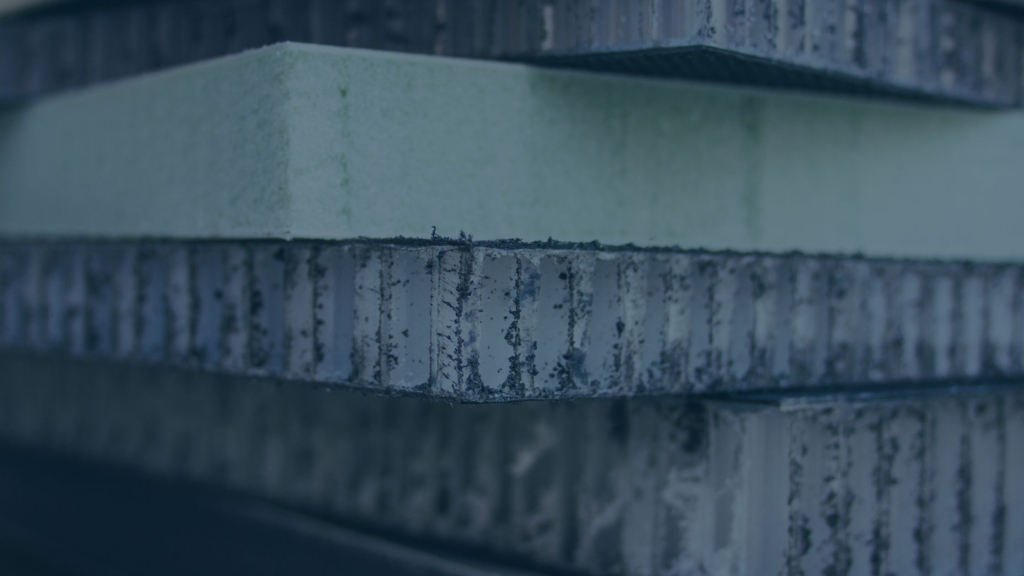
Face sheets on composite sandwich panels are most commonly made from glass-fiber-reinforced thermoplastic, carbon-fiber-reinforced thermoplastic, or unreinforced polypropylene (PP) skins. The right choice depends on the application: structural load requirements, surface finish needs, weight targets, and environmental exposure all shape which face sheet material performs best. The questions below unpack each of these factors in practical terms for manufacturers specifying panels for commercial vehicles, trailers, and industrial applications.
What types of materials are commonly used as face sheets?
The most widely used face sheet materials on composite sandwich panels are glass-fiber-reinforced polypropylene (glass-fiber-PP), carbon-fiber-reinforced polypropylene (carbon-PP), unreinforced PP, and glass-fiber-reinforced PET. Each brings a different balance of strength, weight, surface quality, and cost. For structural applications in transport and construction, glass-fiber-PP is the most common choice.
Beyond thermoplastic skins, the broader sandwich panel market also uses thermoset-based face sheets such as fiber-reinforced polyester, as well as metal skins in aluminum or steel, and paper-based surfaces for interior or decorative applications. The choice of face sheet is rarely made in isolation; it is always paired with a compatible core material and bonding process.
In practical terms, the most relevant face sheet categories for European OEM manufacturers are:
- Glass-fiber-PP: High stiffness-to-weight ratio, good impact resistance, compatible with thermoplastic recycling streams
- Carbon-fiber-PP: Higher stiffness and lower weight than glass-fiber, used where mass reduction is the primary driver
- Unreinforced PP: Lower structural performance but cost-effective for non-load-bearing surfaces
- Glass-fiber-PET: Offers good surface finish and UV stability, commonly used for wall panels requiring a decorative finish
- Steel and aluminum skins: Used in conventional sandwich panels, though these add significant weight compared to fiber-reinforced thermoplastic alternatives
How does the face sheet material affect panel performance?
The face sheet material directly controls the tensile strength, stiffness, impact resistance, and surface durability of a sandwich panel. In a sandwich structure, the face sheets carry the bending loads — tension on one side, compression on the other — while the core resists shear. A stiffer, stronger face sheet produces a panel that can span greater distances or carry higher loads at the same thickness.
Beyond structural performance, the face sheet also determines surface properties. A white PET-film surface, for example, delivers a finished decorative appearance with controlled color properties and strong UV resistance — relevant for interior wall panels in caravans or vehicle bodies. A black anti-skid glass-fiber skin, by contrast, prioritizes grip and durability under foot and vehicle traffic, making it the right choice for floor panels.
The layup architecture of the face sheet matters as much as the material itself. A cross-ply arrangement — where fiber layers alternate at 0° and 90° — equalizes mechanical properties in both directions, so the panel performs consistently regardless of installation orientation. A directionally optimized layup, such as a 90-0-90 configuration used in scaffolding panels, concentrates strength in the direction where loads are highest. Specifying the wrong layup for an application can leave performance on the table even when the base material is correct.
The number of plies also has a direct effect. A 4-ply glass-fiber-PP skin delivers a higher tensile modulus than a 2-ply skin of the same material, which translates to a stiffer panel at the same overall thickness. Asymmetric configurations — using a heavier 4-ply skin on one face and a lighter 2-ply skin on the other — allow engineers to tune stiffness and load capacity for applications where loading is predominantly one-directional.
What is the difference between thermoplastic and thermoset face sheets?
Thermoplastic face sheets are made from polymer matrices — such as polypropylene or PET — that can be remelted and reshaped after manufacture. Thermoset face sheets use resins such as polyester or epoxy that cure irreversibly and cannot be reprocessed. The practical difference for OEM manufacturers comes down to recyclability, processing speed, and long-term performance in demanding environments.
Thermoplastic face sheets
Thermoplastic skins bond directly to thermoplastic cores through heat and pressure, eliminating the need for adhesive layers in many configurations. This simplifies production and creates a chemically compatible bond between skin and core. Thermoplastic panels are fully recyclable at end of life — a compliance advantage under the EU End-of-Life Vehicles (ELV) Directive, which requires manufacturers to demonstrate recyclability for road vehicles. Processing times are fast, and panels can be thermoformed into curved shapes after initial manufacture.
Thermoset face sheets
Thermoset skins — typically fiber-reinforced polyester or epoxy-based laminates — offer high stiffness and good chemical resistance, but they cannot be recycled through standard thermoplastic streams. End-of-life disposal is more complex, and thermoset panels are increasingly scrutinized under European sustainability reporting requirements (CSRD). They also require adhesive bonding to most core materials, adding a process step and a potential failure point at the skin-to-core interface.
For European commercial vehicle manufacturers operating under tightening recyclability regulations, thermoplastic face sheets represent the more future-proof choice. The performance gap between thermoplastic and thermoset skins has narrowed significantly as continuous fiber-reinforced thermoplastic tape technology has matured.
Why are glass-fiber and carbon-fiber skins used on sandwich panels?
Glass-fiber and carbon-fiber skins are used on sandwich panels because they deliver structural performance — tensile strength, stiffness, and impact resistance — at a fraction of the weight of steel or aluminum. Fiber reinforcement allows the face sheet to carry the bending loads that a sandwich panel experiences in service, while keeping the overall panel mass low enough to generate real payload or range benefits.
Glass fiber is the more widely used of the two. It offers a strong combination of mechanical performance and cost, and it bonds well with polypropylene matrices to produce panels that resist impact without fracturing. The use of continuous fiber-reinforced tape technology — rather than chopped or woven fiber — further improves impact resistance by maintaining fiber continuity through the skin thickness.
Carbon fiber delivers higher stiffness and lower weight than glass fiber, but at a higher material cost. It is typically specified when mass reduction is the primary design constraint — for example, in applications where every kilogram saved has a direct commercial value. In electric trucks and vans, this argument is particularly direct: lighter body structures extend battery range per charge, and weight reduction becomes a range argument as much as a payload argument. EV fleet procurement teams in 2026 routinely ask about structural weight as part of their vehicle specification process.
The choice between glass and carbon fiber is not always binary. Hybrid configurations — combining glass-fiber skins for impact resistance with carbon-fiber reinforcement for stiffness — allow engineers to optimize for both properties without paying the full cost premium of an all-carbon solution.
Which face sheet material is best for truck bodies and trailers?
For truck bodies and trailers, glass-fiber-reinforced polypropylene (glass-fiber-PP) face sheets bonded to a PP honeycomb core represent the most practical choice for floor panels, while glass-fiber-PP or glass-fiber-PET skins suit sidewall applications. The combination delivers the load capacity and impact resistance that transport environments demand, at a weight significantly below steel or aluminum alternatives.
Floor panels in truck bodies face the most demanding conditions: concentrated point loads from pallet trucks and forklifts, repeated wash-down cycles, and continuous vibration. A 4-ply glass-fiber-PP skin on a PP honeycomb core handles these conditions without the moisture absorption problems that affect plywood floors. Thermoplastic composite floors also last significantly longer than plywood in heavy transport service — industry experience consistently shows 12 or more years of service life versus 3 to 5 years for plywood, eliminating two to three replacement cycles over a vehicle’s working life. Over a 15-year vehicle life, once you account for panel cost, installation labor, and vehicle downtime during replacement, the composite floor is cheaper per year of service even at a higher unit price.
For sidewall panels, the surface finish of the face sheet matters alongside structural performance. Glass-fiber-PET skins with a white film surface provide a clean interior finish without secondary painting, which reduces assembly time and cost for body builders.
The EV transition adds weight to this argument — literally. Electric truck platforms carry battery packs that add significant mass to the base vehicle. Reducing structural dead weight in the body directly extends range per charge, which is a procurement priority for fleet operators specifying electric vehicles. Lightweight composite panels with glass-fiber skins address this requirement in a way that steel or aluminum body panels cannot.
Can face sheet materials be customized for specific applications?
Yes. Face sheet materials, ply counts, fiber orientations, and surface finishes can all be configured to match the specific load, weight, and surface requirements of an application. Standard off-the-shelf panels cover many common use cases, but the most effective panels for demanding applications are specified with the face sheet configuration optimized for the actual load conditions, installation orientation, and service environment.
Customization options typically include:
- Ply count: 2-ply skins for lighter wall applications, 4-ply skins for floors and structural panels requiring higher stiffness
- Fiber orientation: Cross-ply (0°/90°) for balanced performance in both directions, directionally optimized layups for applications with a dominant load direction
- Surface finish: White PET-film for decorative interior surfaces, black anti-skid finish for floor panels, plain PP for applications where secondary finishing is applied
- Asymmetric configurations: Different ply counts on each face to tune stiffness and load capacity for one-directional loading scenarios
- Panel dimensions: Custom lengths and widths cut to your exact specification, rather than standard sheet sizes that require on-site cutting and generate waste
PP foam cores are available in six density grades, which allows further flexibility when specifying foam-core panels — adjusting core density changes the panel’s stiffness, compressive strength, and weight independently of the face sheet configuration. This level of specification control is what separates engineered composite panels from commodity sheet materials.
How Compoform Helps You Specify the Right Face Sheet
We manufacture thermoplastic sandwich panels with glass-fiber-PP, carbon-PP, PP, and glass-fiber-PET face sheets, paired with PP honeycomb or PP foam cores. Every panel configuration we produce is 100% European-made at our facilities in Beek and Ospel, the Netherlands — with no dependency on overseas supply chains that introduce lead time risk or quality inconsistency.
When you work with us, the starting point is your application, not a standard product list. We review your load requirements, installation constraints, and assembly process before recommending a face sheet configuration. Specifically, we help you with:
- Face sheet selection: Matching ply count, fiber type, and orientation to your actual load conditions and service environment
- Surface finish specification: Selecting the right surface — PET-film, anti-skid, or plain — to reduce secondary finishing steps in your assembly process
- Custom panel dimensions: Panels are available cut to your exact specification, eliminating on-site cutting and reducing material waste
- TCO analysis: We help you build the cost comparison between composite panels and the steel, aluminum, or plywood they replace — including replacement cycles, installation labor, and payload or range value recovered
- Pre-production review: We flag potential integration issues before production starts, not after the first batch arrives at your facility
See how these properties translate in practice for truck body and trailer floor applications, or speak with our engineering team about your specific panel configuration.