

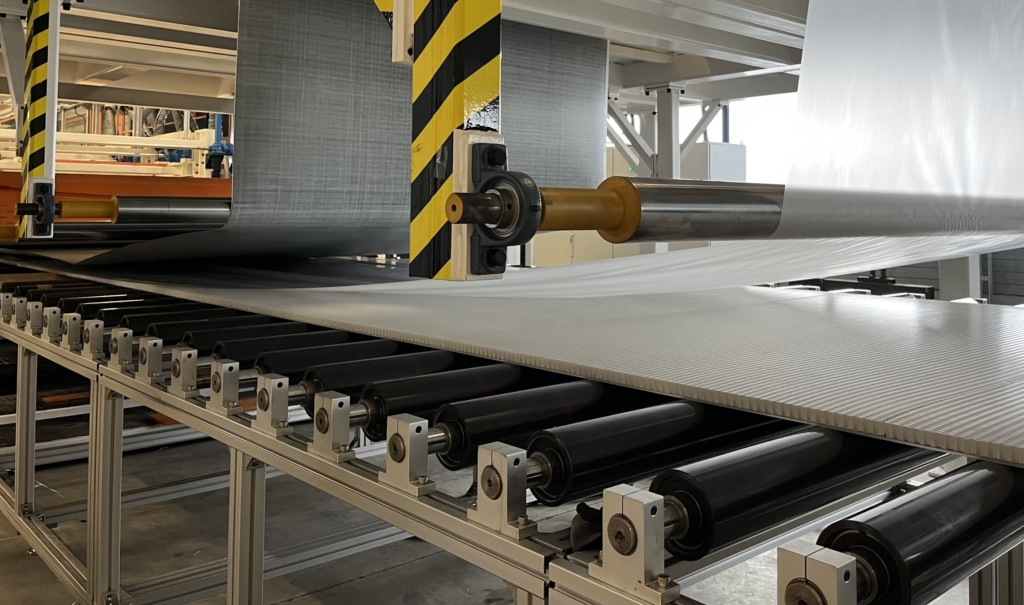
Composite formwork panels last significantly longer than plywood. Where plywood needs replacing after three to five years of intensive use, a high-quality composite panel reaches a service life of twelve years or more under comparable loads. The difference lies in the material composition: composite does not absorb moisture, does not rot and does not delaminate under repeated concrete pressure. The questions below work out that difference in concrete terms, from reuse cycles to total lifetime costs.
How often can composite formwork be reused?
Composite formwork panels are designed for repeated use over a long period. With correct use and maintenance, a glass-fibre-reinforced thermoplastic sandwich panel achieves dozens to hundreds of use cycles, depending on the load, the type of concrete and the way it is stripped. With intensive use, plywood rarely achieves more than twenty to thirty cycles before the surface is too damaged for reliable use.
The high reuse potential of composite stems from a number of material properties. The outer layers, built up from glass-fibre-reinforced thermoplastic skins, resist the alkaline environment of fresh concrete. They do not absorb water, so the panel retains its dimensions and stiffness, even after dozens of pours. The core, made of oriented PP foam or PP honeycomb, contributes to mechanical stability without the material swelling or shrinking with changing humidity.
In practical terms, this means that over its service life a composite panel replaces two to three replacement cycles of plywood. This has a direct impact on logistics: less supply of new material, less disposal of discarded panels and less downtime on site for replacement.
Why does plywood formwork deteriorate faster?
Plywood formwork deteriorates quickly because wood naturally absorbs moisture. Every concrete pour brings the panel into contact with water and alkaline compounds. This combination attacks the glue layers between the wood plies, causing the material to swell, delaminate and lose its flatness. After a limited number of cycles, the surface is too rough or too damaged for an acceptable concrete finish.
Mechanical wear also plays a major role. When formwork is stripped, panels are regularly knocked, pried loose with tools or dropped. Wood is prone to edge damage and splintering, which further weaken the panel. A damaged edge lets in moisture even faster, which accelerates the deterioration.
Temperature fluctuations make the problem worse. In frost, the absorbed water expands within the wood structure, causing internal cracks that are not always visible from the outside. The panel looks intact, but has already partly lost its load-bearing capacity. On sites where panels are stored outdoors, this is a structural risk.
Finally, surface treatment plays a role. Plywood formwork is often fitted with a film coating to extend its service life, but that coating wears with every pour. Once the coating is damaged, moisture absorption increases sharply. Composite needs no coating: the resistance to moisture, UV radiation and chemicals is built into the material itself.
What are the total lifetime costs of composite versus plywood?
Over the full service life, composite formwork is cheaper than plywood in most intensive applications, despite a higher purchase price per panel. The difference lies in the number of replacement cycles, the labour costs for replacement and the downtime that replacement causes.
A concrete calculation example makes this clear. Suppose a plywood panel lasts three to five years under intensive use and then has to be replaced. Over a period of fifteen years, that means two to three replacements, each with its associated material costs, labour costs for dismantling and installation, and possible downtime. A composite panel with a service life of twelve years or more largely eliminates those replacement cycles. Even if the composite panel is two to three times more expensive to purchase, it pays for itself through lower replacement costs and less labour-intensive maintenance.
Indirect savings come on top of this. Composite panels are considerably lighter than plywood of comparable thickness, which lowers handling costs. Less weight means faster installation and stripping, less physical strain on workers and higher load density during transport. On projects where panels are moved frequently, that difference adds up quickly.
Maintenance is another cost item where composite has the advantage. Plywood requires regular inspection, repair of edge damage and sometimes recoating to extend its service life. Composite requires no painting, no drying after use and no structural repairs. Rinsing or wiping down is enough.
Which conditions shorten the service life of formwork panels the most?
The service life of formwork panels, both composite and plywood, is shortened most by continuous exposure to moisture, mechanical shocks during stripping and unprotected outdoor storage. For plywood these are fatal conditions; composite is considerably more resistant, but composite also needs correct use to reach its maximum service life.
Moisture and alkaline environment
Fresh concrete has a high pH value and contains water. For plywood this is the main cause of deterioration: the alkaline environment attacks the glue layers and the water penetrates the wood structure. Composite panels with glass-fibre-reinforced thermoplastic skins are chemically resistant to alkaline environments and do not absorb moisture, so they retain their dimensions and stiffness.
Mechanical load and edge damage
Knocks, drops and the use of crowbars during stripping damage edges and surfaces. With plywood, edge damage quickly leads to moisture ingress and further delamination. With composite panels, the edge is the most vulnerable point: a damaged edge can expose the core to moisture. Edge finishing and careful handling significantly extend the service life of composite panels.
Temperature fluctuations and frost
Repeated freeze-thaw cycles are particularly damaging to plywood because the absorbed water expands when it freezes. Composite panels are dimensionally stable over a wide temperature range and are not susceptible to frost damage, provided the core has not been exposed to water through damaged edges.
When is composite formwork the better choice?
Composite formwork is the better choice when panels are used intensively and repeatedly, when weight matters for handling or transport, and when total costs over several years outweigh the purchase price per panel. For one-off use or short-running projects with a low reuse frequency, plywood may still be the most economical option.
Specific situations in which composite clearly performs better:
- Rental fleets where panels are used and moved dozens of times a year
- Precast concrete production where moulds are used daily and consistent surface quality is required
- Projects in damp or chemically demanding environments, such as foundation work or industrial construction
- Applications where weight determines handling, such as formwork at height or on sites without machine support
- Situations with strict requirements for the concrete surface, where a flat and smooth formwork surface must be guaranteed over many cycles
For formwork systems that are being further developed or brought to market as a product, composite also offers advantages in customisation. Panels can be produced in non-standard dimensions, with specific edge finishes and surface textures tailored to the requirements of the system.
How we help with composite formwork panels
We develop and produce glass-fibre-reinforced thermoplastic sandwich panels suitable for formwork applications. Our panels are built with a PP foam or PP honeycomb core and glass-fibre-reinforced thermoplastic skins, tailored to the mechanical and dimensional requirements of your specific application. What we offer in concrete terms:
- Technical evaluation of your application: we assess the load requirements, the number of use cycles and the environmental conditions before recommending a panel configuration
- Customisation of dimensions and build-up: panels up to 13,500 mm long and 2,900 mm wide, with a choice of core material, skin build-up and edge finish
- Production at scale: with a production capacity of 1.5 million square metres per year, we can deliver both prototypes and series production
- 100% European production: all panels are produced in our factories in Beek and Ospel, the Netherlands
We work as a development partner, not as a supplier who simply ships panels to specification. This means we review your design, optimise the panel configuration for your assembly process and flag potential bottlenecks before production starts. Get in touch to discuss whether composite panels suit your formwork application.
Related Articles
- Why does cheap panel material cost more in the long run?
- How do lead times for custom sandwich panels compare to standard sheet materials?
- What are the slip resistance properties of sandwich panel scaffold boards?
- How to calculate the true lifetime cost of your panel materials?
- What is the difference between continuous and batch lamination?