

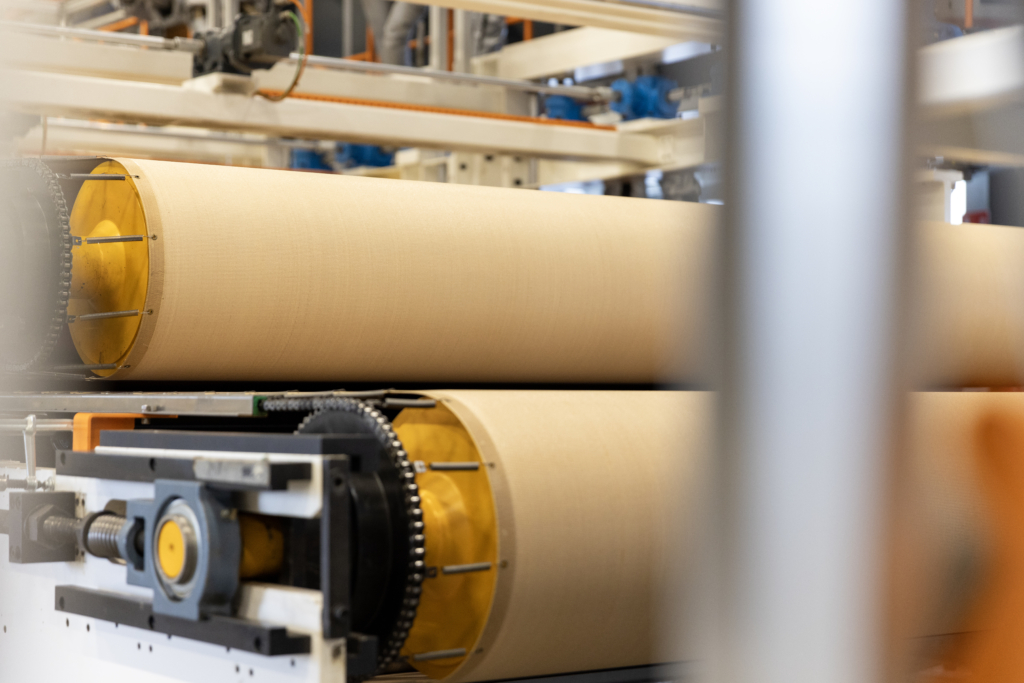
The best sandwich panels for truck body construction combine a lightweight thermoplastic core with glass-fibre-reinforced skins. For walls, PP foam core panels with cross-ply glass-fibre skins deliver the right balance of stiffness and low weight. For floors, PP honeycomb core panels with 4-ply skins and an anti-skid surface handle the higher compressive and bending loads that truck floors demand. The sections below work through the material choices, performance comparisons, and procurement considerations that matter most when specifying composite panels for truck body builds.
This article covers the broader sandwich panel market. Our range at Compoform is limited to PP honeycomb and PET foam cores for commercial vehicles and scaffolding.
What materials are sandwich panels for truck bodies made from?
Sandwich panels for truck bodies consist of two thin, stiff face skins bonded to a lightweight core material. The skins carry tensile and compressive loads, while the core separates them to create structural depth without adding significant mass. For commercial vehicle applications, the most widely used skin material is glass-fibre-reinforced thermoplastic, and the most common core types are PP foam and PP honeycomb.
Core materials
The core is where most of the weight reduction happens. In truck body panels, two thermoplastic core types dominate:
- Oriented PP foam: Available in a range of densities, typically from 40 to 140 kg/m³. Lower densities suit wall panels where bending loads are moderate. Higher densities provide more compressive resistance for floor applications. The oriented structure of the foam improves its mechanical performance compared to isotropic foam alternatives.
- PP honeycomb: A tubular polypropylene structure that delivers very high compressive strength relative to its weight. At 140 kg/m³, PP honeycomb is the preferred core for truck floor panels where point loads from pallet feet and forklifts are a real concern.
Skin materials
Glass-fibre-reinforced thermoplastic skins are the standard for truck body panels. Skins typically contain 66 to 67% glass fibre by weight, which gives them high tensile stiffness without excessive thickness. The fibre architecture matters: cross-ply laminates, where fibres run at 0° and 90° in alternating layers, equalise mechanical properties in both directions and suit wall panels that may be installed in either orientation. Multi-ply unidirectional laminates, such as 4-ply configurations, concentrate strength along the dominant load axis and are used for floor panels.
Surface finishes are applied directly to the skins during manufacture. White PET film provides a clean, UV-resistant decorative surface for interior wall cladding. Black anti-skid finishes are bonded to floor panel skins to prevent cargo movement and protect the surface from repeated foot and equipment traffic.
How do sandwich panels compare to steel and aluminum in truck bodies?
Thermoplastic sandwich panels are significantly lighter than steel and meaningfully lighter than aluminium, while matching or exceeding both metals in specific stiffness for typical truck body panel spans. The practical result is a truck body structure that weighs less, carries more payload, and resists corrosion without surface treatment.
Steel truck body panels are durable but heavy. Every kilogram of steel structure is a kilogram that cannot be converted into revenue-generating cargo. For operators running at or near the legal gross vehicle weight limit, this is a direct commercial constraint. Aluminium reduces that weight penalty but introduces higher material cost, more complex joining requirements, and a surface that dents and deforms under impact rather than flexing and recovering.
Thermoplastic composite panels offer a different set of trade-offs:
- Weight: A composite wall panel is a fraction of the weight of an equivalent steel panel, and lighter than aluminium of comparable thickness.
- Corrosion resistance: Thermoplastic skins do not rust or oxidise. Truck bodies washed down daily, or operating in salt-road environments, benefit from a material that requires no protective coating to maintain structural integrity.
- Impact behaviour: Composite panels absorb and distribute impact energy differently from metal. Continuous fibre-reinforced thermoplastic skins can deliver substantially higher impact resistance than unreinforced alternatives, without the permanent deformation that steel and aluminium exhibit after a significant impact.
- Thermal conductivity: Composite sandwich panels insulate far better than metal sheet, which matters for temperature-sensitive cargo and for reducing condensation on interior surfaces.
- Repairability: Localised damage to a composite panel can be more complex to repair than a dented metal panel, which is a genuine trade-off to factor into fleet maintenance planning.
For electric trucks and vans, the weight argument carries additional weight. Lighter body structures extend battery range per charge. Every kilogram of structural dead weight removed from the body is a kilogram that no longer consumes energy to move. In 2026, this is a standard procurement question from EV fleet buyers, and it shifts the weight reduction argument from a payload discussion into a range discussion. Composite panels address both simultaneously. You can explore composite panel applications across commercial vehicle types to see how these trade-offs apply in practice.
What is the difference between thermoplastic and thermoset sandwich panels?
The core difference between thermoplastic and thermoset sandwich panels lies in how the polymer matrix behaves under heat. Thermoplastic panels can be reheated and reformed after manufacture. Thermoset panels cannot. This distinction affects recyclability, production speed, repairability, and end-of-life compliance.
Thermoset composites, such as those using epoxy or polyester resin systems, cure through an irreversible chemical reaction. Once set, the matrix cannot be melted or reformed. This makes thermoset panels difficult to recycle and increasingly problematic under European end-of-life vehicle regulations. The EU ELV Directive requires that vehicles meet recyclability targets, and thermoset composites complicate compliance for OEMs who need to account for material recovery at end of vehicle life.
Thermoplastic panels use a polymer matrix, such as polypropylene, that softens when heated and solidifies when cooled. This makes them:
- Recyclable: Thermoplastic composite offcuts and end-of-life panels can be reprocessed, which supports compliance with EU recyclability requirements and CSRD sustainability reporting obligations.
- Faster to produce: Thermoplastic processing does not require long cure cycles, which enables higher production throughput on continuous production lines.
- Weldable: Thermoplastic skins can be joined using heat-based methods, which opens fabrication options not available with thermoset panels.
For truck body builders operating in Europe, the recyclability and regulatory compliance advantages of thermoplastic panels are increasingly relevant, not just as a preference but as a procurement requirement from fleet operators and end customers with sustainability commitments.
What panel properties matter most for truck body construction?
For truck body construction, the properties that matter most are bending stiffness, compressive strength, impact resistance, surface durability, and dimensional stability across temperature ranges. The relative importance of each depends on whether the panel is being used as a wall, a floor, or a roof.
Wall panels
Truck body side walls carry distributed wind loads, internal cargo pressure, and occasional impact from loading operations. The governing property is bending stiffness across the panel span. A cross-ply glass-fibre skin architecture distributes stiffness equally in both directions, which simplifies installation and avoids orientation errors during body assembly. UV resistance matters for exterior surfaces: white PET film surfaces with over 22,000 hours of UV resistance, as tested on Compoform wall panels, maintain appearance and surface integrity across a vehicle’s working life without repainting.
Floor panels
Truck floors face concentrated point loads from pallet feet, forklift tines, and heavy cargo. The governing properties are compressive strength and bending resistance under localised load. PP honeycomb cores at 140 kg/m³ are engineered for this demand. A 30 mm PP honeycomb floor panel is self-supporting across standard truck body frame spacings, which means no aluminium subframe is required beneath it. Removing the subframe eliminates a production step and reduces both weight and cost for the body builder. The anti-skid surface finish on floor panels is functional, not decorative: it prevents cargo shift during transit and protects the panel surface from repeated mechanical contact.
Dimensional stability and panel size
Truck bodies are large structures. Panels that require multiple joints introduce potential weak points and add assembly time. Maximum panel dimensions of up to 13,500 mm × 2,900 mm allow body builders to cover full trailer side walls in a single panel, eliminating joints entirely in many configurations. Thermoplastic panels also maintain dimensional stability across the temperature range that European trucks encounter, from cold storage environments to summer road temperatures.
Why do European truck body builders choose locally manufactured composite panels?
European truck body builders choose locally manufactured composite panels primarily because custom dimensions, consistent quality, and responsive technical support are not reliably available from distant suppliers. For production runs that depend on panels arriving to exact specification on a predictable schedule, supply chain proximity is a structural advantage, not a preference.
Several factors reinforce this choice in 2026:
- Custom dimensions: Truck body designs are not standardised. Body builders need panels cut to their exact frame geometry, not standard sheet sizes that require secondary cutting and generate waste. European manufacturers with large-format production lines can supply panels to custom dimensions as part of the standard order process.
- Lead time reliability: Production schedules in truck body manufacturing are tight. A delayed panel delivery stops an assembly line. Local supply chains reduce transit time and eliminate the customs and logistics variability that comes with intercontinental sourcing.
- Technical support continuity: Integrating composite panels into a body design for the first time raises questions about fixings, edge treatment, thermal expansion, and load distribution. A local manufacturer can provide engineering input during the design phase and remain accessible when issues arise during production.
- Regulatory alignment: European-manufactured panels are produced under European quality standards and tested against EN ISO frameworks that European OEM procurement teams recognise and require. Panels from outside Europe may not carry the test documentation that European fleet operators and end customers expect.
- Sustainability compliance: CSRD reporting requirements and EU ELV Directive recyclability targets are driving European OEMs to document the material origin and end-of-life profile of the components they use. Locally manufactured, 100% European-made thermoplastic panels simplify that documentation.
Pull-through demand strengthens this dynamic further. Fleet operators and logistics companies increasingly specify composite body materials as a procurement requirement, which means body builders are not always choosing composite panels freely. They are responding to what their customers demand. When the specification is set by the end user, the body builder’s priority shifts to finding a supplier who can deliver consistently, support integration, and stand behind the product over a multi-year production relationship.
How Compoform Helps with Sandwich Panel Selection for Truck Bodies
We manufacture thermoplastic sandwich panels specifically engineered for truck body walls and floors, produced at our facilities in the Netherlands on a 72-metre continuous production line capable of delivering up to 1.5 million square metres per year. Every panel is made to order.
For truck body builders, this means:
- Custom panel dimensions up to 13,500 mm × 2,950 mm × 150 mm, cut to your exact body geometry so you receive panels ready to fit, not standard sheets that need secondary processing.
- Application-matched configurations: We specify wall panels with oriented PP foam cores and cross-ply glass-fibre skins for side wall applications, and PP honeycomb core panels with 4-ply anti-skid skins for floors, matching core density and skin architecture to your actual load requirements.
- Self-supporting floor panels that eliminate the aluminium subframe from your production process, reducing both assembly time and total body weight.
- Thermoplastic materials that support EU ELV Directive recyclability compliance and CSRD sustainability reporting, with full European manufacturing documentation.
- Engineering support before and during production: we review your body design, flag integration issues, and optimise panel configuration for your assembly process before a single panel is produced.
Over a 15-year vehicle life, a composite floor panel eliminates two to three plywood replacement cycles. When you factor in panel cost, installation labour, and vehicle downtime for each replacement, the composite delivers a lower cost per year of service, even at a higher unit price. That is the calculation we work through with you at the start of a project, not after the first order.
If you are specifying panels for a new truck body programme or reviewing your current material supply, speak with our truck body application engineers. We will review your design, confirm the right panel configuration, and support you through integration, not just the initial sale.