

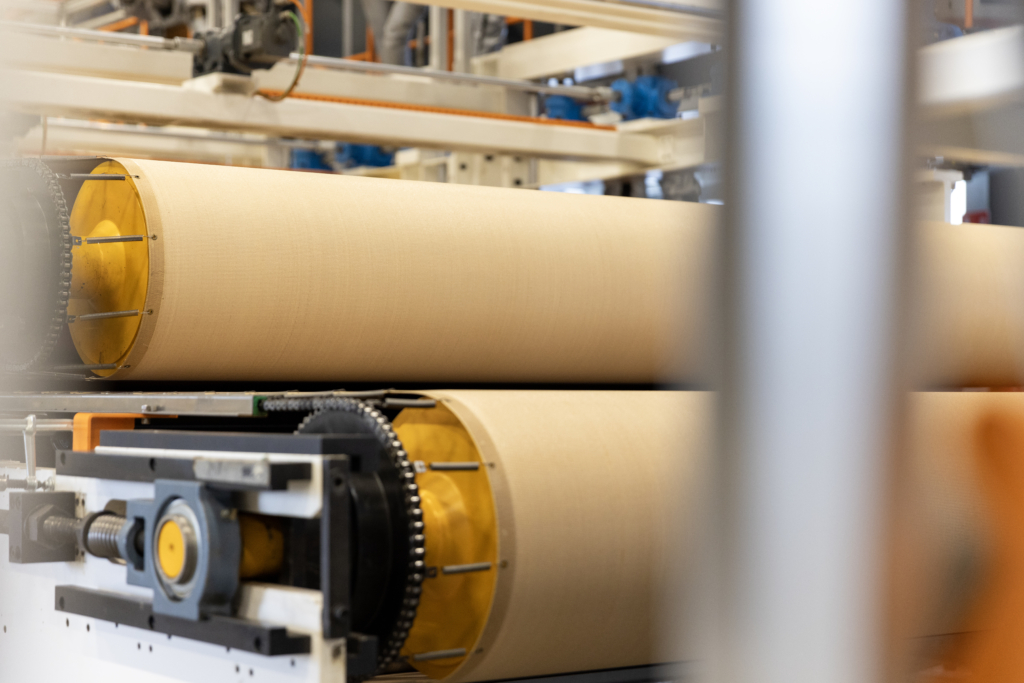
Thermoplastic sandwich panels hold up well in outdoor and off-road RV use when specified correctly. Their glass-fibre-reinforced skins resist moisture, UV radiation, and mechanical impact, while the lightweight core maintains structural rigidity without the weight penalty of steel or solid timber. The sections below answer the most common technical questions RV manufacturers ask before specifying composite panels for demanding outdoor applications.
What makes sandwich panels structurally different from solid panels?
A sandwich panel separates two stiff, thin skins with a lightweight core material, creating a structure that is far stiffer and stronger relative to its weight than a solid panel of equivalent thickness. The skins carry tensile and compressive loads, while the core resists shear forces and keeps the skins apart, a geometry that delivers high bending stiffness without adding mass.
In practical terms, this means a 30mm thermoplastic sandwich panel can replace a much heavier solid timber or steel section while delivering comparable or superior structural performance. For RV and caravan construction, that weight saving translates directly into lower towing weight, better fuel economy, and in the case of electric tow vehicles, extended range per charge. Lighter body structures extend battery range in electric vans and motorhomes — every kilogram of structural dead weight reduces range per charge, making weight reduction a range argument, not just a payload argument. This is a standard procurement question from EV fleet buyers in 2026.
The core material determines how the panel behaves under different load types. A PP-honeycomb core at 140 kg/m³ offers high compressive strength and excellent shear resistance, making it suited to floor panels that must carry point loads. An oriented PP-foam core at lower densities provides good thermal insulation alongside structural support, which is relevant for wall and roof panels where temperature management matters. The skin architecture — whether cross-ply or multi-ply glass-fibre laminate — controls tensile performance and impact resistance in specific directions.
How do sandwich panels perform under UV exposure, rain, and temperature swings?
Thermoplastic sandwich panels with glass-fibre-reinforced skins perform well under prolonged UV exposure, rain, and temperature cycling when the surface finish is correctly specified. The glass-fibre content in the skins does not degrade under UV in the way that organic materials do, and a PET-film or coated surface layer adds an additional barrier against moisture ingress and surface weathering, tested against UV weathering resistance standards such as ISO 4892.
Moisture resistance is particularly relevant for RV applications because panels are exposed to rain, condensation, and periodic washing. Unlike plywood, which absorbs water and delaminates over time, thermoplastic cores and skins do not absorb moisture. The PP and PET materials used in the core and skins are inherently hydrophobic, so the panel does not swell, warp, or lose structural integrity when wet. This is a significant advantage over timber-based panels in caravans and mobile homes operating in wet climates.
Temperature cycling — the repeated expansion and contraction caused by day-night and seasonal temperature changes — can stress bonded joints in panels that use dissimilar materials. Thermoplastic sandwich panels manage this well because the skin and core materials have compatible thermal expansion characteristics. The thermoplastic bond between skin and core flexes with temperature changes rather than cracking, which is a known failure mode in some thermoset composite systems. For RV roofs and sidewalls exposed to full sun in summer and sub-zero temperatures in winter, this thermal compatibility is an important durability factor.
Edge protection matters here. The panel edges are the most vulnerable point for moisture entry. Edge sealing and edge bending protect the core from UV and moisture — a detail that is relevant for any panel washed down regularly or exposed to standing water.
Can sandwich panels handle the vibration and impact loads of off-road driving?
Yes. Glass-fibre-reinforced thermoplastic sandwich panels are well suited to the vibration and impact loads generated by off-road driving. The glass-fibre skins absorb and distribute impact energy across a wide area rather than concentrating stress at a single point, and the thermoplastic matrix has inherent toughness that resists crack propagation under repeated dynamic loading.
Vibration fatigue is a real concern for any structural panel mounted in a vehicle that regularly travels on unpaved surfaces. Thermoset composites can develop micro-cracks in the matrix over time under cyclic loading, which gradually reduces stiffness. Thermoplastic matrices are more resistant to this mechanism because the polymer chains can accommodate deformation without fracturing. This makes thermoplastic sandwich panels a more durable choice for off-road RV and caravan applications compared to equivalent thermoset panels.
Impact resistance depends on skin specification. A 4-ply glass-fibre skin provides substantially higher impact resistance than a 2-ply skin, and continuous fibre-reinforced tape technology can increase impact resistance further compared to standard composite materials. For floor panels in off-road vehicles that may receive point impacts from rocks, tools, or equipment, specifying a higher-ply skin is a straightforward way to improve durability without changing the overall panel thickness or weight significantly.
What’s the difference between thermoplastic and thermoset sandwich panels for RV applications?
The core difference is in how the polymer matrix behaves. Thermoset panels cure irreversibly — once formed, the material cannot be remelted or reshaped. Thermoplastic panels use a polymer matrix that can be reheated and reformed, which affects manufacturing flexibility, repairability, recyclability, and long-term durability in ways that matter for RV manufacturers.
Durability and repairability
Thermoset panels are generally stiffer at equivalent thickness, but they are brittle under impact and difficult to repair in the field. A crack or delamination in a thermoset panel typically requires specialist repair or full panel replacement. Thermoplastic panels are tougher under impact and can, in some configurations, be locally reformed or repaired using heat. For RV operators who need panels to survive years of outdoor use with minimal maintenance, this toughness advantage is meaningful.
Recyclability and regulatory compliance
Thermoplastic panels are fully recyclable at end of life. The material can be remelted and reprocessed, which aligns with the EU End-of-Life Vehicles (ELV) Directive requirements that European OEMs must meet. Thermoset panels cannot be melted down — they can only be mechanically ground or incinerated, which limits recyclability options. For RV manufacturers selling into European markets where sustainability reporting under the CSRD is increasingly a procurement requirement, specifying thermoplastic panels simplifies end-of-life compliance.
How do sandwich panels compare to aluminum and wood in RV construction?
Thermoplastic sandwich panels outperform both aluminium sheet and plywood on the combination of weight, durability, and total cost of ownership that matters most in RV construction. Each material has specific strengths, but composite sandwich panels address the most common failure modes of both alternatives.
Compared to aluminium, sandwich panels offer significantly lower thermal conductivity, which reduces heat transfer through walls and roofs — important for both comfort and insulation efficiency in caravans and motorhomes. Aluminium is also prone to denting and corrosion at joints and fixings, particularly in coastal or high-humidity environments. Sandwich panels do not corrode, and their surface finish options provide consistent appearance over time without the oxidation that affects untreated aluminium.
Compared to plywood and timber-based panels, the durability advantage of thermoplastic composites is substantial. In heavy transport applications, thermoplastic panels last three to four times longer than plywood — typically 12 or more years versus three to five years for plywood under comparable conditions. Over a 15-year vehicle life, a composite floor eliminates two to three plywood replacement cycles. Once you factor in panel cost, installation labour, and vehicle downtime for replacement, the composite option is cheaper per year of service even at a higher unit price. The same logic applies to RV floors and sidewalls that are regularly exposed to moisture, cleaning chemicals, and mechanical wear.
Weight is the third dimension. A thermoplastic sandwich panel floor or wall section is lighter than an equivalent plywood or aluminium construction, reducing the overall vehicle weight. For towed caravans, lower structural weight means a lower towing weight, which opens the vehicle to a wider range of tow cars and reduces fuel or energy consumption on every journey.
What should RV manufacturers check when specifying sandwich panels for outdoor use?
When specifying sandwich panels for outdoor RV applications, manufacturers should evaluate core density, skin ply count, surface finish, edge treatment, and panel dimensions against the specific load and environmental conditions the panel will face. Getting these parameters right at the specification stage prevents performance issues and avoids costly redesigns after production begins.
- Core type and density: PP-honeycomb cores at higher densities suit floor panels with point load requirements. PP-foam cores at lower densities suit wall and roof panels where thermal insulation and weight are the primary drivers. Density selection directly affects stiffness, weight, and cost.
- Skin ply count and fibre orientation: A 2-ply skin is sufficient for lightly loaded wall panels. A 4-ply skin provides higher tensile strength and impact resistance for floors and structural panels. Cross-ply skin architecture distributes load evenly in both directions, which is useful for panels loaded from multiple angles.
- Surface finish: A white PET-film finish provides UV resistance and a clean appearance for interior wall panels. An anti-skid surface finish is appropriate for floor panels where slip resistance is a safety requirement. Confirm the finish specification matches the application environment.
- Edge treatment: Exposed panel edges must be sealed or banded to prevent moisture ingress into the core. This is non-negotiable for panels used in outdoor applications where rain or washing is expected.
- Panel dimensions: Confirm that the panel supplier can produce the exact dimensions your assembly process requires. Panels cut to non-standard sizes on-site introduce waste and inconsistency. Panels available up to 13,500mm × 2,950mm cover most RV body section requirements without joins.
- European standards compliance: Structural performance should be verified against EN ISO 527 for tensile properties and ISO 14125 for flexural behaviour. Confirm that the supplier’s test data references these standards, not ASTM equivalents, which use different test geometries and may not be directly comparable.
How Compoform Helps RV and Caravan Manufacturers Specify the Right Panel
We work with caravan and RV manufacturers at the specification stage — before production begins — to match panel configuration to the actual load, environmental, and assembly conditions of each application. This is not a catalogue selection exercise. We review your design, identify the core density, skin architecture, surface finish, and edge treatment that fits your specific requirements, and flag any integration issues before they become production problems.
What we bring to the specification process:
- Custom panel dimensions up to 13,500mm × 2,950mm × 150mm, produced to your exact requirements on our 72-metre double belt press production line
- Core options in oriented PP-foam (40 to 140 kg/m³) and PP-honeycomb (120 to 140 kg/m³), selectable by application
- Skin options from 2-ply to 4-ply glass-fibre-reinforced thermoplastic, with PET-film or anti-skid surface finishes
- Edge sealing and edge banding as standard for outdoor-use panels
- All panels 100% European-made at our facilities in Beek and Ospel, the Netherlands, with consistent quality and reliable lead times
- Technical support through integration, not just at the point of sale
If you are replacing plywood or aluminium panels in a caravan or RV body and want to understand which thermoplastic sandwich panel configuration fits your structure, contact our engineering team for panel advice. We will review your application and recommend a panel specification — including the commercial case for the switch based on your production volumes and vehicle lifecycle.
Related Articles
- How does vehicle weight affect tyre wear and maintenance costs?
- How does PP honeycomb compare to aluminium honeycomb in transport sandwich panels?
- What sandwich panels are used in temperature-controlled cargo bodies?
- How to cut and fabricate lightweight panels without specialist tools?
- Can sandwich panels replace steel in structural applications?