

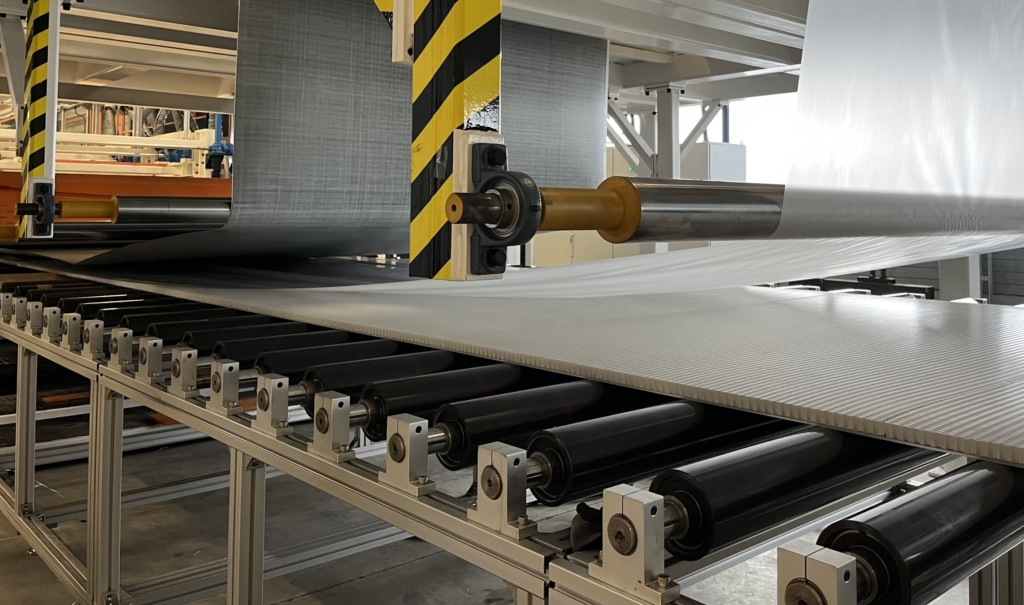
Yes, composite formwork can lower total project costs compared to traditional plywood. The higher purchase price per panel is recovered over its service life through fewer replacements, lower labor costs and less downtime. This applies most strongly to projects with intensive reuse, where the panels go through multiple use cycles. The questions below work through the cost logic step by step.
What are the biggest cost items in traditional formwork?
With traditional plywood formwork, the biggest cost items are material replacement, labor for assembly and dismantling, storage and transport, and waste disposal. Plywood wears quickly due to moisture, mechanical stress and repeated use, which means panels have to be replaced after a limited number of use cycles. That replacement frequency largely determines the total cost over the project duration.
The cost structure of plywood formwork consists roughly of four layers:
- Material costs: Plywood panels are relatively cheap per piece, but have to be replaced regularly. Under intensive use they wear quickly through moisture absorption, delamination and edge damage.
- Labor costs: Heavy panels require more manpower for assembly, dismantling and transport on site. This increases direct labor costs per use cycle.
- Transport and logistics: Plywood is relatively heavy. More weight per shipment means higher freight costs and fewer panels per transport.
- Waste disposal: Treated wood often may not be disposed of as ordinary construction waste. The costs of responsible disposal are frequently underestimated in the initial calculation.
If you only look at the purchase price per panel, you miss a large part of the actual cost structure. The total cost of formwork only becomes visible when you add up all cycles, the associated labor and the disposal costs.
How do composite formwork panels reduce labor costs?
Composite formwork panels reduce labor costs because they are considerably lighter than plywood, so a single worker can handle a panel independently. This speeds up assembly and dismantling, reduces the number of people needed per operation and lowers the physical strain on the job site.
On site, weight translates directly into time and money. When panels are up to 65% lighter than comparable plywood (depending on specification and thickness), the way a crew works changes. Tasks that normally require two people can be carried out by one. That saves not only labor costs, but also planning complexity.
In addition, composite panels require hardly any maintenance between use cycles. Plywood has to be checked after use for delamination, moisture damage and edge damage, and sometimes needs to be touched up or repaired. Composite panels are waterproof, rot-free and dimensionally stable under changing temperatures and humidity. Cleaning can be done by rinsing or wiping with a dry cloth. That saves time and material costs per cycle.
How many use cycles does composite formwork achieve?
Composite formwork panels are designed for a minimum service life of 12 years under continuous use in the fleet. One life cycle of a composite panel replaces four to five replacement cycles of plywood, resulting in considerably lower total formwork costs over time.
Under intensive use, plywood typically achieves a limited number of cycles before delamination, moisture damage or edge damage renders the panels unusable. Composite panels are UV-resistant, chemically resistant and fully waterproof. They retain their dimensions through freeze-thaw cycles and extreme weather conditions, without the need for painting, drying or structural repairs.
For formwork manufacturers and formwork rental companies, this means a fundamentally different depreciation logic. Instead of regularly purchasing new panels, you work with a longer asset life and a lower replacement frequency. This has direct consequences for the balance between purchase costs and operating costs over the project lifetime.
What is the difference between the TCO of composite and plywood formwork?
The total cost of ownership (TCO) of composite formwork is lower over its service life than that of plywood, despite a higher purchase price per panel. The difference lies in the combination of fewer replacements, lower labor costs per cycle, higher freight density and lower waste disposal costs.
A concrete calculation example makes this clear. Suppose a plywood panel has to be replaced four to five times during the period that one composite panel lasts. Add to that:
- The labor costs for each replacement (delivery, assembly, dismantling, disposal)
- The logistics costs of multiple orders and transports
- The costs of responsible disposal of treated wood
- The indirect costs of downtime or delays due to panel shortages
When you add up all these factors over a period of twelve years, the cost balance tips in favor of composite. The higher purchase price is recovered, and after that the composite panel delivers a net saving. This is the core of the TCO reasoning for composite formwork: not the price per panel, but the price per year of use.
An additional advantage is the higher freight density. Lighter panels mean more panels per shipment, which lowers the logistics cost per panel and reduces delivery frequency.
When is composite formwork the most cost-efficient choice?
Composite formwork is most cost-efficient in applications with intensive reuse, harsh environmental conditions or high labor costs per cycle. The more often a panel is used and the heavier the load, the faster the higher purchase price is recovered.
Specific situations in which composite formwork is the most logical choice:
- Formwork system rental: Rental panels are used intensively by multiple customers. Every extra cycle a panel lasts directly increases the margin per panel.
- Industrial environments: When used near chemicals, salt water or extreme temperature swings, plywood degrades quickly. Composite retains its properties in these conditions.
- Projects with high labor costs: In markets where labor costs are high, the weight advantage of composite carries more weight in the TCO calculation.
- Precast concrete production: In precast applications, molds and formwork elements are used repeatedly under controlled conditions. The long service life of composite fits well with this.
For single-use applications or projects with a very short duration, the higher purchase price is harder to recover. In those cases the TCO argument is weaker, unless other factors such as weight or safety are decisive.
Which technical properties determine the cost performance of composite panels?
The cost performance of composite formwork panels is determined by four technical properties: structural strength at low weight, resistance to moisture and chemicals, dimensional stability over the service life, and the quality of the anti-slip surface. Together, these properties determine how long a panel lasts and how much maintenance it requires.
Structural strength is the foundation. A panel that bends or breaks under load is unusable, regardless of its weight. Composite panels with a fiber-reinforced core construction can be certified according to EN 12811, load classes 3 and 4, which confirms the load-bearing capacity under heavy conditions without the need for additional support.
Moisture resistance and chemical resistance determine the service life in practice. Plywood absorbs moisture, swells and delaminates. Composite panels are fully waterproof and rot-free, which directly lowers the replacement frequency.
Dimensional stability is relevant for formwork applications where dimensional accuracy of the concrete surface is required. Panels that shrink or expand due to temperature changes or humidity produce inconsistent results. Composite retains its dimensions under changing conditions.
Finally, the surface quality determines both safety and maintenance costs. A permanently molded anti-slip surface, such as the R12-structured texture used in composite panels, does not wear off and does not need to be reapplied. That saves maintenance and reduces the risk of slipping on the work floor.
How do we help you with composite formwork?
We develop and produce thermoplastic sandwich panels for companies looking for an alternative to plywood and other conventional formwork materials. Our panels are manufactured at our ISO-certified production sites in the Netherlands, with strict quality control on every production batch.
What we can concretely do for you:
- Technical evaluation: We assess your current formwork design and determine which panel configuration best matches your load requirements, dimensions and operating conditions.
- Custom solutions: Panels are available in custom dimensions, thicknesses and edge finishes, tailored to your specific application.
- Prototyping and testing: Our in-house R&D team develops and tests new composite formulations and panel constructions, so we can quickly adapt to special project requirements.
- Drop-in compatibility: Composite panels are designed as a direct replacement for plywood, without modifications to your existing systems or processes.
We work as a technical partner, not as a supplier who simply ships made-to-order panels. That means we walk through your design, optimize the panel construction for your assembly process and flag potential bottlenecks before production starts. Want to know whether composite formwork is the right choice for your application? Get in touch for a technical assessment of your project.
Related Articles
- Why does cheap panel material cost more in the long run?
- How does a lightweight sandwich panel reduce vehicle emissions over time?
- How do sandwich panels meet aerospace weight and strength requirements?
- How thick should sandwich panels be in a motorhome build?
- How do sandwich panel truck floors compare to aluminium floors?