

European sandwich panel suppliers typically work to lead times of four to eight weeks for standard configurations, with custom-dimensioned panels for OEM production runs often falling in the six to ten week range depending on specification complexity and order volume. For mid-volume OEMs building truck bodies, trailers, or specialist vehicles, the practical answer is that a well-structured supply relationship with a European manufacturer delivers far more schedule certainty than the headline lead time suggests. The questions below unpack the specific factors that determine whether your panel supply keeps pace with your production line.
What lead times can OEMs expect from European sandwich panel suppliers?
For standard sandwich panel configurations, European suppliers typically deliver within four to eight weeks from order confirmation. Custom OEM specifications, including non-standard dimensions, specific core densities, or particular skin architectures, generally require six to ten weeks. The more important factor for production scheduling is consistency: a reliable European supplier hits the same window repeatedly, which is what allows you to plan assembly sequences with confidence.
Lead time predictability depends on several variables that procurement teams should clarify before placing repeat orders:
- Panel dimensions: Panels cut to your exact specification require dedicated production slots. Suppliers running semi-automatic production lines can accommodate large-format panels, but scheduling must account for changeover time between configurations.
- Core and skin combination: PP honeycomb cores and PET foam cores have different material lead times upstream. Knowing which your supplier stocks versus orders to demand affects how quickly production can begin.
- Order volume and frequency: Suppliers prioritise customers with predictable, recurring volumes. Establishing a call-off agreement or blanket order typically compresses effective lead times because your slot is pre-allocated.
- Proximity: European manufacturing means road freight rather than ocean freight. This removes four to six weeks of transit uncertainty that comes with sourcing from outside Europe, and it eliminates the customs clearance variability that can stall a production line at the worst possible moment.
For EV truck and van body builders in particular, supply schedule reliability has taken on additional weight in 2026. Fleet operators transitioning to electric vehicles are specifying lightweight composite body structures as a direct range requirement. Every kilogram of structural dead weight reduces battery range per charge, so weight reduction has become a range argument, not just a payload argument. That procurement pressure flows upstream to body builders, who need panel supply that does not introduce production delays into an already tight vehicle delivery schedule.
How do sandwich panel suppliers handle custom dimensions for OEM runs?
Reputable European sandwich panel suppliers produce panels to your exact dimensions rather than supplying standard sheet sizes for you to cut down on-site. Panels are available in custom dimensions cut to your exact specification, with maximum panel sizes reaching up to 13,500 mm x 2,950 mm on modern continuous production lines. This eliminates on-site cutting waste, reduces assembly labour, and ensures dimensional consistency across every panel in a production run.
The process typically works as follows. You supply a panel specification, including overall dimensions, core material and density, skin architecture, number of plies, and any surface finish requirements. The supplier translates this into a production configuration and confirms tolerances. For OEM runs, the same configuration is locked in and reproduced identically for every subsequent order, which is what makes composite panels viable for serial production rather than one-off fabrication.
One practical consideration for truck body builders and trailer manufacturers is that large-format panels reduce the number of joints in a finished structure. Fewer joints mean fewer potential weak points, less sealing work during assembly, and a cleaner finished surface. Suppliers capable of producing panels up to 13.5 metres long can often supply a full truck body side wall as a single panel, which changes the assembly process significantly compared to working with smaller sheet formats.
What happens when an OEM changes specifications mid-production run?
Specification changes mid-run are manageable but require early communication. The impact depends on how far into production the change is requested and how significantly it alters the panel configuration. Changes to surface finish or core density are generally easier to accommodate than changes to panel dimensions or skin architecture, which may require a new production setup. The earlier you flag a change, the lower the cost and schedule impact.
This is where the distinction between a commodity panel supplier and an application partner becomes concrete. A supplier operating purely on transactional terms will treat a mid-run specification change as a new order with a new lead time and potentially a penalty for the cancelled configuration. A supplier working as a production partner will have a named contact who understands your assembly process, can assess whether the change affects structural performance, and can advise on whether a simpler modification achieves the same outcome.
For OEMs producing vehicle bodies, specification changes often originate downstream. A fleet operator updates their payload requirement, a regulatory change affects gross vehicle weight limits, or an EV platform swap changes the floor load distribution. These are not unusual events in a multi-year supply relationship. The supplier’s ability to respond to them without disrupting your production schedule is a more useful measure of supply quality than the initial lead time quoted at the start of the contract.
How does composite panel supply affect payload capacity and vehicle compliance?
Switching from steel or plywood body panels to thermoplastic sandwich panels directly reduces the unladen weight of a vehicle body, which converts into additional legal payload capacity under European gross vehicle weight regulations. For a truck body builder, every kilogram removed from the body structure is a kilogram the fleet operator can carry as revenue-generating cargo. In practice, composite body panels can reduce body weight significantly compared to equivalent steel or timber construction, depending on the panel specification and the structure being replaced.
For electric trucks and vans, the weight argument extends beyond payload. Lighter body structures extend battery range per charge. Fleet operators running electric vehicles in 2026 are increasingly treating structural weight as a range variable, not just a payload variable. This means EV fleet buyers are asking body builders specific questions about panel weight at the procurement stage, which in turn means body builders need panel suppliers who can provide accurate weight data per square metre for each configuration.
Compliance considerations also include the EU End-of-Life Vehicles (ELV) Directive, which requires vehicle manufacturers to demonstrate that a defined proportion of vehicle materials are recyclable. Thermoplastic sandwich panels offer a recyclability advantage over thermoset composites because the thermoplastic matrix can be reprocessed at end of life. For OEMs building vehicles that will eventually be subject to ELV compliance reporting, this is a material selection argument worth raising with your panel supplier at the specification stage.
Which industries rely most on European composite panel suppliers for OEM schedules?
Commercial vehicle manufacturing, specifically truck body building and trailer production, represents the largest and most schedule-sensitive market for European sandwich panel suppliers in 2026. Scaffolding board manufacturing is the other primary application. Both industries share a common requirement: panels must meet consistent structural performance standards across every unit in a production run, with no variation that would require rework or rejection at the assembly stage.
Truck body builders use composite sandwich panels for side walls, roof panels, and floor structures. Floor panels in particular require high compressive and bending performance, since they carry forklift loads during loading and unloading. Wall panels prioritise low weight and a finished surface that does not require additional cladding. The two applications often use different core materials and skin architectures, which is why suppliers offering a range of configurations are more useful to body builders than those offering a single standard product.
Scaffolding manufacturers rely on composite panels to meet EN 12811 load class requirements while keeping board weight low enough for safe manual handling. An 11 mm thermoplastic composite scaffolding panel can achieve EN 12811 load class 4 with no support underneath, which is a meaningful structural result for a product that workers carry and position repeatedly throughout a working day.
Other sectors, including modular construction and specialist vehicle manufacturing, use composite panels in smaller volumes. These composite panel application areas and industries are worth noting, but commercial vehicles and scaffolding represent the production volumes and schedule demands that define how European composite panel suppliers structure their capacity and service models.
What should OEMs ask a sandwich panel supplier before committing to a production contract?
Before committing to a production contract, OEMs should ask a sandwich panel supplier six specific questions: What is your maximum panel dimension? Can you hold a fixed configuration across repeat orders? What is your production capacity in square metres per year? How do you handle specification changes mid-contract? What test data supports the structural claims for my application? And who is my named contact for technical and production queries after the contract is signed?
These questions separate suppliers who can support serial OEM production from those better suited to one-off or low-volume supply. The answers reveal whether the supplier has the production scale to absorb your volume without disruption, the technical depth to validate panel performance for your specific load case, and the service structure to support you through the inevitable changes that arise in a multi-year production relationship.
Additional questions worth asking before signing:
- Do you manufacture in Europe? European production means shorter and more predictable lead times, no customs exposure, and a supplier subject to the same regulatory environment as your own operation.
- Can you supply weight data per square metre for each configuration? This is now a standard question from EV fleet buyers and needs to be answerable at the body builder level.
- What surface finishes are available, and do they require additional treatment before assembly? A panel with a finished PET-film surface eliminates a painting or cladding step. Knowing this upfront changes your assembly cost calculation.
- How do you protect panel edges? Edge sealing and edge bending protect the core from moisture and UV degradation, which matters for truck floors washed down regularly and scaffolding boards exposed to weather.
- What is your position on total cost of ownership versus unit price? A thermoplastic composite floor panel typically lasts three to four times longer than plywood in heavy transport use. Over a fifteen-year vehicle life, that eliminates two to three replacement cycles. Once you include panel cost, installation labour, and vehicle downtime for replacement, the composite is cheaper per year of service even at a higher unit price. A supplier who can walk you through that calculation is thinking about your business, not just the transaction.
How Compoform Supports OEM Production Schedules
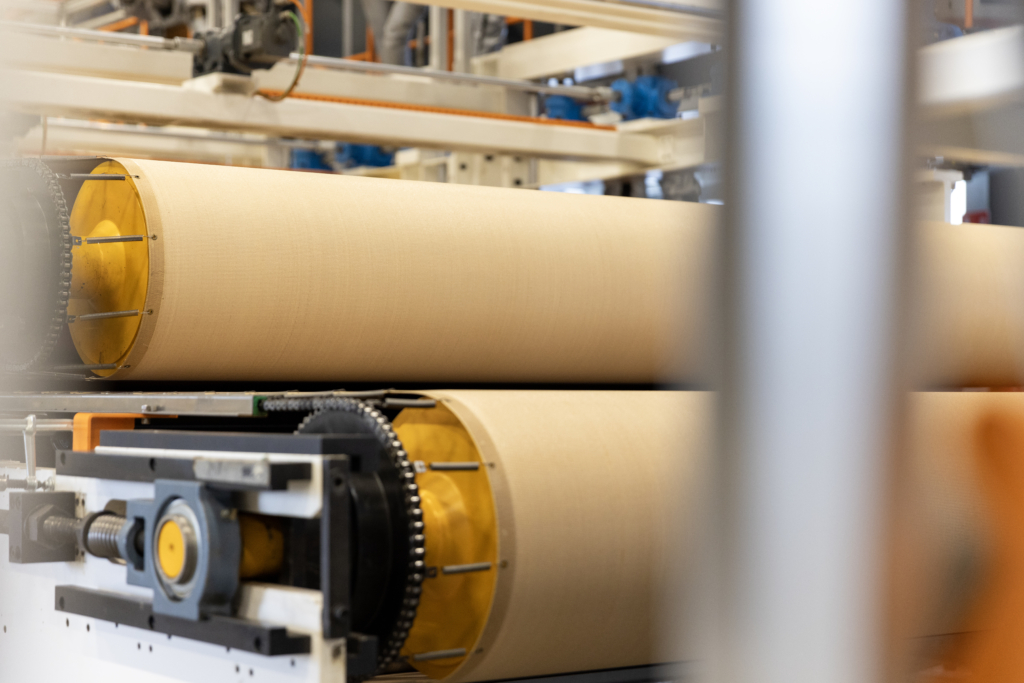
We design and produce fully custom thermoplastic sandwich panels on a 72-metre semi-automatic double belt press production line with annual capacity of 1.5 million square metres. Every panel is made to your specification, not adapted from a standard format. Our production line handles panels up to 13,500 mm x 2,950 mm x 150 mm, which means truck body side walls, trailer floors, and scaffolding boards can often be produced as single panels rather than assembled from smaller sheets.
Here is what working with us on an OEM production contract looks like in practice:
- Specification review before production: We review your panel design against your assembly process and load requirements, and flag any configuration issues before a single panel is produced. This prevents costly corrections mid-run.
- Fixed configuration across repeat orders: Once your specification is locked, we reproduce it identically for every subsequent order. Core material, skin architecture, dimensions, and surface finish are held constant.
- Custom dimensions as standard: Panels are cut to your exact dimensions. You receive production-ready panels, not oversized sheets requiring on-site processing.
- European manufacturing and delivery: All panels are manufactured at our facilities in Beek and Ospel, the Netherlands. Road freight to most European destinations removes the transit uncertainty and customs exposure that comes with non-European sourcing.
- Named technical contact post-contract: You have a direct contact who understands your application and can respond to specification questions, change requests, and technical queries without routing through a generic customer service process.
If you are evaluating composite panels for a truck body, trailer, or scaffolding application and want to understand how a specific configuration would perform in your assembly process, speak with our engineering team directly. We will review your design, confirm the right panel configuration for your load case, and give you a clear picture of what serial production supply looks like before you commit to a contract.
Related Articles
- How do lightweight sandwich panels help manufacturers meet EU emissions targets?
- Why are sandwich panels replacing plywood floors in commercial vehicles?
- How do sandwich panels handle moisture and humidity?
- What are sandwich panels used for?
- How to evaluate panel materials for weight-sensitive applications?