

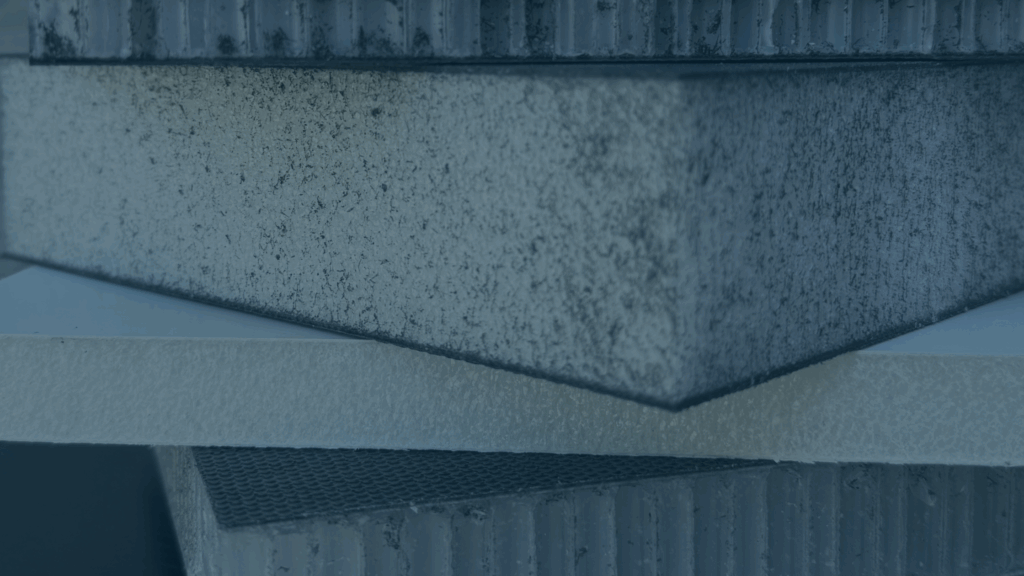
Thermoplastic sandwich panels do not absorb moisture the way GRP sheets do. The polypropylene-based skins and cores used in thermoplastic sandwich construction are inherently non-hygroscopic, meaning water cannot penetrate and weaken the panel structure over time. GRP sheets, by contrast, can allow moisture ingress through the resin matrix, which degrades mechanical performance progressively. The questions below unpack how this difference plays out in real applications.
Do sandwich panels absorb moisture the way GRP sheets do?
No. Thermoplastic sandwich panels built with PP foam or PP honeycomb cores do not absorb moisture in the way GRP sheets do. Polypropylene is a closed-cell, non-polar polymer with negligible water uptake. The glass-fibre-reinforced thermoplastic skins bond directly to the core without an open resin matrix, so there is no pathway for water to migrate into the panel structure.
GRP sheets use a thermoset polyester or epoxy resin to bind glass fibres together. That resin matrix is porous at a microscopic level, and over time water molecules diffuse through it in a process called osmotic absorption. The result is a gradual but measurable increase in panel weight and a reduction in the bond strength between fibres and resin. Thermoplastic panels avoid this mechanism entirely because the matrix is a solid polymer, not a cured liquid resin.
For truck body, trailer, and scaffolding panel applications like truck body walls, trailer floors, or scaffolding boards that are regularly exposed to rain, wash-down water, or condensation, this difference is not just a material science detail. It determines how long the panel holds its rated mechanical performance in service.
What happens to GRP sheets after prolonged water exposure?
After prolonged water exposure, GRP sheets experience a combination of fibre-matrix debonding, surface blistering, and a measurable reduction in bending strength and stiffness. The process is gradual but cumulative, and it accelerates in environments where panels are repeatedly wetted and dried rather than kept at a constant humidity level.
The mechanism works as follows. Water molecules diffuse through the polyester or epoxy resin and collect at the interface between the resin and the glass fibres. This weakens the adhesion that gives the composite its structural properties. Over months and years, micro-cracks form, the laminate begins to delaminate internally, and the surface develops blisters as trapped moisture expands under temperature cycling.
In transport applications, this degradation is compounded by mechanical loading. A trailer floor or vehicle sidewall that flexes under load while also absorbing moisture loses stiffness faster than laboratory ageing tests suggest, because the two stressors interact. By the time visible surface damage appears, the structural properties of the GRP sheet may already be significantly reduced from their original values.
For operators running vehicles over a 10 to 15-year service life, this means GRP body panels often require inspection, repair, or replacement well before the vehicle itself is retired. That replacement cost, including panel procurement, installation labour, and vehicle downtime, is a real and recurring expense that thermoplastic sandwich panels avoid.
How do sandwich panels maintain structural integrity in wet conditions?
Thermoplastic sandwich panels maintain structural integrity in wet conditions because neither the skins nor the core absorbs water in quantities that affect mechanical performance. The glass-fibre-reinforced thermoplastic skins tested against UV ageing per ISO 4892 and alkaline ageing at 50°C for 500 hours retain their rated properties, confirming resistance to the chemically aggressive conditions found in wash-down environments and outdoor exposure.
The structural logic of a sandwich panel also contributes to wet-condition performance. The stiff skins carry bending loads while the core resists shear. Because the core in a thermoplastic panel is either oriented PP foam or PP honeycomb, both of which are closed-cell polypropylene structures, water cannot saturate the core and add dead weight or reduce shear resistance. The panel’s load-carrying geometry stays intact.
Edge protection is a practical factor that matters as much as the material chemistry. Even a moisture-resistant panel can be compromised if the core is exposed at cut edges. Proper edge sealing or edge bending closes off the core from direct water contact, which is relevant for scaffolding boards and truck floors that are regularly washed down. When edge protection is specified correctly, the panel’s wet-condition performance matches its dry-condition performance across its service life.
Which panel type is better for vehicle bodywork in wet climates?
For vehicle bodywork in wet climates, thermoplastic sandwich panels outperform GRP sheets on moisture resistance, long-term structural stability, and total cost of ownership. GRP sheets may offer a lower unit price at the point of purchase, but their susceptibility to moisture-driven degradation creates maintenance and replacement costs that erode that initial saving over a vehicle’s service life.
The weight argument reinforces this conclusion. A thermoplastic sandwich panel delivers a higher stiffness-to-weight ratio than a GRP sheet of equivalent thickness. For truck bodies and trailers, every kilogram saved in body structure is a kilogram that can carry revenue-generating cargo. In 2026, this weight argument extends beyond payload. Lighter body structures extend battery range in electric trucks and vans. Every kilogram of structural dead weight reduces range per charge, making weight reduction a range argument, not just a payload argument. This is a standard procurement question from EV fleet buyers, and thermoplastic panels address it directly.
In wet climates specifically, the maintenance cycle for GRP body panels is shorter. Panels that absorb moisture and delaminate need inspection and replacement more frequently, which means vehicle downtime. Over a 15-year vehicle life, a thermoplastic composite floor or sidewall eliminates two to three replacement cycles compared with GRP or plywood alternatives. Once you factor in panel cost, installation labour, and lost operating days, the thermoplastic panel is cheaper per year of service even at a higher unit price.
Can sandwich panels be used in applications with direct water contact?
Yes. Thermoplastic sandwich panels can be used in applications with direct and repeated water contact, provided the panel specification includes appropriate edge protection and the correct skin finish for the environment. The PP-based core and glass-fibre thermoplastic skins are not degraded by water immersion or repeated wet-dry cycling in the way thermoset composites are.
Scaffolding boards are a practical example. Scaffold planks sit outdoors, are rained on continuously, and are often pressure-washed between uses. An 11 mm thermoplastic sandwich panel with a directionally optimised skin layup handles these conditions while maintaining the load performance required for EN 12811 compliance. The anti-skid surface finish available on floor and scaffolding panels is inherent to the product, not a coating that wears away with repeated washing.
For truck floors and trailer decking, the relevant condition is regular wash-down with water and cleaning agents. The alkaline ageing resistance confirmed in Compoform’s own testing at 50°C for 500 hours covers the chemical exposure typical of commercial vehicle cleaning routines. The panels do not soften, blister, or delaminate under these conditions.
The one area that requires attention in any direct-water-contact application is edge sealing. Where panels are cut to custom dimensions, the cut edges expose the core. Specifying edge bending or sealing at those edges closes the core from direct water ingress and ensures the panel performs as tested across its full service life.
How We Help with Sandwich Panel Performance in Wet Environments
We work with truck body builders, trailer manufacturers, and scaffolding companies to specify the right panel configuration for their operating environment, not just their structural load requirements. For wet-climate applications, that means reviewing edge details, surface finishes, and core density alongside the mechanical specification.
- Panel configuration review: We assess your application, load conditions, and exposure environment to recommend the correct core type, skin architecture, and thickness before production begins.
- Edge protection specification: For panels used in wash-down or outdoor environments, we advise on edge sealing and bending options that protect the core at cut edges and maintain long-term performance.
- Custom dimensions: Panels are available cut to your exact specification, up to 13,500 mm × 2,900 mm, so you are not adapting your design around standard sheet sizes.
- TCO framing for procurement: We help you build the cost-per-year-of-service argument for thermoplastic panels versus GRP or plywood, including replacement cycle savings and downtime reduction, which is the calculation that matters to fleet operators and procurement engineers.
- Integration support: We stay involved after the first delivery, supporting you through assembly integration, any dimensional adjustments, and ongoing production runs.
If you are specifying panels for a vehicle body or scaffolding application where moisture exposure is a factor, bring us in at the design stage. We review your assembly drawings, flag potential issues with edge details or surface finish selection, and confirm the panel configuration before you commit to production. That engineering review is part of how we work, not an add-on service. Contact us to discuss your panel specification.
Related Articles
- Why does material choice affect resale value of commercial vehicles?
- How do biobased sandwich panels compare to conventional sandwich panels?
- What are the acoustic properties of PP honeycomb sandwich panels?
- How do sandwich panel bridge decks compare to steel and concrete?
- What is the lifespan of a sandwich panel in outdoor infrastructure use?