

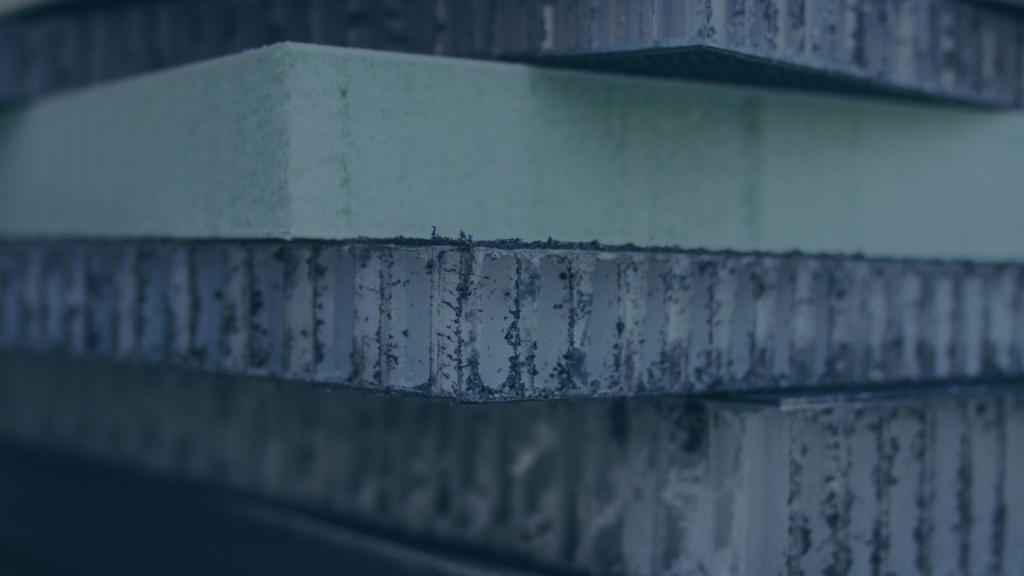
Sandwich panel edges are finished using a combination of edge sealing, edge banding, profiled finishing sections and protective caps; the right method depends on the core material of the panel, the application environment and the way the panel connects to the surrounding structure. For thermoplastic composite panels used in commercial vehicle and scaffold board systems, edge finishing is a functional requirement, not merely an aesthetic one. The sections below address the questions buyers and builders ask most often about edge treatment for sandwich panels.
What types of edge finishes are used on sandwich panels?
Sandwich panel edges are finished using four main methods: sealed edges (filled or coated to close off the core), edge banding (a strip of material bonded along the perimeter), profiled aluminium or thermoplastic sections (mechanical profiles that cover or frame the edge), and folded or bent skin layers (where the outer skin is wrapped around the edge during production). The choice depends on the core type, the exposure conditions and the joining method used during assembly.
With open-cell or porous cores, sealing the edge is the first priority; moisture and contaminants can penetrate the core if the cut face is left unprotected. With honeycomb cores, the open tube geometry at the cut edge creates a direct path for water ingress, which makes edge protection particularly important in environments with intensive cleaning, such as truck bodies or scaffold boards used outdoors.
Edge banding uses a strip of compatible material, often the same thermoplastic as the skin, which is bonded along the perimeter. This creates a clean, closed surface that resists impact and moisture. Profiled finishing sections, typically aluminium or thermoplastic extrusions, serve a dual purpose: they protect the edge and provide a mechanical connection point for attaching panels to frames, floors or adjacent panels. In high-traffic applications such as vehicle floors, corner profiles also absorb impact that would otherwise cause the skin to detach at the edge.
Why does edge sealing matter for composite panel performance?
Edge sealing matters because an unsealed sandwich panel edge is the most vulnerable point in the entire panel system. Moisture entering through a cut edge can degrade the bond between skin and core, reduce structural performance over time and, in freeze-thaw environments, cause progressive internal damage. For panels used in applications involving regular cleaning, outdoor exposure or chemical contact, an unsealed edge is a direct route to premature failure.
In commercial vehicle applications, truck floors and trailer walls are regularly cleaned with high-pressure washers. Any unsealed edge becomes a water entry point that attacks the panel from the inside. After months of use, this weakens the bond between skin and core along the panel perimeter, precisely where fasteners and force transfer points are concentrated.
For scaffold boards, the situation is similar. Boards are stored outdoors, exposed to rain and frost, and handled roughly at the edges. Edge sealing and edge folding protect the core from UV radiation and moisture, a practical requirement for any scaffold panel that must retain its structural rating over multiple seasons of use. A panel that meets the load class requirements of EN 12811 at purchase must continue to perform after repeated exposure cycles, and edge protection is part of how that durability is ensured.
How does edge finishing differ between thermoplastic and thermoset sandwich panels?
Thermoplastic sandwich panel edges can be thermoformed, welded and rejoined through thermal processes; thermoset panels cannot. This means thermoplastic panels support edge finishing methods that are faster, cleaner and more reversible than the adhesive-only or mechanical-fastening methods required for thermoset composites. The thermoplastic core material can also be locally remelted to create a fused, sealed edge without additional sealants.
With thermoset panels, such as those with glass-fibre-reinforced polyester skins, edge finishing relies on adhesive bonds, mechanical caps or applied sealants, because the cured material cannot be reworked with heat. This limits the options and adds process steps. Adhesive bonds at edges can also be a weak point if the adhesive is not compatible with the operating environment.
Thermoplastic skins, by contrast, can be locally heated and folded or pressed to enclose the core edge, during or after production. This creates a monolithic edge without a separately bonded component. For glass-fibre-reinforced polypropylene panels, this approach produces an edge that is mechanically one piece with the skin — no adhesive seam that can fail, no separate material that can detach. This is a significant advantage in applications where edge durability is a factor in service life, not just a cosmetic consideration.
Discuss your project with our team and find out how Compoform can help you with durable sandwich panel solutions.
Which edge profiles and finishing sections are compatible with sandwich panels?
The most common edge profiles compatible with sandwich panels are U-channel profiles, L-angle profiles, T-joint profiles and flat edge banding strips. These are available in aluminium, thermoplastic extrusions and rubber or EPDM for applications where flexibility or vibration damping is required. The profile geometry must match the panel thickness precisely; a loose-fitting profile allows movement at the edge, which accelerates wear.
U-channel and L-angle profiles
U-channel profiles slide over the panel edge and are held in place by adhesive, rivets or mechanical fasteners. They are widely used on trailer walls and cargo area panels where the edge needs protection against contact with forklifts and loading dock impacts. L-angle profiles are used at corners where two panels meet at 90 degrees, providing both edge protection and a neat visual finish. Both profile types are available in standard sizes that match common panel dimensions.
T-joint and coupling profiles
T-joint profiles connect two panels edge to edge in a flat plane, which is common in floor systems and wall cladding where panels are placed side by side. The T-profile bridges the joint, seals both edges at the same time and distributes the load across the joint. In scaffold applications, joint profiles must be compatible with the load class of the panel; the profile must not become the weak point in a system designed to meet the EN 12811 requirements.
Can sandwich panel edges be cut and refinished on site?
Yes, sandwich panels can be cut on site with standard woodworking or composite cutting tools; circular saws, jigsaws and routers all work effectively on thermoplastic composite panels. After cutting, the exposed edge must be resealed or recapped before installation. Leaving a freshly cut edge unprotected in a humid application will shorten the service life of the panel at that location.
For thermoplastic panels, on-site edge finishing typically means applying a compatible edge profile or sealant to the cut face. The cut itself is clean and in most cases requires no grinding or sanding; thermoplastic skins cut without the fraying or delamination that can occur with some thermoset laminates. This makes on-site adjustment practical for builders who need to adapt panel dimensions to non-standard openings or joint details.
That said, cutting on site introduces variability. Factory-cut panels are delivered with finished, dimensionally accurate edges that can be installed straight away. Panels are available in custom sizes, cut to your exact specification, which in most production scenarios removes the need for on-site cutting and keeps edge quality consistent for every panel in a building project.
How does edge finishing affect the total cost of a sandwich panel system?
Edge finishing affects total cost in three ways: initial material and labour costs for the finishing itself, installation time (panels with pre-finished edges are installed faster), and long-term maintenance costs (panels with inadequate edge protection fail sooner and require replacement or repair). In commercial vehicle and scaffold board systems, maintenance and replacement costs typically far exceed the initial finishing costs.
Consider a truck floor that is replaced every three to five years when made of plywood. Over a vehicle lifetime of 15 years, that means two to three replacement cycles, each involving panel costs, installation labour and vehicle downtime. A thermoplastic composite floor with properly sealed edges lasts considerably longer under the same conditions, eliminating those replacement cycles. When you include panel costs, installation labour and downtime over the vehicle’s lifetime, the composite with the right edge finishing is cheaper per year of use, even at a higher unit price.
For scaffold boards, the calculation is similar. A board that fails at the edge after one season because the core has absorbed moisture is not a cost saving; it is a liability. Correct edge finishing is the factor that ensures a panel’s structural performance is maintained throughout its rated service life, which is the basis on which the system’s cost per use is calculated.
In electric truck and van applications, this argument goes further. Lighter body structures extend the battery range of electric trucks and vans; every kilogram of structural dead weight reduces the range per charge. In 2026, this is a standard procurement question for EV fleet buyers: edge finishing that adds unnecessary weight (heavy aluminium caps over large panel surfaces, for example) works against the range argument that makes composite panels attractive in the first place. Choosing lightweight thermoplastic edge profiles instead of heavier metal alternatives is as much a range decision as a cost decision.
How Compoform approaches edge finishing for commercial vehicle and scaffold board systems
We design edge finishing as part of the panel specification, not as an afterthought. For truck floors, trailer walls and scaffold boards, the edge treatment is determined together with the core density, skin build-up and panel dimensions, because the edge is where panels connect to the structure, absorb impact and endure the heaviest environmental exposure.
- Custom panel dimensions: Panels are produced to your exact dimensions on our 72-metre semi-automatic line, with maximum dimensions of up to 13,500 mm × 2,950 mm. Less cutting on site means fewer exposed edges to manage.
- Thermoplastic edge compatibility: Our glass-fibre-reinforced PP skins support heat-based edge finishing methods that thermoset panels cannot accommodate, giving you more options for a clean, durable edge treatment without additional adhesive bond lines.
- Application-specific edge specification: For scaffold boards that must maintain EN 12811 load class performance across outdoor exposure cycles, and for truck floors that are cleaned regularly, we specify edge protection suited to the operating environment, not a generic solution applied to all products.
- Technical review before production: We review your assembly design and flag edge finishing requirements before panels go into production, identifying joint details, profile compatibility and potential moisture exposure points that affect long-term performance.
If you are specifying composite panels for a truck body, trailer or scaffold system and want to discuss edge finishing options alongside the panel build-up, contact our engineering team before finalising your design. We will walk through the full panel specification with you — dimensions, core, skin and edge treatment — so that the solution suits your assembly process from the start.
Related Articles
- How much does aluminium really cost over its lifetime?
- How are sandwich panel manufacturers reducing waste in production?
- What weight savings do sandwich panel scaffold boards offer over timber?
- Can sandwich panels replace steel in structural applications?
- What face sheet materials are used on composite sandwich panels?