

Composite formwork delivers a smoother and more uniform concrete finish than plywood in most cases. The reason is simple: composite panels have a non-porous, dimensionally stable surface layer that does not absorb moisture and does not deform under the pressure of fresh concrete. How large the difference is depends on the specific surface finish of the composite panel and the requirements of the concrete work. The questions below look more closely at the factors that determine concrete finish and what composite does differently from plywood.
What factors determine the smoothness of a concrete surface?
The smoothness of a concrete surface is determined by the flatness and porosity of the formwork surface, the stiffness of the panel under concrete pressure, the way the formwork material reacts to moisture, and the quality of the stripping process. A formwork surface that absorbs moisture, deforms, or deflects imprints those irregularities directly into the concrete.
Specifically, the following factors play a role:
- Surface porosity: A porous material absorbs water from the fresh concrete, which leads to a rough, irregular surface texture in the finished product.
- Dimensional stability: If a panel swells, shrinks, or deflects under load, the concrete surface follows that deformation precisely.
- Stiffness: A panel with insufficient bending stiffness yields under the hydrostatic pressure of fresh concrete, causing waviness or sagging in the surface.
- Release properties: Materials to which concrete adheres damage the surface when the formwork is removed.
- Repeatability: With repeated use, the formwork surface wears. Every use that changes the surface texture has a direct effect on the concrete finish.
For architectural exposed concrete, where the finish is both functionally and aesthetically decisive, all of these factors are relevant at the same time. For standard structural concrete, panel stiffness is usually the most critical variable.
Why does plywood formwork often produce an uneven concrete surface?
Plywood formwork produces an uneven concrete surface because wood naturally absorbs moisture and therefore swells, shrinks, and deforms. Fresh concrete contains a lot of water. That water is drawn into the wood fibres, causing the panel to swell locally and the surface texture of the wood to be imprinted into the concrete. After repeated use, this effect increases.
Plywood also has a visible grain and pore structure. That structure is imprinted into the concrete surface with every use, leaving a texture that requires finishing work when quality requirements are higher. Even with a form oil or release agent, this effect cannot be fully eliminated, because the wood fibre itself determines the structure.
A second problem is the loss of stiffness through moisture absorption. Plywood that has been exposed to water several times gradually loses its bending stiffness. This means that the same panel deflects more on its third or fourth use than on its first, resulting in a wavy concrete surface. In practice, plywood formwork panels are therefore replaced after a limited number of use cycles, which increases total material costs.
How does the surface of composite panels affect the concrete finish?
Composite panels affect the concrete finish positively because their surface layer is non-porous, dimensionally stable, and smooth. Concrete takes on the exact geometry of the formwork surface. A smooth, stiff composite surface produces a smooth concrete surface. Because composite does not absorb moisture, the surface texture does not change between the first and the twentieth use.
The surface finish of a composite panel largely determines the final concrete quality. Panels with a smooth film layer, such as a PET film surface, produce a particularly even imprint. The non-porous nature of thermoplastic composites also means that less release agent is needed and that the concrete adheres less to the panel, which makes stripping easier and limits surface damage.
In addition to the surface layer, the bending stiffness of the composite panel plays a direct role. A stiff sandwich panel with a fibre-reinforced skin and a lightweight core distributes the concrete pressure evenly without sagging locally. This prevents the wavy surfaces that occur with panels that deform under load. The stiffness also remains constant over the service life of the panel, because composite does not degrade through moisture absorption.
Does composite formwork always deliver a better finish than plywood?
Composite formwork does not automatically deliver a better finish than plywood in every situation. Surface quality depends on the specific finish of the composite panel, the application, and the requirements of the concrete work. A composite panel with a rough or textured surface layer produces a different imprint than a panel with a smooth film layer.
For standard structural concrete where surface quality is not a high priority, well-maintained plywood can deliver adequate results. The advantage of composite grows as quality requirements become higher, the number of use cycles increases, or conditions become wetter and more demanding.
Key factors in the comparison are:
- Surface finish of the composite panel: A smooth film layer produces a different imprint than an anti-slip or textured surface. The choice of finish must match the concrete quality requirement.
- Number of use cycles: With repeated use, composite retains its surface quality longer than plywood, which degrades over time.
- Wet conditions: In wet environments, composite consistently outperforms plywood, which deforms when exposed to moisture.
- Concrete specification: For architectural exposed concrete or precast concrete products with tight tolerances, the dimensional stability of composite is a clear advantage.
The conclusion is that composite formwork structurally outperforms plywood in demanding applications, but that the right panel construction and surface finish must be matched to the specific concrete application.
What are the other benefits of composite formwork panels besides surface quality?
Besides better surface quality, composite formwork panels offer a longer service life, lower weight, higher dimensional stability, and lower total costs over the period of use. In many cases these benefits are at least as relevant as the surface finish, especially for companies that use formwork intensively and repeatedly.
The most relevant benefits at a glance:
- Longer service life: Thermoplastic composite panels last considerably longer than plywood in heavy-duty applications. Where plywood panels have to be replaced after a limited number of cycles, composite remains dimensionally stable over a much longer period of use. That eliminates multiple replacement cycles and the associated material and labour costs.
- Lower weight: Composite sandwich panels are significantly lighter than comparable wooden panels. That speeds up the assembly and dismantling of formwork systems and reduces the physical strain on workers on site.
- Moisture resistance: Composite does not absorb water, does not rot, and does not delaminate. That makes the panels suitable for use in wet conditions, outdoor storage, and intensive cleaning cycles without loss of quality.
- Dimensional stability: The dimensions of a composite panel do not change with temperature fluctuations or moisture exposure. That is relevant for precast concrete products where dimensional accuracy is a requirement.
- Lower total costs: The higher purchase price of composite is offset over the period of use by fewer replacements, lower maintenance costs, and more efficient handling. Over a period of several years, composite is generally cheaper per use cycle than plywood in intensive applications.
How does Compoform help with composite formwork solutions?
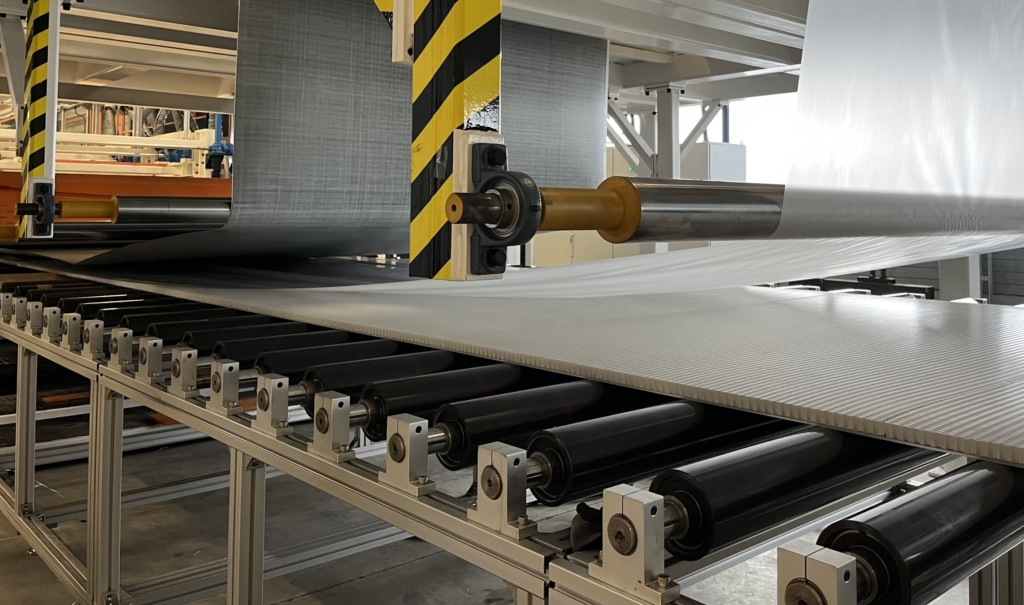
We develop and produce thermoplastic sandwich panels that can be used as an alternative to plywood and other conventional formwork materials. Our panels combine a fibre-reinforced skin with a lightweight core of PP honeycomb or PET foam, resulting in a stiff, lightweight, and durable panel that retains its properties over many use cycles.
What we offer for formwork applications:
- Custom panels, up to maximum dimensions of 13,500 mm x 2,900 mm, tailored to your formwork system
- A choice of surface finishes that match your concrete quality requirements
- Technical support in selecting the panel construction, core material, and skin architecture for your specific application
- Development of prototypes and test panels for evaluation in your production process
- Production in the Netherlands, with a capacity of 1.5 million square metres per year
We approach every project as a technical partnership. That means we review your design and assembly process, optimise the panel construction for your specific situation, and flag potential bottlenecks before production starts. Get in touch via our contact page to discuss which composite solution suits your formwork application, or take a look at our applications for more context on what we produce.
Related Articles
- What maintenance practices improve formwork durability?
- Can composite formwork withstand outdoor storage?
- Why does material choice affect resale value of commercial vehicles?
- What is the procurement process for sandwich panels in high-volume manufacturing?
- What sandwich panels are used in swap body and container construction?