

Improving the lifespan of formwork panels starts with consistent maintenance after every use. Panels that are cleaned, inspected, and stored correctly after each concrete pour last considerably longer than panels that are treated ad hoc. This applies to both plywood and composite formwork. The questions below cover the most relevant maintenance practices step by step.
What factors determine how long formwork lasts?
The lifespan of formwork panels is determined by four interrelated factors: the choice of material, the quality of maintenance, the way the panels are stored, and the intensity of use. Panels that are cleaned regularly, protected with a release agent, and stored dry last several times longer than panels that are neglected.
Material plays a major role. Plywood absorbs moisture, swells, and delaminates with repeated use in wet conditions. Composite panels based on glass-fibre-reinforced thermoplastic absorb less than 1.5% moisture (in accordance with ISO 62), which means they remain structurally more stable over multiple use cycles.
Besides material, mechanical load also matters. Panels that are exposed to impact loads, careless transport, or overloading during pouring lose their structural integrity faster. A well-designed formwork panel takes the expected load scenarios into account, including the concrete pressure and the way the panel is fixed and released.
Finally, the surface finish also influences how long a panel lasts. Panels with a closed, smooth surface are easier to clean and less concrete adheres to them, which limits wear during stripping.
How do you clean formwork panels after each use?
Clean formwork panels immediately after stripping the formwork, before concrete residue hardens. Use a pressure washer or a stiff brush with water. Avoid aggressive solvents that can damage the surface finish. Remove all concrete residue completely, including along the edges and in connection points.
Concrete residue that hardens on the panel is harder to remove and can damage the concrete surface during the next use. It also increases the likelihood of adhesion, which means more force is needed during stripping. This increases the mechanical load on the panel itself.
After cleaning, it is advisable to visually inspect the panel while it is still wet. Damage such as cracks, delamination, or damaged edges is more visible then. Let panels dry completely before storing them to prevent moisture build-up.
Which release agents extend the lifespan of formwork?
The right release agent reduces the adhesion between concrete and panel, protects the surface, and makes stripping easier. Choose a release agent that is compatible with the panel material. For composite panels with a closed thermoplastic surface, a thin, even layer that is oil-based or water-based is often sufficient.
Apply the release agent in a thin, even layer before every concrete pour. Too much release agent can affect the concrete surface and leads to waste. Too little increases adhesion and raises the risk of surface damage during stripping.
Avoid release agents that contain silicones if the concrete surface will later be painted or bonded. Silicones can negatively affect the adhesion of finishing layers. Consult the technical specifications of both the panel and the release agent to be sure of compatibility.
How do you inspect and repair damaged formwork panels?
Inspect formwork panels systematically after every cleaning on four points: surface damage, edge integrity, structural deformation, and connection points. Panels with visible cracks, detached layers, or severe deformation must not be reused without repair or replacement.
What to check during inspection
- Surface: check for scratches, pitting, or damaged finish that can affect concrete quality
- Edges: check for damage, gaps, or detached edge sealing
- Structure: check for deflection or permanent deformation that affects dimensional accuracy
- Connections: check drill holes, clamps, and fixing points for wear or damage
When to repair and when to replace
Minor surface damage to composite panels can in many cases be repaired with a compatible repair compound or sealant. Edge damage on thermoplastic panels can sometimes be repaired by reapplying the edge sealing. Structural damage, such as delamination of the skin from the core, is a reason for replacement. A damaged panel that stays in use can lead to dimensional deviations in the concrete work and an increased risk of failure during pouring.
What is the best way to store formwork panels?
Store formwork panels horizontally or vertically on a flat, stable surface, out of direct sunlight and protected from rain. Ensure sufficient support along the full length to prevent deflection. Do not stack panels too high, to avoid point loads on the lower panels.
Damp storage is one of the most common causes of premature wear in plywood formwork. Composite panels are less sensitive to moisture, but here too dry storage extends the lifespan and reduces the risk of surface damage from freezing or condensation.
Protect panels against impact damage during transport and storage. Use corner protectors or spacers when stacking. Preferably keep panels in a covered space or under a tarpaulin if outdoor storage is unavoidable.
When is composite formwork more cost-effective than plywood in the long term?
Composite formwork becomes more cost-effective than plywood once the higher purchase price is recouped through a longer service life and lower replacement costs. Plywood formwork lasts on average 20 to 50 pours, depending on use and maintenance. Well-maintained composite panels achieve considerably more use cycles, which greatly reduces the number of replacement moments over the project period.
The calculation becomes more concrete when you look at the total costs over the lifetime of a project. Suppose a composite panel lasts three times as long as plywood: you then eliminate two replacement cycles, including the associated material costs, labour for replacement, and downtime. With intensive use or large projects, this adds up quickly.
Composite panels are also lighter than plywood of comparable thickness, which lowers handling costs and reduces the physical strain on workers. On projects where panels are moved frequently, that is a relevant operational advantage in addition to material durability.
Composite formwork is most advantageous in applications with high usage frequency, aggressive conditions such as high humidity or alkaline contact, and projects where dimensional accuracy across multiple pours is important. For single-use applications or very low volumes, the higher purchase price takes longer to recoup.
How we help with durable formwork panels
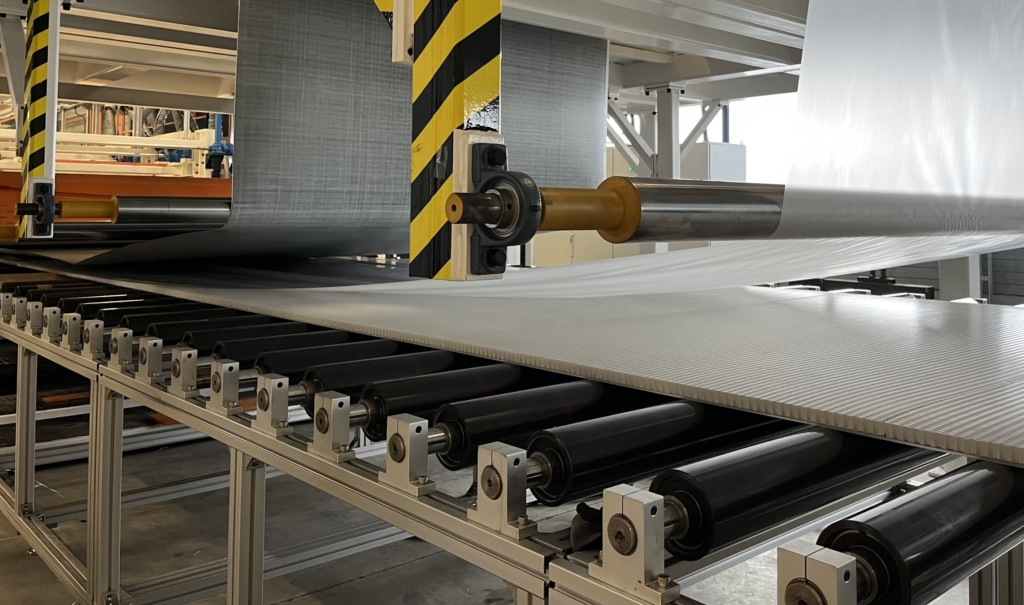
We develop and produce composite sandwich panels specifically tailored to the requirements of formwork applications. Our panels are built from glass-fibre-reinforced thermoplastic skins on a PP core, resulting in a closed, smooth surface that is easy to clean, to which little concrete adheres, and that is resistant to alkaline contact. Compoform panels are tested for heat resistance (2,000 hours at 80°C), UV resistance (in accordance with ISO 4892-2), and alkaline exposure (500 hours in lime milk at 50°C), which matches the conditions in concrete formwork.
What we concretely offer for formwork applications:
- Custom dimensions up to 13,500 mm × 2,950 mm, cut to size for your formwork system
- Choice of core material and thickness matched to the required load capacity and weight requirement
- Closed surface finish that simplifies cleaning and extends service life
- Technical support in assessing your design and optimising the panel configuration for your production process
We approach every project as a technical partnership. That means we review your design, tailor the panel configuration to your assembly process, and flag potential bottlenecks before production starts. Contact us to discuss which composite panel solution suits your formwork application.