

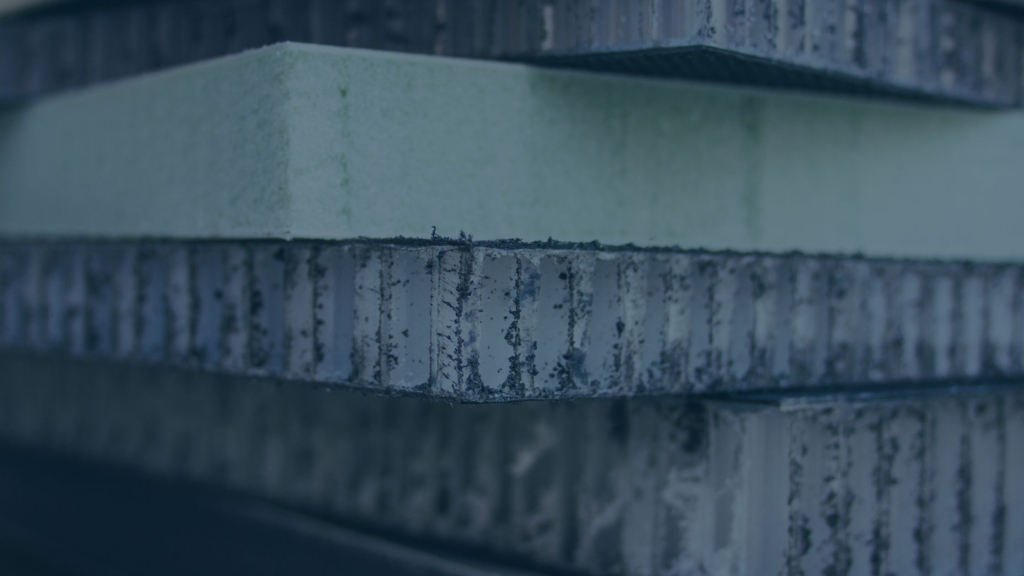
Thermoplastic sandwich panels are highly water-resistant and, in practical terms, perform as waterproof in most commercial applications. The glass-fibre-reinforced thermoplastic skins and polypropylene cores used in these panels do not absorb moisture, rot, or corrode, making them a fundamentally different material from plywood or steel in wet environments. The sections below unpack what drives that performance, where risks still exist, and how to seal panels correctly for long-term durability.
What makes a sandwich panel water-resistant or waterproof?
A sandwich panel is water-resistant when its skins and core materials are inherently non-absorbent and when the bond between them remains intact under moisture exposure. In thermoplastic composite panels, both the glass-fibre-reinforced skins and the polypropylene core are hydrophobic by nature, water cannot penetrate the material matrix itself, so the panel does not swell, delaminate from within, or lose structural strength when wet.
The surface finish plays a significant role here. A white PET-film surface, for example, creates a smooth, sealed outer layer that sheds water rather than allowing it to sit and work into the panel. This is different from a painted or coated surface that can chip or peel, the PET film is laminated directly into the panel structure during manufacturing, so it does not separate under repeated wet-dry cycling.
The core material is equally important. Polypropylene foam and PP honeycomb are both closed-cell or sealed-cell structures. They do not wick moisture through capillary action the way open-cell foams or natural materials like balsa or plywood do. This means that even if water reaches the core through a damaged edge or unsealed cut, it does not travel through the panel or cause progressive internal degradation.
Which sandwich panel materials perform best in wet conditions?
Glass-fibre-reinforced thermoplastic skins bonded to PP honeycomb or PP foam cores deliver the strongest combination of water resistance and structural performance in wet environments. The thermoplastic matrix is chemically inert to water, and the glass fibre reinforcement does not corrode or degrade on contact with moisture, unlike steel-faced panels, which rust, or wood-based panels, which absorb water and swell.
When comparing core materials specifically for wet-environment performance:
- PP honeycomb cores offer high strength-to-weight ratios and are fully resistant to moisture. The tubular cell structure means there is minimal material volume for water to contact, and polypropylene itself has very low water absorption.
- PP foam cores in oriented, closed-cell configurations resist moisture absorption effectively. The foam density can be specified across a wide range, and higher-density grades provide additional resistance to surface compression in wet loading conditions.
- PET-film surface finishes add a further barrier layer. Wall panels with a white PET-film finish have demonstrated UV resistance exceeding 22,000 hours in testing conducted to ISO 4892, a result that reflects both colour stability and surface integrity under prolonged environmental exposure.
Steel-faced or aluminium-faced sandwich panels resist surface water but are vulnerable at joints, fastener points, and cut edges where the metal can corrode. Thermoplastic composite panels do not share this vulnerability, the material is consistent through the skin thickness, so a cut edge exposes the same inert material as the surface.
Where do sandwich panels fail against water — and why?
The most common point of water ingress in any sandwich panel is the cut edge. When a panel is trimmed to size, the core is exposed along the cut line. In thermoplastic composite panels, the core itself resists moisture, but an unsealed edge still creates a pathway for water to enter the panel structure over time, particularly in commercial vehicle and trailer panel applications where panels are regularly washed down, exposed to standing water, or subject to pressure washing.
A second failure point is the fastener location. Drilling or screwing through a panel without appropriate sealing allows water to track along the fastener into the core. In high-vibration environments like truck bodies or trailers, fastener holes can also enlarge slightly over time, increasing the gap through which moisture enters.
A third risk is delamination caused by poor original bonding rather than water itself, but once a delamination void exists, water can enter and accelerate the separation. This is a manufacturing quality issue rather than a material limitation, and it underlines why panel quality and consistent production standards matter in wet-environment applications.
It is worth noting that thermoplastic composite panels are significantly more tolerant of these failure modes than plywood. Plywood absorbs water aggressively through any exposed edge or fastener hole, swells, and begins to delaminate within a relatively short service period. A composite panel with an unsealed edge will not perform ideally, but the degradation is far slower and more contained.
Are sandwich panels suitable for outdoor and vehicle applications?
Yes. Thermoplastic sandwich panels are well-suited to outdoor and vehicle applications, provided the panel specification matches the environmental demands of the application. Truck bodies, trailers, cargo boxes, and scaffolding boards all represent environments where panels face rain, pressure washing, temperature cycling, and UV exposure, and thermoplastic composite panels are engineered to handle all of these conditions.
UV resistance is a specific concern for outdoor applications. PET-film-surfaced panels have demonstrated over 22,000 hours of UV resistance in testing to ISO 4892, which corresponds to many years of outdoor service without significant colour shift or surface degradation. This makes them appropriate for wall cladding on vehicle bodies and exterior-facing panels in scaffolding systems.
For vehicle floors specifically, the combination of moisture resistance and structural load capacity is what makes composite panels a practical replacement for plywood. A 30 mm PP sandwich panel floor is self-supporting, it requires no aluminium subframe beneath it, which removes a production step and reduces the total weight of the vehicle body. In electric trucks and vans, that weight reduction carries additional value: every kilogram of structural dead weight reduces battery range per charge. In 2026, this is a standard procurement consideration for EV fleet buyers, not a secondary benefit.
Scaffolding boards face a particularly demanding combination of wet conditions and structural load requirements. A composite scaffold board must maintain its load capacity when wet, resist surface degradation from repeated use, and not become dangerously slippery. Anti-skid surface finishes address the traction requirement, while the thermoplastic core and skins address moisture performance.
How should sandwich panels be sealed to prevent water ingress?
Sealing a sandwich panel against water ingress focuses on three areas: cut edges, fastener points, and panel-to-panel joints. Addressing all three is necessary for panels used in applications with regular water exposure.
Cut edges should be sealed with a compatible edge sealant or, where the design allows, protected with an edge profile or edge banding. For thermoplastic composite panels, edge bending is an option that folds the skin material over the cut edge, enclosing the core without requiring a separate sealant. This is a more durable solution than applied sealants in high-wear environments like truck floors that are washed down regularly.
Fastener points should use sealing washers or be filled with a compatible sealant after installation. In structural applications where fastener integrity matters, through-bolting with sealed bushings is preferable to self-tapping screws, which can work loose under vibration and enlarge the hole over time.
Panel joints in wall cladding or vehicle body applications should be covered with a capping strip or sealed with a flexible sealant that accommodates thermal movement. Thermoplastic panels expand and contract with temperature, so a rigid sealant applied across a joint will crack under cycling, a flexible polyurethane or silicone-based sealant is appropriate.
Thermoplastic panels last significantly longer than plywood in heavy transport environments, industry experience from vehicle body builders points to 12 or more years of service life versus 3 to 5 years for plywood floors. Over a 15-year vehicle life, that eliminates two or three replacement cycles. When you factor in panel cost, installation labour, and vehicle downtime for each replacement, the composite floor is cheaper per year of service even at a higher unit price. Correct sealing at installation is what protects that lifespan advantage.
How Compoform Helps with Waterproof Sandwich Panel Specification
We manufacture thermoplastic sandwich panels with PP honeycomb and PP foam cores for commercial vehicle bodies, trailer floors, and scaffolding applications. Every panel we produce uses glass-fibre-reinforced thermoplastic skins that are inherently moisture-resistant, no coatings, no treatments that wear off over time.
When you bring us a project, we review the specific moisture exposure your application involves and configure the panel accordingly:
- Surface finish selection — PET-film for wall panels and exterior cladding; anti-skid black finish for floors and scaffold boards where traction under wet conditions matters
- Core specification — PP honeycomb for high-load floor applications; PP foam in densities from 40 to 140 kg/m³ for wall and cladding applications where weight and stiffness need to be balanced
- Edge treatment guidance — we advise on edge sealing and edge bending options that suit your assembly process and the wash-down or weather exposure your panels will face in service
- Custom dimensions — panels are available cut to your exact specification, up to 13,500 mm × 2,950 mm, so you are not working around standard sheet sizes when designing joints and edges
We also flag integration issues before production starts. If your design creates an edge condition that is difficult to seal reliably, or a fastener pattern that puts water ingress risk in a structurally sensitive area, we raise that in the design review, not after the first batch has been installed.
See how these properties translate in scaffolding board applications or speak with our engineering team about your specific vehicle body or trailer floor requirements.