

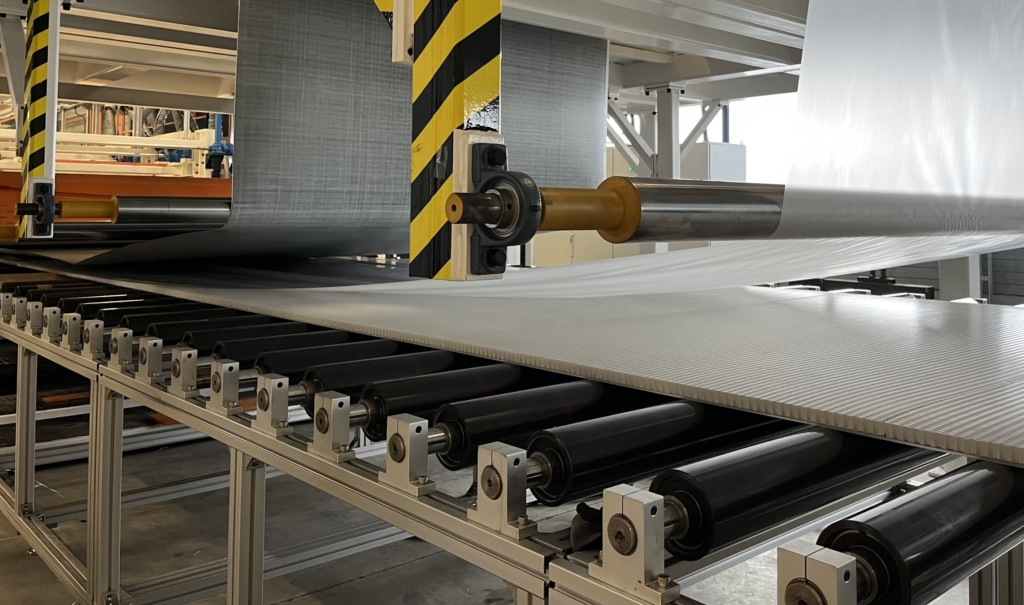
Composite panels maintain their structural performance well through repeated concrete pours, provided the panels are designed for that application. Unlike plywood, thermoplastic sandwich panels do not absorb moisture, do not deform under concrete pressure, and retain their dimensional accuracy over multiple use cycles. The questions below take a closer look at exactly what happens to the panel with each pour.
How many concrete pours can a composite panel withstand?
A well-designed composite formwork panel can withstand considerably more pour cycles than traditional plywood. Whereas plywood in practice already shows visible degradation after five to ten pours due to moisture absorption and delamination, thermoplastic sandwich panels can, depending on the configuration and loading conditions, last dozens of cycles without loss of structural function.
The exact number of cycles depends on several factors: the skin materials used, the core construction, the concrete pressure per pour, the cleaning method, and the mechanical load during assembly and disassembly. Panels with glass-fibre-reinforced thermoplastic skins are particularly resistant to repeated mechanical loading. The cross-ply laminate construction, in which fibres are oriented in multiple directions, distributes forces evenly across the panel and prevents localised failure.
For formwork manufacturers this is a relevant distinction: one life cycle of a composite panel in practice replaces several plywood replacement cycles, which lowers the total material cost over time.
How does concrete pressure affect the structural integrity of composite panels?
Concrete pressure loads a formwork panel in bending and compression. Thermoplastic sandwich panels resist this load through the interaction between the stiff skins and the core: the skins absorb the tensile and compressive forces, while the core transfers the shear forces and keeps the skins at a distance from each other. This sandwich principle delivers high bending stiffness at low weight.
With repeated pours, the behaviour of the core material is decisive. A PP honeycomb core or a PP foam core of sufficient density retains its compressive stiffness even after multiple loading cycles. Moisture absorption, a common problem with plywood, plays no role with thermoplastic cores: the material is inherently non-hygroscopic. As a result, there is no progressive weakening caused by moisture fluctuations between pours.
It is important, however, that the panels are supported correctly and that the pouring rate and concrete height remain within the design limits. Overloading through pouring too quickly or inadequate propping affects any formwork material, composite or not.
What happens to the panel surface after multiple pours?
The surface of a composite formwork panel wears gradually with repeated use, but the wear progresses differently from plywood. Thermoplastic skins do not delaminate, do not flake, and do not absorb cement water. The concrete surface the panel produces therefore remains consistent in quality for longer.
After multiple pours, slight scratches or mechanical damage may occur from the placement of reinforcing steel, the use of chipboard screws, or the stripping of the formwork. This surface damage generally does not affect the structural performance of the panel, but it can affect the concrete finish if the damage is deep enough to disrupt the concrete contact surface.
A smooth or lightly textured thermoplastic skin surface releases concrete more easily than rough plywood, particularly after the first pour. This reduces the amount of release oil required and lowers the risk of damage during stripping. Cleaning is straightforward with water and a brush, with no risk of moisture damage to the panel itself.
Does repeated use affect the dimensional accuracy of composite panels?
Thermoplastic sandwich panels retain their dimensions considerably better than plywood under repeated use. Plywood shrinks and swells due to moisture fluctuations, leading to dimensional deviations that undermine the fit accuracy of the formwork system. Composite panels are non-hygroscopic and show no significant dimensional change due to moisture or temperature fluctuations within normal construction conditions.
This is a practical advantage for formwork manufacturers and contractors: panels that retain their dimensional accuracy fit consistently in the formwork system without having to be readjusted or corrected with every pour. That reduces assembly time and lowers the risk of leakage along the joints.
Thermal expansion does play a role with large temperature differences, but the expansion coefficient of thermoplastic composites is manageable and predictable. This can be taken into account when designing the formwork system, so that dimensional accuracy is also assured under changing weather conditions.
When does a composite formwork panel need to be replaced?
A composite formwork panel needs to be replaced when it shows structural damage that jeopardises safety or concrete quality. Think of visible delamination of the skin, deep cuts that expose the core, or localised deformation that does not recover after unloading. Surface wear alone is generally not a reason for replacement.
In practice, there are three signs to watch for:
- Structural deformation: a panel that does not return to its original flatness after unloading has been mechanically compromised and must be replaced.
- Exposed core: if the skin has been punctured by mechanical damage and the core is visible, moisture or cement can penetrate and degrade the core.
- Loss of stiffness: a panel that deflects noticeably more than in earlier pours under comparable load has lost load-bearing capacity.
Visual inspection after every pour is the most effective way to assess panels in good time. Composite panels generally show damage clearly, which makes inspection easier than with plywood, where internal moisture damage is not always visible from the outside.
How we help you choose reusable composite formwork
We develop and produce thermoplastic sandwich panels for formwork manufacturers and precast concrete producers looking for a durable alternative to plywood. Our panels are produced entirely in the Netherlands and are available in custom dimensions and configurations, tailored to your specific formwork application.
What we can do for you:
- Tailor the panel construction to your concrete pressure, pouring rate, and desired number of use cycles
- Select skin materials and core type based on your technical requirements and assembly procedure
- Supply prototypes and test panels so you can validate performance before moving to series production
- Help think through integration into your existing formwork system, without you having to modify your system
We approach every project as a technical partnership: we review your design, optimise the panel construction for your production process, and flag bottlenecks before production starts. Get in touch via our contact page to discuss your formwork application with us, or take a look at our applications for more context on what composite panels can mean in practice.