

Plywood warps and rots in wet conditions because wood is a hygroscopic material: it absorbs and releases moisture continuously. When water penetrates the glue lines between plywood veneers, the individual layers swell and shrink at different rates, creating internal stress that causes warping. Prolonged moisture exposure breaks down the adhesive bond and feeds fungal growth, which is what rot actually is. These problems are structural, not cosmetic, and they accelerate significantly in transport and outdoor applications where panels face repeated wetting and drying cycles.
What actually happens to plywood when it gets wet?
When plywood gets wet, water penetrates the wood fibres and causes each veneer layer to swell. Because the grain direction alternates between layers in cross-ply construction, adjacent veneers resist each other’s movement. This internal tension is what causes warping. If the moisture reaches the glue lines, the adhesive weakens, and the layers begin to separate: a process called delamination.
The sequence typically follows a predictable pattern. Surface moisture is absorbed within hours. If the panel dries quickly and evenly, visible damage may be limited. But repeated wet-dry cycles cause cumulative stress. Each cycle stretches and compresses the fibres slightly differently, and over time the panel loses its flat geometry permanently.
Edge exposure is particularly damaging. Plywood edges are end-grain, which absorbs water far faster than the face. In trailer floors, truck bodies, and scaffold boards, the edges are often the first point of failure, especially where panels are cut to fit and the raw edge is left unsealed.
Why does plywood rot faster than solid wood?
Plywood rots faster than solid wood primarily because of its glue lines and layered construction. The adhesive bonds between veneers create micro-gaps where moisture collects and cannot easily escape. These trapped pockets of moisture create ideal conditions for fungal growth, the biological process that causes rot, even when the surface of the panel appears dry.
Rot is caused by wood-decay fungi, which digest the cellulose and lignin that give wood its structural strength. These fungi need moisture, oxygen, and a food source, and plywood provides all three. Once fungal activity begins inside a panel, it spreads through the veneer layers without being visible on the surface. By the time rot is detectable from the outside, the structural integrity of the panel is already compromised.
Solid wood, by contrast, has no glue lines and fewer internal voids. Moisture still causes problems in solid timber, but the decay pathway is slower and more visible. In plywood, the internal structure accelerates the process while hiding it.
Which types of plywood are most resistant to moisture?
Marine-grade plywood and exterior-grade plywood offer the best moisture resistance among wood-based panel products. Marine plywood uses waterproof phenolic resin adhesive and selects veneers with minimal voids, which reduces the internal gaps where moisture accumulates. Exterior-grade plywood uses similar adhesives but with less strict veneer selection.
The key distinction between plywood grades is the adhesive specification:
- Interior grade (Type 1): Uses urea-formaldehyde adhesive. Not suitable for wet environments.
- Exterior grade (Type 2): Uses melamine or phenolic adhesive. Handles intermittent moisture but not prolonged immersion.
- Marine grade: Full phenolic resin throughout, void-free veneers. Best performance in wet conditions, but still subject to rot over time.
- Treated plywood: Pressure-impregnated with preservatives to resist fungal attack. Common in scaffold boards and ground-contact applications.
Even marine-grade plywood is not immune to rot. Given sufficient time and moisture, fungal decay will establish itself in any wood-based panel. The grade determines how long that process takes, not whether it happens.
Can warped or rotted plywood be repaired?
Warped plywood can sometimes be flattened if the distortion is minor and the adhesive bonds remain intact. Rotted plywood cannot be meaningfully repaired: once fungal decay has broken down the wood fibres, the structural loss is permanent. Epoxy consolidants can stabilise surface rot for cosmetic purposes, but they do not restore load-bearing capacity.
For warping without rot, controlled re-wetting and clamping can partially restore flatness, but the panel will remain vulnerable to re-warping under the same conditions. In structural applications, trailer floors, vehicle body panels, scaffold boards, a warped panel is a replacement job, not a repair job. The geometry change affects how loads transfer across the panel, creating stress concentrations that accelerate further failure.
In practice, repair attempts on plywood in transport or industrial applications rarely make economic sense. The labour cost of repair often approaches or exceeds the cost of replacement, and a repaired panel does not return to its original structural specification.
What are the structural consequences of plywood rot in vehicles and panels?
Rot in vehicle floors and body panels reduces the panel’s ability to carry load, resist deflection, and distribute stress. In a trailer floor, for example, rot softens the panel locally, creating a weak zone that deflects under forklift loads or point loads from cargo. This deflection transfers stress to fasteners and surrounding structure, accelerating failure across a wider area.
The structural consequences compound over time:
- Reduced load capacity: Rotted fibres carry less stress, so the effective load rating of the floor drops below its design specification.
- Fastener pull-through: As the panel softens, screws and bolts lose their grip. In vehicle bodies, this means wall panels, lashing rails, and floor fittings become unreliable.
- Delamination under vibration: Road vibration accelerates separation of weakened glue lines, causing the panel to fail in layers rather than as a unit.
- Hidden failure: Rot progresses internally before it is visible. A panel can appear serviceable while carrying significantly less than its rated load.
In scaffolding, the consequences are more immediate. A rotted scaffold board that fails under load is a safety event, not just a maintenance issue. European scaffold standards under EN 12811 set load class requirements precisely because board failure in service is a foreseeable risk with degraded materials.
For fleet operators and truck body builders, the operational cost of plywood rot extends beyond panel replacement. Downtime for floor replacement, labour for removal and refitting of internal fittings, and the risk of cargo damage or vehicle inspection failures all contribute to a total cost that is rarely captured in the initial panel price.
What materials replace plywood in wet or high-load environments?
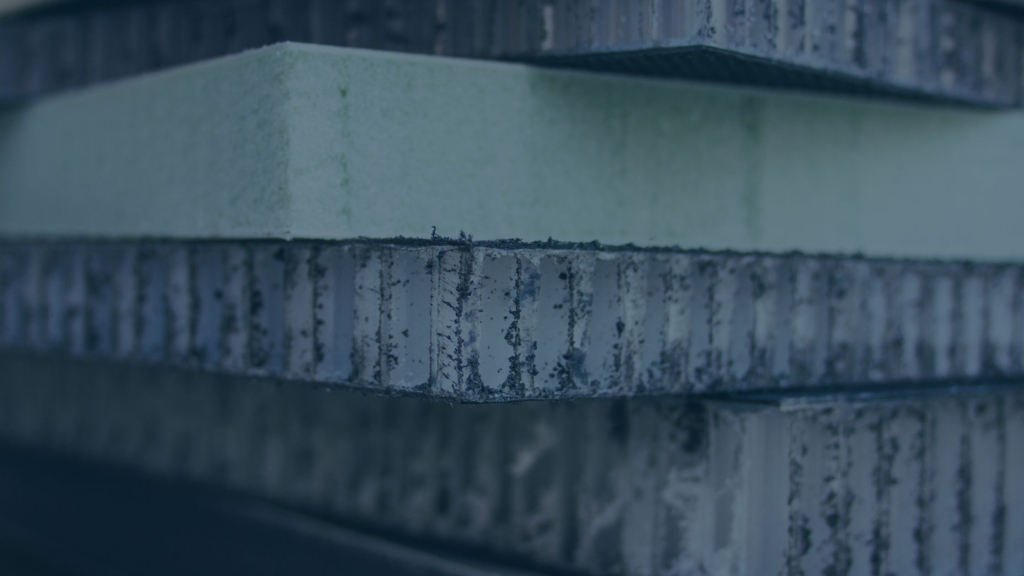
Thermoplastic composite sandwich panels are the most widely adopted structural replacement for plywood in transport and industrial panel applications. These panels combine fibre-reinforced thermoplastic skins with a lightweight core, typically PP honeycomb or PET foam, to deliver structural performance without any of the moisture-related failure modes that affect wood. They do not absorb water, they do not rot, and they do not warp under repeated wet-dry cycling.
The performance difference in wet environments is fundamental, not incremental. Where plywood degrades continuously from first exposure, a thermoplastic sandwich panel maintains its geometry and load capacity regardless of moisture. This makes composite panels particularly well suited to trailer floors, truck body panels, and scaffold boards, all environments where panels face regular washing, rain exposure, and condensation.
From a weight perspective, composite sandwich panels are significantly lighter than equivalent-thickness plywood. In commercial vehicles, that weight reduction translates directly into payload capacity, and in 2026, it also translates into battery range for electric trucks and vans. Lighter body structures extend range per charge, which is a standard procurement consideration for EV fleet buyers. Every kilogram of structural dead weight reduces range, making weight reduction a range argument as much as a payload argument.
Other materials used in wet or high-load environments include:
- High-density polyethylene (HDPE) boards: Fully waterproof but heavy and with limited structural stiffness compared to sandwich panels.
- Steel and aluminium: High strength but add significant dead weight and are subject to corrosion without surface treatment.
- Fibre cement boards: Moisture-resistant but brittle, heavy, and difficult to cut and fit on-site.
For structural flooring and decking in transport applications, thermoplastic composite sandwich panels offer the most practical combination of low weight, moisture immunity, and long service life. In heavy transport, composite floors typically last significantly longer than plywood, eliminating multiple replacement cycles over a vehicle’s working life and reducing total cost of ownership accordingly.
How Compoform Addresses Plywood Rot and Moisture Failure
We manufacture thermoplastic sandwich panels specifically for the applications where plywood rot causes the most operational and financial damage: trailer floors, truck body panels, and scaffold boards. Our panels use PP honeycomb or PET foam cores with glass-fibre-reinforced thermoplastic skins, materials that are inherently impervious to moisture, fungal decay, and the wet-dry cycling that destroys plywood over time.
Here is what that means in practice for your application:
- No rot, no warping: Thermoplastic skins and polymer cores do not absorb water. The panel geometry and load capacity remain stable across the service life.
- Longer service life: In heavy transport, our composite panels last significantly longer than plywood, eliminating two to three replacement cycles over a vehicle’s working life. Once you account for panel cost, installation labour, and vehicle downtime, the composite floor is cheaper per year of service even at a higher unit price.
- Drop-in replacement: No redesign or hardware changes are required. Any system built to accept plywood panels accepts our composite panels without modification.
- Edge protection built in: We apply edge sealing and edge bending to protect the core from moisture ingress, relevant for floors washed down regularly and scaffold boards exposed to outdoor conditions.
- Scaffold load compliance: Our 10.5mm scaffold panel achieves EN 12811 load class 4 with no support underneath, a tested result, not a general claim.
- Self-supporting floor panels: A 30mm PP honeycomb sandwich floor panel is self-supporting, removing the need for an aluminium subframe. This eliminates a production step and reduces cost for truck body builders.
- Weight reduction for EV fleets: Lighter composite floors reduce structural dead weight, extending battery range in electric trucks, a specification requirement that EV fleet buyers are raising directly with body builders in 2026.
We work with truck body builders, trailer manufacturers, and scaffolding companies across Europe to review their current panel configuration, identify where plywood is creating maintenance and cost problems, and specify the right composite panel for their load requirements and assembly process. That review happens before production, so issues are resolved at the design stage, not after panels are fitted.
If you are replacing plywood in a trailer floor, truck body, or scaffold board application, speak with our engineering team about the right panel specification for your load class and operating environment.