

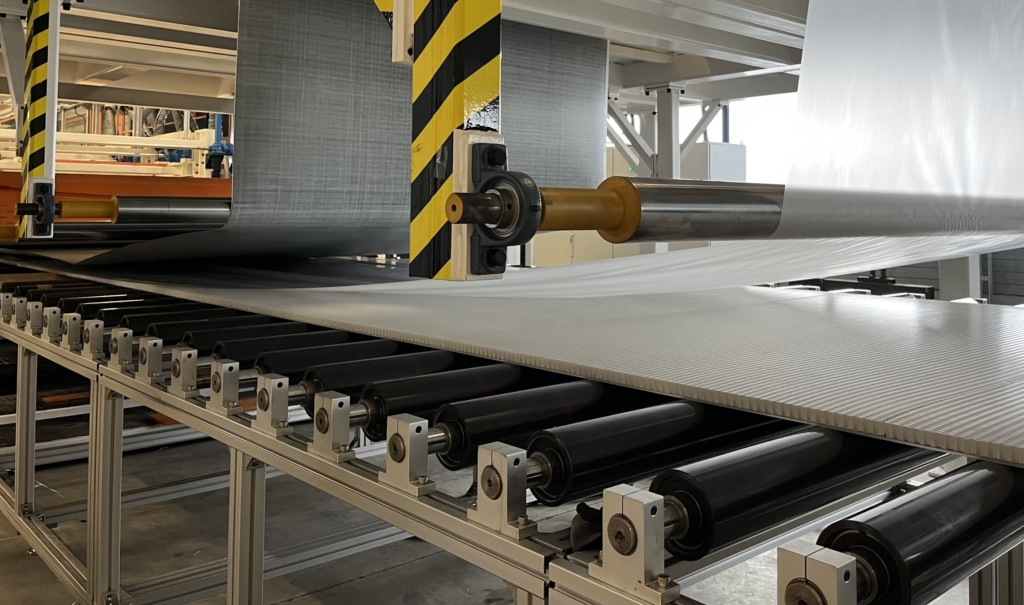
Damaged composite formwork panels can in many cases be repaired, but whether repair makes sense depends on the type and severity of the damage. Surface damage is usually easy to restore, while structural damage to the core or the fibre-reinforced skin more often justifies replacement. The questions below help you assess when repair is possible, how to go about it, and when replacing is the better choice.
What types of damage are most common in composite formwork panels?
The most common types of damage in composite formwork panels are superficial scratches and abrasions, edge damage caused by impacts during transport or assembly, local indentations from point loads, and, in more serious cases, delamination or cracks in the skin. The type of damage directly determines which repair option applies.
Composite sandwich panels consist of a lightweight core, such as PP foam or PP honeycomb, with a fibre-reinforced thermoplastic skin on both sides. Each layer can be damaged in a different way, depending on the conditions of use.
Surface damage
Scratches, minor abrasions and light stains are the most common and least serious forms of damage. They do not affect the structural integrity of the panel. For panels with a PET film surface or a built-in anti-slip structure, functionality generally remains intact even after surface damage.
Edge damage and structural damage
Edge damage often occurs with repeated use: panels are stacked, moved and assembled, with the edges absorbing most of the knocks. Without edge finishing, moisture or concrete can penetrate the core. Structural damage, such as cracks in the skin or visible delamination, is more serious and requires careful assessment before the panel is put back into service as reusable concrete formwork.
Can composite formwork panels be repaired, or do they need to be replaced?
Composite formwork panels can in many cases be repaired, as long as the damage is limited to the surface or the edges and the structural core is intact. Once the core is damaged or the skin has come loose over a larger area, replacement is safer and more economical.
The decision depends on three factors: the location of the damage, its extent, and the remaining service life of the panel. A panel that has been used intensively for years and shows multiple instances of damage delivers less value from repair than a relatively new panel with an isolated defect.
An important advantage of composite panels over plywood is that they do not absorb moisture. With plywood formwork, edge damage quickly leads to moisture ingress, swelling and structural failure. Composite panels with a closed thermoplastic skin remain more resistant to moisture even after edge damage, which keeps the repair option open for longer.
How are damaged composite formwork panels repaired?
Repairing composite formwork panels generally follows three steps: cleaning the damaged area, filling or sealing it with a compatible material, and, if necessary, mechanically reinforcing the edge or surface. The exact method depends on the type of damage and the panel construction.
Surface scratches and minor damage
Small scratches or abrasions in the skin do not require extensive repair. The damaged surface can be cleaned and, depending on the application, sealed with a compatible thermoplastic primer or sealant. For panels with an anti-slip surface, it is important to check that the slip resistance still meets the required standard after damage.
Edge damage and larger defects
Damaged edges are repaired by replacing the fitted edge profile or edge finishing. For panels without edge finishing, a new edge can be applied using a thermoplastic profile that fits the panel. Larger defects in the skin, such as local cracks, are in practice sometimes repaired with a laminate patch, but this requires knowledge of the original material composition to avoid compromising the strength properties of the panel.
For panels used as reusable concrete formwork, every repair must be assessed for its effect on the flatness of the formwork surface. Irregularities in the surface become directly visible in the concrete surface, which sets high quality requirements for the repair.
How long do composite formwork panels last with proper maintenance?
With proper maintenance, composite formwork panels last considerably longer than traditional plywood panels. Whereas plywood formwork lasts on average three to five years under intensive use, thermoplastic composite panels achieve a service life of twelve years or more under comparable conditions.
This longer service life is a direct result of the material properties. Thermoplastic composite panels do not absorb moisture, do not rot, and are resistant to the chemical environment of wet concrete and cleaning agents. They do not deform with changing temperatures or moisture levels, which is a common cause of premature failure in plywood.
Proper maintenance for composite panels consists of relatively simple tasks: rinsing or wiping down after use, checking edges for damage, and storing panels flat to prevent sagging. There is no painting, drying or structural repair, as is regularly needed with timber formwork. Over a period of fifteen years, this eliminates two to three replacement cycles compared with plywood, which in most cases more than offsets the higher purchase price of composite panels.
When does it make economic sense to repair a composite formwork panel?
Repair makes economic sense when the cost of restoration is lower than the residual value of the panel and the repair does not significantly shorten its remaining service life. As a rule of thumb: repair when the damage is limited and local, and replace when multiple zones are affected or the core is structurally damaged.
Because composite panels have a higher purchase value than plywood, the economic incentive to repair is also greater. A panel that still has eight of its expected twelve years ahead of it represents a considerable residual value. A targeted repair that keeps that panel fully operational then delivers a clearly positive return.
Take the following factors into account when weighing the options:
- Age of the panel: a young panel with isolated damage is a good candidate for repair; a panel at the end of its service life is not.
- Type of damage: surface and edge damage can be restored cost-effectively; core damage or extensive delamination justifies replacement.
- Quality requirements of the application: for exposed concrete or tight dimensional tolerances, the requirements for the formwork surface are stricter, which raises the bar for repair.
- Repair cost versus replacement cost: if the repair costs more than fifty percent of the replacement value without restoring the full service life, replacement is generally the wiser choice.
For large quantities of reusable formwork panels, it pays to set up a periodic inspection protocol. This allows you to identify damage early, intervene more cheaply, and prevent panels from failing unexpectedly during a project.
How we help with composite panels for concrete formwork
We develop and produce thermoplastic sandwich panels for companies looking for a durable alternative to plywood formwork. Our panels combine a low-profile panel construction with a long service life, which makes them suitable for repeated industrial use in demanding environments.
What we offer for formwork applications:
- Custom panels in customer-specific dimensions, up to 13,500 mm × 2,900 mm
- Choice of PP foam and PP honeycomb core, matched to the load requirements of your application
- Fibre-reinforced thermoplastic skins with a PET film surface or anti-slip finish
- Edge finishing that protects the core against moisture and mechanical damage
- Technical support with the panel construction, including assessment of the load situation and dimensioning
We work as a development partner, not as a catalogue supplier. This means we review your design and assembly process, optimise the panel configuration for your production process, and flag potential bottlenecks before production starts. Contact us to discuss which composite panel solution fits your formwork application.