

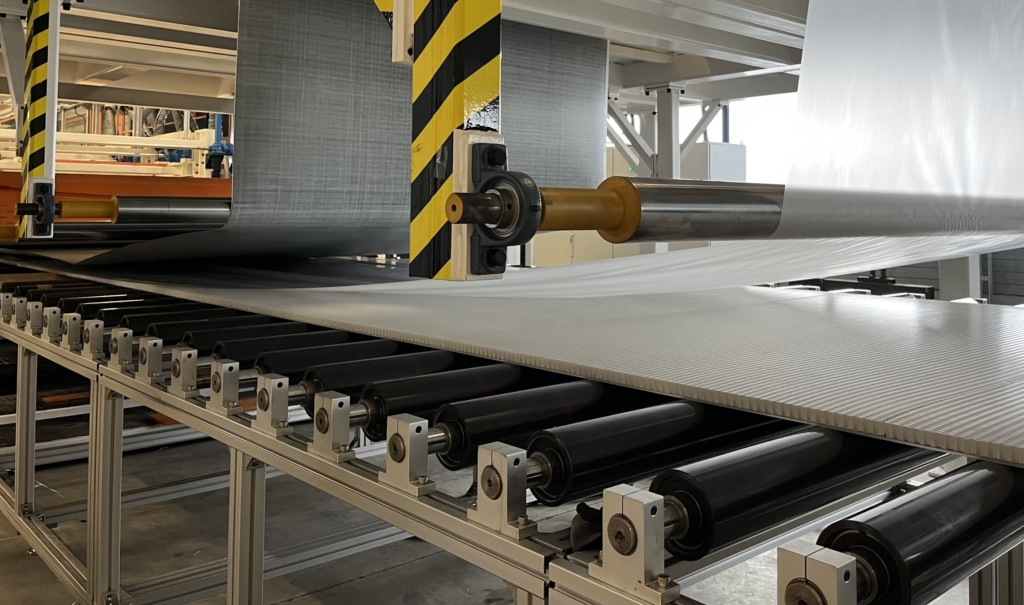
Temperature has a direct influence on the mechanical performance of composite formwork panels. In extreme cold, stiffness increases but the material becomes more brittle, while high temperatures can reduce compressive strength and stiffness. For formwork manufacturers and contractors working with durable concrete formwork, understanding these thermal limits is decisive when choosing the right panel. The questions below take a closer look at the specific effects of temperature on composite panels in practice.
Which temperature ranges are critical for composite formwork?
Composite formwork panels based on thermoplastic sandwich constructions function safely within a continuous operating range of -30°C to +100°C. For short-term exposure, a wider range of -40°C to +130°C applies. Above 55°C, compressive strength and stiffness begin to decrease noticeably, which is relevant for formwork exposed to direct sunlight or heat-generating processes.
For practical use on the construction site, there are two critical limits. First, the lower limit: at temperatures below zero, the behaviour of the composite material changes. Second, the upper limit: under sustained heat above 80°C, mechanical performance can deteriorate structurally. Within the standard construction site range of -20°C to +60°C, however, thermoplastic sandwich panels perform stably.
The core materials play a major role here. PP foam cores with a higher density (around 150 g/l) retain their compressive strength better at elevated temperatures than variants with a lower density (around 60 g/l). This makes density selection a technically relevant decision for applications in warm climates or under intensive solar loading.
How does freezing weather affect the strength and stiffness of composite panels?
At freezing temperatures, thermoplastic composite panels become stiffer, but also slightly more brittle. The glass fibre-reinforced skin remains structurally intact, but the impact resistance of the core material decreases in extreme cold. This means that knocks or drop impacts at temperatures well below zero can cause more damage than at room temperature.
In practice, this effect is manageable. Composite panels are inherently moisture-resistant, which is a major advantage over plywood. Plywood absorbs water, which expands when it freezes and damages the wood fibres. Composite panels with a water absorption of less than 1.5% (in accordance with ISO 62) are virtually immune to frost damage caused by moisture uptake.
For formwork applications in Northern Europe, where frost and thaw regularly alternate, this is a relevant advantage. Every freeze-thaw cycle degrades plywood further, whereas a well-designed composite panel withstands these cycles without structural deterioration. The continuous operating temperature of -30°C offers ample margin for most European construction site conditions.
What happens to composite formwork at high temperatures?
At high temperatures, the compressive strength of composite formwork panels decreases, particularly above 55°C. Above 80°C, sustained exposure can lead to permanent deformation or loss of dimensional stability, depending on the load on the panel. The maximum process temperature without thickness reduction is 155°C, but this is a production limit, not an operating limit for formwork.
On the construction site, the most common heat sources are direct sunlight on dark formwork surfaces and heat released as concrete cures. During the hydration process, concrete can locally reach temperatures of 40°C to 70°C, depending on the concrete mix and the thickness of the pour. This is a temperature range in which composite panels still function, but where it is advisable to have the specific panel build-up assessed.
Panels with a higher core material density perform better at elevated temperatures. Higher density means more material per unit of volume, which slows heat transfer and preserves structural integrity for longer. For formwork that is regularly exposed to warm concrete mixes or intensive solar loading, this is a relevant design consideration.
How does the thermal dimensional change of composite compare to plywood?
Composite panels based on glass fibre-reinforced thermoplastic skins have a lower coefficient of thermal expansion than plywood and therefore respond more stably to temperature fluctuations. Plywood expands not only due to heat, but also due to moisture absorption, which leads to warping, delamination and dimensional deviations after repeated use.
This difference is particularly relevant for reusable formwork systems. With plywood, dimensional accuracy decreases the more often the panel is used and exposed to changing temperatures and humidity. A composite panel retains its dimensions over a much longer service life, which keeps the quality of the concrete surface consistent.
For manufacturers of modular formwork systems, dimensional stability is a direct product quality requirement. Deviations in panel dimensions lead to joint problems, concrete leakage and additional labour costs on site. The dimensional stability of composite panels under temperature fluctuations is therefore not only a material property, but a functional requirement for durable concrete formwork that lasts through multiple usage cycles.
Which composite panel performs best in extreme construction site conditions?
For extreme construction site conditions, where frost, heat, mechanical loading and humidity come together, thermoplastic sandwich panels with a higher core material density and glass fibre-reinforced skins perform best. The combination of a higher-density PP foam core and a cross-ply or multilayer glass fibre-reinforced skin offers the best balance between thermal stability, compressive strength and impact resistance.
Relevant performance criteria for extreme conditions are:
- Thermal stability: continuous operating range of -30°C to +100°C
- Moisture resistance: water absorption below 1.5% (ISO 62), which prevents frost damage caused by moisture uptake
- Alkali resistance: composite panels withstand 500 hours of alkaline ageing in lime water at 50°C, which is relevant for direct contact with fresh concrete
- UV resistance: tested in accordance with ISO 4892-2, which allows outdoor storage and prolonged exposure to sunlight
- Heat ageing: 2,000 hours at 80°C without measurable mechanical deterioration for floor panels
Alkali resistance deserves extra attention for formwork applications. Fresh concrete has a high pH value and attacks many materials. Thermoplastic composite panels are inherently resistant to alkaline environments, which makes them suitable for repeated contact with wet concrete without surface degradation.
How we help you choose the right panel for your formwork application
We develop and produce thermoplastic sandwich panels tailored to the specific requirements of your formwork application. Temperature range, load profile, usage cycles and dimensional accuracy are all factors we take into account in the panel configuration, before anything is produced.
What we do for you in concrete terms:
- Assessment of your thermal operating conditions and translation into the right core material density and skin build-up
- Advice on panel thickness and build-up based on the mechanical load in your formwork system
- Production of panels up to 13,500 mm × 2,950 mm, cut to size for your application
- Support in evaluating composite as an alternative to plywood, including a TCO analysis over multiple usage cycles
Thermoplastic composite panels demonstrably last longer than plywood in intensive applications. Over a service life of 10 to 15 years, you eliminate multiple replacement cycles, including the associated material costs, labour costs and downtime. In most cases, this makes the higher initial investment cost-effective on an annual basis.
We review your design, optimise the panel configuration for your assembly procedure and identify technical bottlenecks before production starts. Get in touch to discuss your formwork application and find out which panel configuration best suits your requirements.