

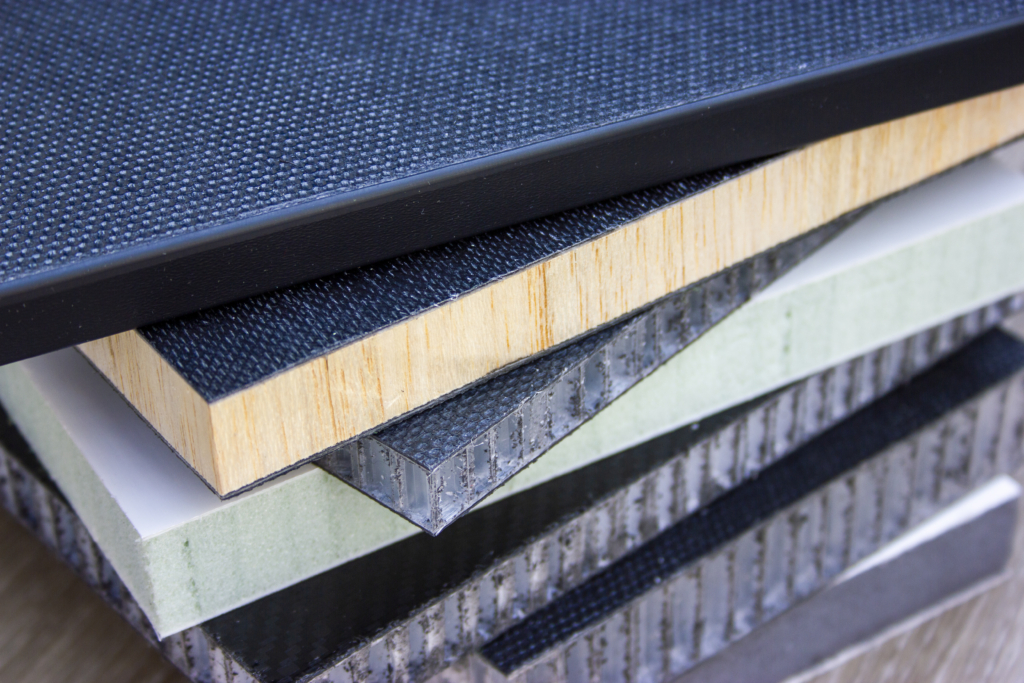
GRP, or glass-reinforced plastic, is a thermoset composite material made from glass fibres embedded in a polyester or epoxy resin matrix. As a sandwich panel face sheet, it bonds to a lightweight core to create a rigid, load-bearing structure that is significantly lighter than steel or aluminium of equivalent stiffness. GRP face sheets are widely used across transport, construction, and industrial applications where corrosion resistance and structural performance matter. The sections below address the most common questions manufacturers ask when evaluating GRP as a face sheet material.
Note: This article covers the broader sandwich panel market. Our range at Compoform is limited to thermoplastic composite face sheets with PP honeycomb and PET foam cores, primarily for commercial vehicles and scaffolding.
What materials make up a GRP face sheet?
A GRP face sheet consists of glass fibres combined with a thermoset resin, most commonly unsaturated polyester, vinyl ester, or epoxy. The glass fibres provide tensile strength and stiffness, while the resin matrix binds the fibres together, transfers loads between them, and protects them from environmental exposure. The resulting laminate is rigid, corrosion-resistant, and relatively lightweight.
The specific construction of a GRP face sheet varies depending on the application and the performance requirements of the finished sandwich panel. The main variables are fibre architecture and resin type.
Fibre architecture
Glass fibres in a GRP skin can be arranged in several ways. Woven fabrics offer balanced properties in two directions. Chopped strand mat (CSM) distributes fibres randomly, producing isotropic properties at lower cost but with reduced strength compared to woven or unidirectional formats. Unidirectional (UD) fabrics concentrate strength along one axis and are used where loads are predictable and directional. Cross-ply laminates stack fibres at 0° and 90° to balance stiffness in both directions, a configuration also used in thermoplastic composite skins.
Resin systems
Polyester resin is the most common choice for cost-sensitive applications such as trailer side walls and agricultural panels. Vinyl ester offers better chemical resistance and improved toughness. Epoxy resin delivers the highest mechanical performance and adhesion quality but at a significantly higher material cost, making it more common in aerospace and high-end structural applications than in volume transport manufacturing.
Glass fibre content by weight typically ranges from around 30% to 70% depending on the manufacturing process. Higher fibre content generally improves stiffness and strength but requires more controlled processing, such as resin infusion or prepreg layup, rather than open hand layup.
How does GRP perform as a sandwich panel face sheet?
GRP performs well as a sandwich panel face sheet in applications that require corrosion resistance, moderate stiffness, and low weight relative to metals. It bonds effectively to foam and honeycomb cores, distributes bending loads across the panel surface, and resists moisture and chemical attack without surface treatment. However, its performance is sensitive to fibre architecture, resin quality, and processing method.
In a sandwich panel, the face sheets carry the tensile and compressive stresses generated by bending loads, while the core resists shear. GRP skins are well suited to this role because glass fibre has a high tensile strength-to-weight ratio. The stiffness of the finished panel depends on both the skin modulus and the panel thickness, so even a relatively thin GRP skin contributes meaningfully to overall rigidity when bonded to a thick core.
UV weathering is a relevant consideration for GRP used in exterior applications. Without a gel coat or protective film, the resin surface can degrade under prolonged UV exposure, leading to fibre blooming and a reduction in surface quality. Manufacturers typically apply a gel coat or UV-stable surface layer to panels intended for outdoor use. Testing against ISO 4892 is a standard method for evaluating UV resistance in composite skins.
Impact resistance is one area where GRP shows limitations. Thermoset resins are brittle by nature, and a sharp impact can cause delamination or cracking that is not always visible on the surface. This is a meaningful consideration for truck body panels and scaffolding boards that experience regular mechanical contact in service.
What industries use GRP sandwich panels?
GRP sandwich panels are used across a wide range of industries, with the strongest adoption in transport, construction, and marine sectors. The combination of low weight, corrosion resistance, and design flexibility makes GRP panels a practical alternative to steel or aluminium in applications where weight reduction and weather resistance are priorities.
In the transport sector, GRP sandwich panels appear in trailer side walls, refrigerated vehicle bodies, and cargo box construction. The panels reduce vehicle tare weight, which directly increases legally permitted payload capacity. In 2026, this weight argument extends beyond payload: for electric trucks and vans, lighter body structures also extend battery range per charge. Every kilogram of structural dead weight reduces range, making weight reduction a range argument as much as a payload argument. This is now a standard procurement question from EV fleet buyers.
In construction, GRP sandwich panels are used for façade cladding, temporary site enclosures, and modular building components. Their resistance to moisture and corrosion makes them suitable for exterior applications where steel panels would require ongoing maintenance.
Marine applications use GRP extensively for hull panels, deck structures, and interior partitions, where saltwater resistance is a baseline requirement. Wind energy is another sector where GRP composites are well established, particularly in turbine blade construction, though this falls outside the sandwich panel category in most cases.
Scaffolding is a growing application for composite panels more broadly. Composite scaffold boards offer significant weight savings over timber, which reduces manual handling loads for workers and lowers transport costs for scaffolding contractors.
What are the disadvantages of GRP in sandwich panel applications?
The main disadvantages of GRP sandwich panels are brittleness under impact, limited recyclability, inconsistent quality in open-mould production, and higher processing complexity compared to thermoplastic alternatives. These limitations are relevant for manufacturers evaluating total cost of ownership rather than unit price alone.
Thermoset resins, which form the matrix in GRP, cure through an irreversible chemical reaction. Once cured, the material cannot be remelted or reshaped. This makes end-of-life recycling difficult. GRP panels typically cannot be mechanically recycled into a material of equivalent quality, and chemical recycling routes remain commercially limited. For European OEMs subject to the EU End-of-Life Vehicles (ELV) Directive, this is a compliance consideration, not just a sustainability preference. Manufacturers sourcing panels for vehicle applications need to account for how composite materials will be handled at vehicle end of life.
Open-mould hand layup, still common in GRP production, introduces variability in fibre content and resin distribution. This can lead to inconsistencies in mechanical properties between panels or between production batches, which is a concern for OEMs who need predictable, repeatable performance across large production runs.
Repair is another practical limitation. Damaged GRP panels can be repaired, but the process requires skilled labour and the repaired area rarely matches the original laminate properties exactly. In high-cycle applications such as scaffolding or fleet vehicle bodies, this adds maintenance complexity over the panel’s service life.
How does GRP compare to thermoplastic composite face sheets?
GRP and thermoplastic composite face sheets differ primarily in their resin system, recyclability, impact behaviour, and processing characteristics. GRP uses a thermoset resin that cures irreversibly, while thermoplastic skins use a polymer matrix, such as polypropylene, that can be remelted and reshaped. Each has genuine advantages depending on the application.
Mechanical performance
GRP skins, particularly those made with woven or unidirectional glass fabrics and epoxy resin, can achieve high tensile strength and stiffness. Thermoplastic composite skins reinforced with continuous glass fibres in a cross-ply or multi-ply architecture are competitive in stiffness and offer better impact toughness. Thermoset GRP tends to crack or delaminate under sharp impact, while thermoplastic skins absorb energy more effectively before failure. For applications with regular mechanical contact, this difference is operationally significant.
Recyclability and regulatory compliance
Thermoplastic composite skins have a clear recyclability advantage. Because the polymer matrix can be remelted, thermoplastic panels are more compatible with mechanical recycling processes. This is directly relevant to European OEMs working under the EU ELV Directive and reporting obligations under the Corporate Sustainability Reporting Directive (CSRD). GRP panels, as thermoset composites, do not offer the same end-of-life pathway, which is an increasing factor in procurement decisions across the European transport sector.
Production consistency
Thermoplastic composite panels produced on continuous automated lines deliver consistent fibre content and laminate thickness across every panel. GRP production quality varies more with the manufacturing method: closed-mould processes such as resin transfer moulding (RTM) produce more consistent results than open hand layup, but at higher tooling cost. For OEMs running high-volume production, consistency directly affects assembly quality and warranty exposure.
When should a manufacturer choose GRP over other face sheet materials?
A manufacturer should choose GRP face sheets when the application requires a low-cost thermoset composite with good corrosion resistance, the production volumes are too low to justify thermoplastic tooling investment, or the panel geometry is complex enough to benefit from GRP’s ability to conform to curved moulds. GRP remains a practical choice in these specific scenarios, even as thermoplastic alternatives gain ground in volume transport applications.
GRP is well suited to low-to-medium volume production where part complexity justifies hand layup or RTM tooling rather than continuous line processing. Custom boat hulls, specialist vehicle bodies, and architectural cladding panels with non-standard profiles are examples where GRP’s mouldability is an advantage that thermoplastic sheet materials cannot easily replicate.
Where chemical resistance is the dominant requirement, vinyl ester or epoxy GRP skins outperform standard thermoplastic alternatives in aggressive environments. Industrial flooring panels, chemical storage structures, and certain marine applications fall into this category.
However, for manufacturers producing at meaningful volume in the commercial vehicle and scaffolding sectors, the case for GRP weakens against thermoplastic composite panels. Thermoplastic panels offer better impact resistance, recyclability aligned with European regulation, and consistent quality from automated production. The total cost of ownership calculation, including maintenance, replacement cycles, and end-of-life compliance, increasingly favours thermoplastic composites for these applications.
How Compoform Helps with Sandwich Panel Face Sheet Selection
We manufacture thermoplastic sandwich panels with glass-fibre-reinforced PP skins bonded to PP honeycomb or PET foam cores. Our panels are engineered specifically for commercial vehicle bodies and scaffolding applications, where impact resistance, weight reduction, and long service life are the deciding factors.
Here is what working with us looks like in practice:
- Application review before specification: We review your design and loading requirements before recommending a panel configuration. Skin architecture, core density, and panel thickness are selected for your specific assembly, not taken from a generic catalogue.
- Custom dimensions cut to your specification: Panels are available in custom dimensions up to 13,500 mm × 2,900 mm, produced on our 72-metre semi-automatic line in the Netherlands. You are not constrained by standard sheet sizes.
- Long service life with a concrete TCO argument: Thermoplastic composite floors last 3 to 4 times longer than plywood in heavy transport applications, based on Compoform’s operational experience. Over a 15-year vehicle life, that eliminates two to three replacement cycles. Once you add panel cost, installation labour, and vehicle downtime, the composite is cheaper per year of service, even at a higher unit price.
- Recyclability for ELV and CSRD compliance: Our thermoplastic panels support your obligations under the EU ELV Directive and CSRD reporting requirements in a way that thermoset GRP panels cannot.
- EN 12811 load class 4 performance: Our 10.5 mm scaffolding panel achieves EN 12811 load class 4 with no support underneath, a verified result from our own testing programme.
We act as an engineering partner throughout the process, from initial design review to post-delivery support, not a supplier that ships panels to a purchase order and moves on. If you are evaluating face sheet materials for a truck body, trailer floor, or scaffolding board application, speak with our engineering team about your requirements before committing to a specification.
Related Articles
- What is the environmental impact of PP honeycomb sandwich panels compared to aluminium?
- What are the advantages of sandwich panels in temporary infrastructure?
- What is the difference between sandwich panels and conventional composite sheets?
- What face sheet materials are used on composite sandwich panels?
- What are sandwich panels used for?