

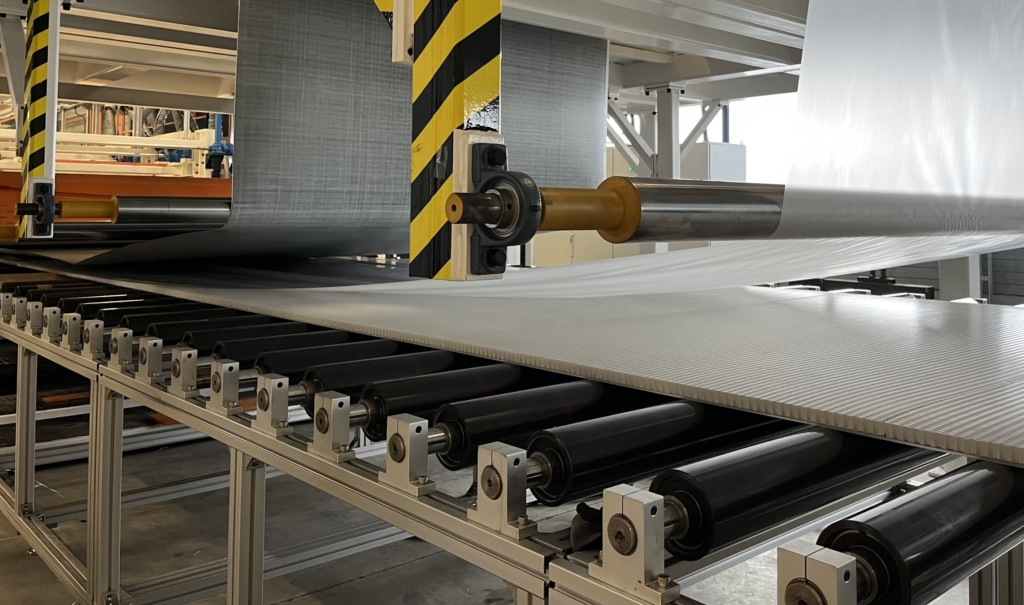
Composite panels are considerably more dimensionally stable than plywood under repeated use in formwork applications. Plywood absorbs moisture, swells and shrinks under changing conditions, causing its dimensions to drift further with each use cycle. Composite sandwich panels with a glass-fibre-reinforced thermoplastic skin are inherently moisture-resistant and keep their shape even after dozens of use cycles. The questions below explore the comparison in more detail.
Why does plywood lose its dimensional stability with repeated use?
Plywood loses its dimensional stability because the wood absorbs and releases moisture. With every pour, the panel is exposed to water, wet concrete and mechanical stress. The wood swells when it gets wet and shrinks as it dries. After several cycles, small deformations accumulate, causing the panel to warp, delaminate and fray at the edges.
The root of the problem is the cellular structure of wood. Wood cells take up water along the grain direction, but also across it, and the degree of swelling differs by direction. This creates internal stresses that load the glue lines between the veneer layers. Once the glue bond weakens, the layers begin to separate. This process accelerates in concrete formwork, because the panel is regularly cleaned with high-pressure water and comes into contact with alkaline concrete water.
In addition to moisture absorption, mechanical wear plays a role. Formwork panels are repeatedly clamped, released and moved. The edges are the most vulnerable: once damaged, moisture penetrates faster and degradation speeds up. Even plywood with a film coating loses that protective layer over time, after which the unprotected wood is exposed to the same problems.
How do composite panels retain their dimensions under concrete pressure?
Composite sandwich panels retain their dimensions under concrete pressure because the glass-fibre-reinforced thermoplastic skin does not absorb moisture and does not react with alkaline concrete water. The combination of a rigid fibre skin and a lightweight core distributes the load evenly across the panel, without the dimensions changing due to moisture or temperature fluctuations.
The structure of a sandwich panel is decisive here. The outer layers consist of glass-fibre-reinforced polypropylene, a material that is chemically inert to water and concrete. The core, for example PP foam or PP honeycomb, contributes to the overall stiffness without adding weight. Because none of the components absorb moisture, there is no swelling, shrinkage or delamination.
The cross-ply laminate build-up of the skin also plays a role. By laying the fibres in multiple directions, the mechanical properties are equalised in both directions. This prevents the panel from expanding or shrinking more in one direction than in the other, which is a well-known cause of deformation in plywood. Composite panels therefore remain dimensionally accurate even after prolonged exposure to moisture and changing temperatures.
What are the consequences of dimensional deviations for concrete quality?
Dimensional deviations in formwork panels lead directly to inaccuracies in the concrete structure. If a panel is warped or its edges are no longer flat, gaps appear in the formwork. Concrete leaks through those gaps, resulting in irregular surfaces, dimensional deviations in the finished product and additional finishing work.
For precast concrete producers, the consequences are particularly noticeable. Precast elements are produced to fixed tolerances. If the mould deviates, the product deviates. That can mean elements no longer fit during installation on site, leading to costly adjustments, delays or rejection of the element.
The surface quality of the concrete also suffers from deformed formwork. Concrete takes on the shape of the panel against which it sets. A convex or concave panel produces an uneven concrete surface, which is immediately visible in exposed concrete and, in structural concrete, can affect the cover to the reinforcement. In short, the dimensional stability of the formwork panel directly determines the quality and dimensional accuracy of the concrete product.
How many use cycles do composite and plywood formwork panels achieve?
Plywood formwork panels achieve an average of 20 to 50 use cycles, depending on the quality of the coating and the conditions on site. Composite sandwich panels can achieve considerably more cycles with correct use, with the thermoplastic skin remaining resistant to mechanical stress, moisture and alkaline concrete water without structural degradation.
The difference in service life has a direct impact on total costs. Suppose a formwork panel achieves an average of 30 cycles with plywood and 150 cycles with composite. Over the service life of a formwork system, that means multiple replacements of the plywood, each with associated material costs, labour for replacement and production downtime. Composite largely eliminates those replacement cycles.
In the heavy transport sector, where comparable requirements apply for durability and repeated loading, thermoplastic sandwich panels show a service life of 12 years or more, compared with 3 to 5 years for plywood, based on practical experience with floor panels in lorries and trailers. That ratio is indicative of what is also possible in formwork applications, although the exact cycle counts always depend on the specific application, the design and the conditions of use.
When is composite the better choice over plywood for formwork?
Composite is the better choice over plywood when repeated use, dimensional accuracy and low maintenance costs carry significant weight. This applies in particular to precast concrete producers, manufacturers of modular formwork systems and formwork rental companies that use panels intensively and want to reduce replacement frequency.
Concrete situations in which composite is clearly preferable:
- High-cycle applications: When panels are used dozens to hundreds of times, the higher purchase price of composite pays for itself through the elimination of replacement costs and downtime.
- Exposed concrete and dimensionally accurate precast elements: Composite delivers a consistently flat surface, cycle after cycle, without the deformation that plywood shows after repeated exposure to moisture.
- Aggressive environments: Formwork that is regularly cleaned with high-pressure water or comes into contact with aggressive release agents benefits from the chemical resistance of a thermoplastic composite skin.
- Weight reduction as an operational requirement: Lighter panels reduce the load on formwork frames and improve handling on site, which increases labour productivity.
- Sustainability objectives: Thermoplastic composite panels are fully recyclable, which is relevant for companies that must comply with the EU ELV Directive or report under the CSRD.
Plywood remains a viable choice for low-cycle applications with a limited budget, or when the formwork is used once and then discarded. As soon as reuse and total cost over the service life become decisive, the balance shifts towards composite.
How we help you with composite formwork panels
We develop and produce thermoplastic sandwich panels for formwork system manufacturers and precast concrete producers looking for a durable alternative to plywood. Our approach is that of a technical partner: we assess your specific application, optimise the panel configuration for your production process and flag bottlenecks before production starts.
What we can do for you in practice:
- Assess which core and skin build-up best suit your cycle and load requirements
- Produce custom panels up to 13,500 mm × 2,950 mm, matched to your formwork sizes
- Provide technical documentation based on our own test results, so your R&D and purchasing teams can make a well-founded comparison
- Make prototypes or test panels available for evaluation in your own production environment
All panels are produced in the Netherlands, fully European-made, and are suitable for applications where dimensional stability, repeated use and low total cost of ownership are central. View our applications or get in touch to discuss what composite can do for your formwork project.
Related Articles
- How do European sandwich panel suppliers support OEM production schedules?
- What is the role of sandwich panels in dry freight trailer construction?
- Why is traditional material weight hurting your vehicle's fuel costs?
- How much weight can a sandwich panel support?
- What is a PP foam core and when is it used?