

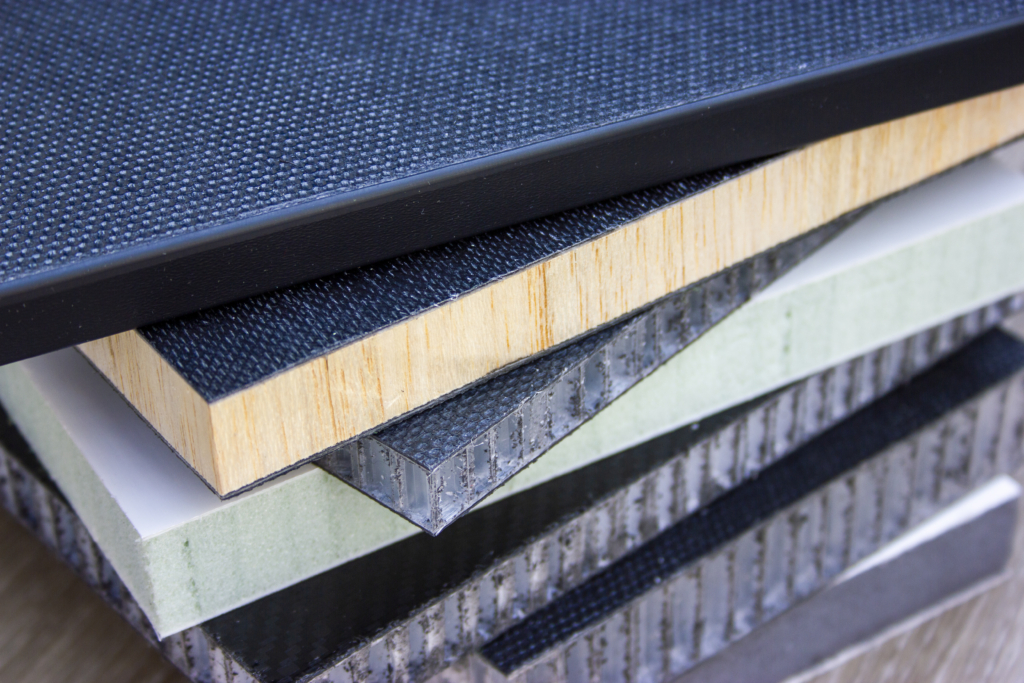
Thermoplastic sandwich panels are significantly more sustainable than thermoset composites across most lifecycle stages. The core reason is material chemistry: thermoplastics can be remelted and reprocessed, while thermosets cure into a permanently cross-linked structure that cannot be reversed. For European manufacturers facing tightening environmental regulation in 2026, this distinction has moved from a preference to a compliance consideration.
The sections below address the specific sustainability questions that procurement engineers and OEM designers ask most often when evaluating composite panel types.
Which composite panel type is easier to recycle at end of life?
Thermoplastic composite panels are substantially easier to recycle at end of life than thermoset panels. Because thermoplastics soften when reheated, the material can be mechanically shredded and reprocessed into secondary products. Thermoset composites, once cured, cannot be remelted; the cross-linked polymer network is permanent, which limits end-of-life options to downcycling or landfill.
For truck body builders and trailer manufacturers operating in Europe, this is not simply an environmental preference. The EU End-of-Life Vehicles (ELV) Directive sets recovery and recyclability targets for vehicles and their components. As that regulation tightens, the ability to demonstrate that a structural panel is recyclable becomes a compliance requirement, not just a sustainability talking point.
In practical terms, thermoplastic panels based on polypropylene (PP) cores and glass-fibre-reinforced PP skins can be mechanically recycled by grinding the panel into granulate and incorporating it into lower-grade commercial vehicle and transport applications. The glass fibre content complicates closed-loop recycling, but the process is technically feasible and increasingly supported by European recycling infrastructure. Thermoset panels, by contrast, typically require energy-intensive pyrolysis or cement co-processing to recover any value from the material, and even then the recovered fibre is degraded.
What makes thermoplastic composites lower in embodied carbon?
Thermoplastic composites carry lower embodied carbon than thermoset alternatives primarily because their manufacturing process requires less energy and avoids the chemical curing agents that thermosets depend on. Polypropylene, the base polymer in PP honeycomb and PP foam cores, is produced at lower processing temperatures than epoxy or polyester resin systems, and the absence of a curing stage removes a significant energy input from the production chain.
There are several additional factors that reduce the carbon footprint of thermoplastic sandwich panels over their full lifecycle:
- Lighter weight in service: A thermoplastic sandwich panel delivers structural performance at a fraction of the weight of steel or aluminium alternatives. In transport applications, every kilogram of structural dead weight removed reduces fuel consumption or, in electric vehicles, reduces the energy drawn per kilometre. For EV truck and van operators, lighter body structures directly extend battery range per charge, making weight reduction a range argument, not just a payload argument. This is a standard procurement question from EV fleet buyers in 2026.
- Longer service life: Thermoplastic panels in heavy transport applications typically last three to four times longer than plywood equivalents. Fewer replacement cycles mean fewer panels manufactured over the vehicle’s life, which reduces cumulative embodied carbon across the fleet.
- No solvent-based processing: Thermoset manufacturing often involves resins, hardeners, and release agents that carry their own environmental burden. Thermoplastic processing is largely solvent-free.
- European production: Panels manufactured in Europe avoid the transport emissions associated with long-haul shipping from Asia, which adds measurable carbon to the supply chain of imported alternatives.
How do thermoplastic panels perform in circular economy frameworks?
Thermoplastic sandwich panels align well with circular economy principles because the material can re-enter a production cycle rather than ending as waste. The core circular economy criteria, designing for disassembly, enabling material recovery, and extending product life, are all more achievable with thermoplastic composites than with thermoset alternatives.
In a circular economy framework, a panel’s value is measured not just at the point of sale but across its entire use cycle. Thermoplastic panels score well on several dimensions:
- Repairability: Thermoplastic skins can be locally reheated and reformed, which means surface damage that would write off a thermoset panel can sometimes be repaired in the field.
- Material recovery: At end of life, thermoplastic panels can be mechanically processed and the polymer fraction recovered. This supports the material loop that circular economy frameworks require.
- Durability as a circular metric: A panel that lasts 12 or more years in a truck body application reduces the frequency of replacement, which is itself a circular economy outcome, fewer resources consumed per year of service.
European manufacturers are increasingly required to report on circular economy performance under the Corporate Sustainability Reporting Directive (CSRD). For OEMs subject to CSRD, being able to document that structural panels are thermoplastic and therefore recyclable in principle is a meaningful step toward meeting disclosure requirements. Thermoset panels, with no viable mechanical recycling route, are harder to position favourably in these frameworks.
Are thermoset composites ever the more sustainable choice?
In specific, narrow applications, thermoset composites can be the more sustainable choice, primarily where extreme structural performance is required at very low weight and no thermoplastic alternative can match the mechanical specification. In those cases, the weight saving over a service life may offset the end-of-life recycling disadvantage. However, for the majority of commercial vehicle and scaffolding applications, this trade-off does not apply.
Thermoset composites have historically been favoured in applications where high stiffness-to-weight ratios are non-negotiable and where panels are not expected to be recycled at all, certain aerospace structures, for example. But these are not the conditions that truck body builders, trailer manufacturers, or scaffolding companies operate under.
In commercial transport and access equipment, thermoplastic sandwich panels now match or exceed the structural performance of thermoset alternatives for the load cases that matter, floor loading, bending resistance, and impact tolerance, while offering a clear advantage in recyclability, repairability, and alignment with European environmental regulation. The sustainability case for thermoset in these markets is weak and narrowing further as thermoplastic material science advances.
What sustainability certifications apply to thermoplastic composite panels?
Thermoplastic composite panels can be assessed against several European sustainability frameworks and standards, though no single universal certification covers all applications. The most relevant references for European manufacturers in 2026 are the EU ELV Directive for vehicle components, CSRD reporting requirements for OEMs above the disclosure threshold, and EN ISO standards that govern material testing and performance claims.
For panels used in commercial vehicles, the EU End-of-Life Vehicles Directive is the primary regulatory framework. It sets targets for the proportion of vehicle mass that must be recoverable and recyclable, and thermoplastic panels contribute positively to those targets in a way that thermoset panels cannot.
For structural performance, European standards govern how panels are tested and what claims can be made. Flexural performance is assessed under ISO 14125, tensile properties under EN ISO 527, and scaffold load capacity under EN 12811. These are not sustainability certifications in themselves, but they provide the verified performance data that underpins the durability and service-life arguments central to any lifecycle sustainability assessment.
Environmental product declarations (EPDs) are increasingly used by manufacturers to document the embodied carbon and lifecycle impact of construction and transport materials. An EPD produced to EN 15804 provides a standardised, third-party-verified summary of a panel’s environmental performance from raw material extraction through to end of life. For OEMs required to report under CSRD, supplier EPDs are a practical tool for populating sustainability disclosures with verified data.
How We Help with Sustainable Sandwich Panel Specification
We manufacture thermoplastic sandwich panels with PP honeycomb and PET foam cores, produced entirely in the Netherlands. Every panel we supply is 100% European-made, which removes the supply chain carbon associated with long-haul imports and gives you a traceable, documentable source for sustainability reporting.
When you work with us on a panel specification, we review your application requirements and help you select the configuration that delivers the right structural performance at the lowest weight. For truck body and trailer applications, that typically means:
- Selecting core density and skin architecture to meet your floor or wall load specification without overbuilding
- Confirming that the panel contributes to your vehicle’s ELV recyclability targets
- Providing technical data to support your CSRD or procurement sustainability documentation
- Advising on edge sealing and surface finish to maximise panel service life, reducing replacement frequency and the associated material consumption over the vehicle’s life
A 30 mm PP sandwich panel floor, for example, is self-supporting with no aluminium subframe required. That removes a production step, reduces total vehicle weight, and eliminates a secondary material from your end-of-life recovery calculation.
We do not ship panels to spec and move on. We stay involved through integration, flag issues before they reach production, and support you through the full lifecycle of the application. If you are specifying panels for a truck body, trailer floor, or scaffolding board and want to understand how the material choice affects your sustainability position, speak with our engineering team about your requirements.
Related Articles
- How does the choice of face sheet affect sandwich panel stiffness and weight?
- How are sandwich panels used in bridge deck construction?
- Why is traditional material weight hurting your vehicle's fuel costs?
- What face sheet materials are used on composite sandwich panels?
- How thick can a sandwich panel be?