

Sandwich panels play a central structural role in dry freight trailer construction, replacing traditional steel and wood across walls, floors, and roofs. They combine a lightweight thermoplastic core with glass-fibre-reinforced skins to deliver high stiffness and impact resistance at a fraction of the weight of conventional materials. The questions below unpack how this works in practice, from structural load requirements to panel manufacturing and material selection.
This article covers the broader sandwich panel market. Our range at Compoform is limited to PP honeycomb and PET foam cores for commercial vehicles and scaffolding.
What structural loads do dry freight trailer walls need to handle?
Dry freight trailer walls must resist a combination of lateral pressure from cargo shifting during transit, point loads from forklift contact and loading equipment, and distributed loads from stacked goods pressing outward against the sidewalls. They also need to handle vibration fatigue over tens of thousands of road kilometres without delaminating or cracking at joints.
The dominant load case for sidewalls is lateral pressure from cargo. When a trailer brakes sharply or corners, the load shifts and pushes against the wall panels. For a fully loaded 24-tonne trailer, this can generate significant outward force across the full panel height. Panels must resist this without permanent deformation.
Point loads matter just as much. Forklift tines, pallet edges, and hand trucks all concentrate force into small contact areas. A panel that performs well under distributed load but dents or cracks under point impact will fail in real-world logistics environments. This is why impact resistance is a primary selection criterion for trailer wall panels, not a secondary one.
Roof panels face a different load profile: distributed snow and wind loads, plus the weight of roof-mounted equipment such as refrigeration units in temperature-controlled variants. Floor panels carry the highest loads of all, combining the static weight of cargo with dynamic impact from pallet drops and forklift wheel loads. For floor applications, bending strength tested to ISO 14125 and compressive resistance are the governing properties.
How do sandwich panels replace steel and wood in trailer bodies?
Sandwich panels replace steel and wood in trailer bodies by replicating their structural function through a different mechanism: instead of relying on material density and thickness for stiffness, a sandwich panel separates two thin, strong skins with a lightweight core. The skins carry tensile and compressive stress; the core resists shear and keeps the skins apart, which is what generates bending stiffness.
In a traditional steel trailer body, the wall is a thin steel sheet supported by a frame of steel uprights. The sheet itself carries little load; the frame does the structural work. This system is heavy, prone to corrosion, and expensive to repair when dented. Plywood walls are lighter but absorb moisture, delaminate over time, and require replacement every three to five years in heavy transport use.
A composite sandwich panel eliminates the need for a dense supporting frame in many commercial vehicle and trailer body applications. The panel itself is self-supporting across the span between mounting points. For trailer sidewalls, this means fewer internal uprights, which in turn creates more usable interior width and simplifies the body assembly process. For floors, a 30 mm PP honeycomb sandwich panel can be self-supporting without an aluminium subframe, removing a production step entirely.
The replacement is not a like-for-like swap in thickness. A composite panel achieving the same bending stiffness as a steel panel will be thicker but dramatically lighter. Trailer builders need to account for this dimensional difference during body design, particularly at door frames, corner posts, and floor-to-wall junctions where panels meet structural members.
What weight savings can trailer builders expect from composite panels?
Weight savings from switching to composite sandwich panels depend on the specific panel configuration and what material is being replaced, but trailer builders typically achieve meaningful reductions in body weight that translate directly into additional legal payload capacity. Replacing steel sidewalls with glass-fibre-reinforced thermoplastic sandwich panels can reduce wall weight by a significant margin, depending on panel thickness and skin specification.
The payload argument is straightforward: in Europe, the maximum gross vehicle weight for a standard articulated truck is 40 tonnes. Every kilogram saved in the trailer body structure is a kilogram that can be loaded as revenue-generating cargo. Over thousands of trips, even a 200 kg reduction in body weight compounds into measurable freight revenue.
In 2026, weight reduction carries a second argument that procurement teams at EV fleet operators now raise as standard: battery range. Lighter body structures extend the range of electric trucks and vans on a single charge. Every kilogram of structural dead weight reduces range per charge, which affects route planning, charging infrastructure requirements, and total operating cost. For fleet operators transitioning to electric drivetrains, the weight of the trailer body is no longer just a payload question. It is a range question.
Plywood floors are a particularly high-value target for weight reduction. A composite floor panel of equivalent structural performance will be lighter and will not absorb moisture over time, which means the weight advantage does not degrade with age the way a waterlogged plywood floor does.
What’s the difference between thermoplastic and thermoset composite panels for trailers?
The core difference between thermoplastic and thermoset composite panels is how the polymer matrix behaves under heat. Thermoset panels cure through an irreversible chemical reaction and cannot be remelted. Thermoplastic panels use a polymer matrix that softens when heated and re-solidifies on cooling, which makes them reformable, weldable, and fully recyclable at end of life.
Thermoset composite panels
Thermoset panels, typically using fibre-reinforced polyester or epoxy matrices, have been used in trailer construction for decades. They offer good stiffness and are well understood by body builders. However, they cannot be thermally welded, which limits joining options. At end of vehicle life, thermoset panels cannot be recycled through standard polymer recycling streams. As European OEMs face increasing pressure under the EU End-of-Life Vehicles Directive and CSRD sustainability reporting requirements, the non-recyclability of thermoset composites is becoming a compliance issue, not just an environmental preference.
Thermoplastic composite panels
Thermoplastic panels use PP or PET-based matrices combined with glass-fibre skins. They can be thermally welded, which simplifies joining and repair. They are fully recyclable, which supports compliance with EU recyclability regulations. In impact resistance, thermoplastic panels perform strongly: the continuous fibre-reinforced thermoplastic architecture resists crack propagation differently from thermoset laminates, which tend to fracture more brittly under sharp impact. For trailer sidewalls subject to forklift contact and road debris, this matters in service.
Thermoplastic panels also support faster production cycles in high-volume manufacturing because they do not require cure time in the way thermoset panels do. For trailer builders running continuous production, this can reduce panel lead times.
Which panel properties matter most for refrigerated versus dry freight trailers?
For dry freight trailers, the governing panel properties are bending stiffness, impact resistance, and floor load capacity. For refrigerated trailers, thermal insulation performance measured to EN 12667 becomes equally important alongside structural properties, because the panel must limit heat transfer through the body wall to maintain cargo temperature without overloading the refrigeration unit.
In dry freight applications, the wall panel’s job is purely structural and protective. Bending strength tested to ISO 14125, point load resistance, and surface durability under repeated contact are the properties that determine service life. A white PET-film surface finish provides a cleanable interior surface and UV resistance exceeding 22,000 hours, which matters for panels exposed to sunlight through open trailer doors during loading.
Floor panels in dry freight trailers face the most demanding load conditions. A 30 mm PP honeycomb floor panel delivers substantially higher bending and compressive performance than thinner variants. The anti-skid surface finish on floor panels is not cosmetic; it prevents cargo movement during transit and reduces the risk of load shift that could compromise vehicle stability.
For refrigerated trailers, thermal conductivity becomes a design constraint. The core material and thickness must achieve a target U-value that keeps the refrigeration unit within its operating capacity across the expected ambient temperature range. Thicker cores with lower thermal conductivity reduce heat ingress. However, increasing core thickness adds weight and reduces interior volume, so the specification involves a genuine trade-off between thermal performance, weight, and usable cargo space. Structural requirements do not disappear in refrigerated applications; the panel must still handle the same lateral and floor loads as a dry freight body.
How are sandwich panels manufactured to trailer-specific dimensions?
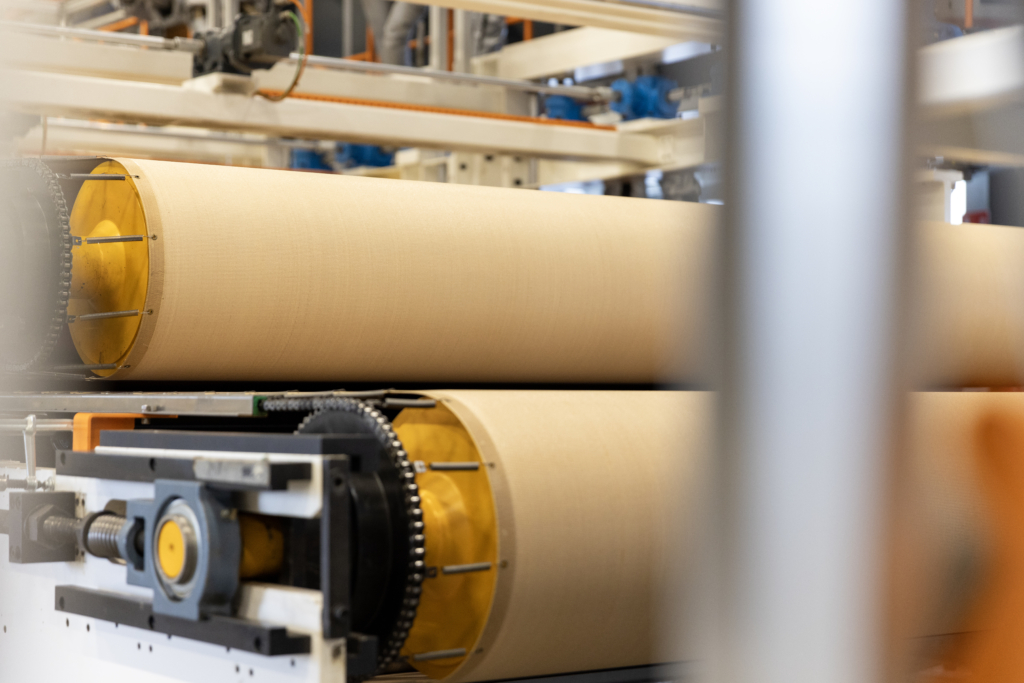
Sandwich panels for trailer applications are manufactured on continuous production lines that laminate glass-fibre-reinforced skins onto a thermoplastic core under controlled heat and pressure. The continuous process allows panels to be produced in lengths that match trailer body dimensions directly, eliminating joints that would otherwise create weak points and add assembly complexity.
Trailer bodies present specific dimensional requirements that standard panel formats cannot always meet. A standard European curtainsider trailer is approximately 13.6 metres long, and a sidewall panel that runs the full length without a vertical joint simplifies body construction and removes a potential failure point. Production lines capable of handling panels up to 13,500 mm in length can supply full-length trailer wall panels as a single piece.
Panel width is equally important. Trailer floor widths and roof widths vary by body type, and panels cut from a standard sheet width may require joining or leave waste. A production line capable of producing panels up to 2,950 mm wide covers the internal width of most European trailer bodies without requiring a longitudinal joint in the floor.
Core density and skin specification are set during production, not after. The number of glass-fibre skin plies, their orientation (cross-ply for balanced properties in both directions, or unidirectional for maximum strength in one axis), and the core density are all determined by the structural requirements of the specific trailer application. This means panel specification is part of the design process, not a catalogue selection.
Edge treatment is a production step that matters in trailer applications. Exposed panel edges on floors and walls are subject to moisture ingress during wash-down and road spray. Edge sealing and edge bending protect the core from UV and moisture, which is directly relevant to service life in heavy transport environments where panels are washed down regularly.
How Compoform Helps with Dry Freight Trailer Panel Specification
We manufacture thermoplastic sandwich panels specifically configured for commercial vehicle applications, including dry freight trailer walls, floors, and roofs. Our production line in the Netherlands produces panels up to 13,500 mm x 2,950 mm x 150 mm, which covers full-length trailer sidewalls and floors as single pieces without intermediate joints.
When you come to us with a trailer body application, we do not simply quote a standard panel from a catalogue. We review your structural requirements, your assembly process, and your target weight budget, then configure the panel specification accordingly. This includes:
- Core selection: PP honeycomb or PET foam, with core thickness and density matched to your floor load or wall stiffness requirement
- Skin architecture: cross-ply for balanced biaxial performance or multi-ply unidirectional for applications with a dominant load direction
- Surface finish: white PET-film for interior wall panels, anti-skid for floor panels subject to forklift and pallet traffic
- Edge treatment: edge sealing and bending to protect the core in wash-down environments
- Custom dimensions: panels cut to your exact body dimensions, reducing waste and eliminating on-site cutting where possible
Our thermoplastic panels are 100% recyclable, which supports your compliance with EU ELV Directive requirements and CSRD sustainability reporting obligations. Over a 15-year vehicle life, a composite floor eliminates two to three plywood replacement cycles. Once you factor in panel cost, installation labour, and vehicle downtime, the composite floor is cheaper per year of service, even at a higher unit price.
We also flag integration issues before production starts. If your body design creates a stress concentration at a panel joint, or if your floor mounting detail will compromise the panel’s self-supporting performance, we identify that during the design review, not after the first panels arrive on your production floor.
To discuss your trailer body panel requirements and get a configuration review from our engineering team, contact our trailer panel engineering team.