

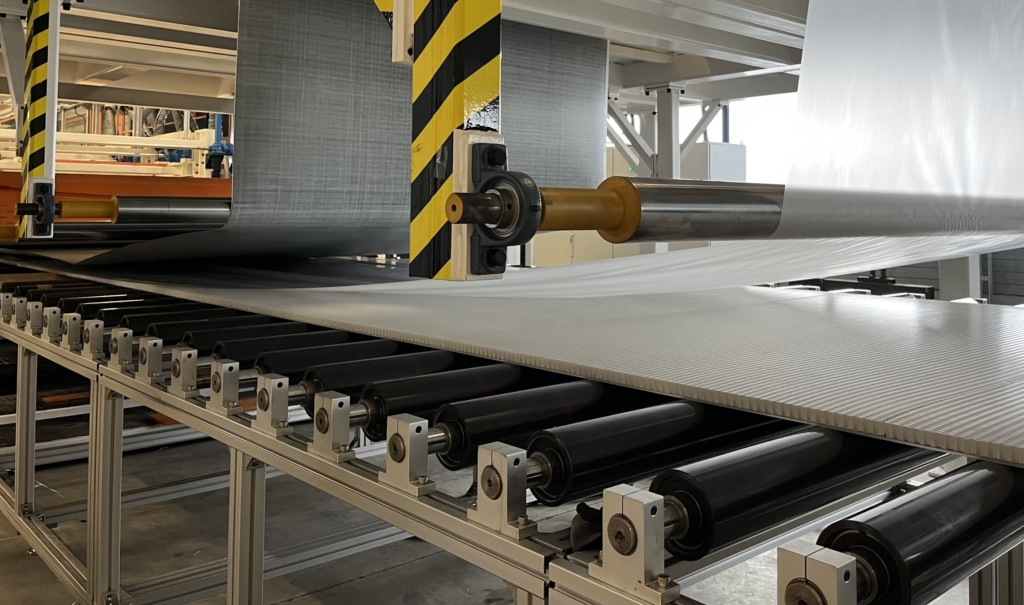
Composite formwork panels cost more than plywood at the time of purchase, but their total cost over the service life is generally lower. The purchase price varies depending on panel thickness, core material, dimensions and the required performance level. For formwork applications, the relevant question is therefore not what a panel costs, but what it costs per use. The sections below answer the most frequently asked questions about the price, reusability and cost advantages of composite formwork.
What determines the price of composite formwork?
The price of composite formwork panels is determined by four factors: the choice of core material, the thickness and dimensions of the panel, the skin construction and the required performance level. The heavier the load the panel must be able to carry, the more material and engineering go into the construction, and the higher the price per square metre.
The core material has the greatest influence on price. A PP honeycomb core offers higher compressive and flexural strength than a PP foam core of comparable thickness, but also costs more. For formwork applications where the panel must repeatedly withstand concrete pressure, a stiffer core is generally necessary. PP foam is available in densities from 40 to 140 kg/m³, which makes it possible to match the stiffness to the specific load requirements without paying unnecessarily for excess capacity.
The skin construction also helps determine mechanical performance. A 4-layer glass fibre laminate offers more flexural strength than a 2-layer version, but also increases material costs. For formwork panels that are regularly stacked, moved and cleaned, the surface finish also plays a role: an integrated anti-slip or smooth formwork layer can make additional finishing steps on site unnecessary.
Customisation and volume also affect the price. Standard dimensions are cheaper than panels cut to size. At larger order volumes, the unit cost falls. Panels with special edge finishing, private labelling or specific certifications require a higher investment, but can also reduce processing costs for the customer.
How many times can composite formwork be reused?
With correct use, composite formwork panels can be reused dozens to hundreds of times, depending on the panel construction, the concrete pressure and the conditions on site. This is a fundamental difference from plywood, which with intensive use already deteriorates visibly after five to twenty pours due to moisture absorption and delamination.
Thermoplastic composite panels are fully waterproof and resistant to delamination. They do not absorb moisture, do not swell and do not lose dimensional stability with repeated contact with concrete and water. This makes them particularly suitable for precast concrete production, where panels are used and cleaned daily. In that environment, composite panels structurally outperform timber or plywood, which warp over time and lose their flatness.
The actual service life depends on how the panel is handled. Mechanical damage caused by improper use of formwork clamps or sharp tools shortens the service life more than the concrete itself. With a good working procedure and periodic inspection, composite formwork panels in practice achieve a service life of more than ten years in industrial environments.
What are the total cost advantages compared with plywood?
Over the full service life, composite formwork panels are cheaper than plywood, even though the purchase price is higher. The difference lies in the number of replacement cycles, the labour costs of replacement and the weight of the panels. Anyone who looks only at the purchase price misses most of the cost picture.
Plywood formwork panels last three to five years with intensive use before replacement is necessary. Over a life cycle of fifteen years, that means two to three replacement cycles, each with its own material costs, labour costs for dismantling and installation, and downtime. Composite formwork panels eliminate those cycles. Even with a purchase price that is two to three times higher, the total cost per year of use is lower once you take all factors into account.
Weight also plays a role in the total cost. Composite panels are considerably lighter than plywood of comparable thickness. This speeds up the assembly and dismantling of formwork systems, reduces the physical strain on workers and lowers transport costs per shipment because more panels fit per load. In precast concrete production, where panels are moved daily, those hours add up quickly.
Maintenance is a third cost item that disappears with composite. Plywood requires periodic treatment, inspection for delamination and replacement of damaged sheets. Composite panels require no painting, no drying time and no structural repairs. Cleaning with water is sufficient.
Which composite formwork panels are suitable for precast concrete?
For precast concrete production, composite formwork panels with a PP honeycomb core and a multi-layer glass fibre laminate are the most suitable. This combination offers the high flexural and compressive strength needed to withstand concrete pressure, while the panel retains dimensional stability under daily use and intensive cleaning.
Precast concrete moulds place specific demands on the surface quality of the panel. A smooth, non-porous surface finish gives a better concrete imprint and makes demoulding easier. Composite panels with a PET film surface or a specialised formwork layer perform better here than plywood, which develops a rougher surface over time due to moisture absorption.
Customisation is often necessary in precast applications. Precast producers work with fixed mould shapes and need panels in specific dimensions, with precise tolerances and sometimes special edge finishing to prevent concrete slurry from leaking. Composite panels can be produced to size up to maximum dimensions of 13,500 mm by 2,900 mm, which covers most precast mould formats without welding or joints.
For applications with higher loads, such as thick precast elements or stacked production, the choice of core thickness and density is decisive. A thicker core with higher density increases deflection resistance, which benefits the dimensional accuracy of the finished product.
How do you request a quote for composite formwork panels?
You request a quote for composite formwork panels by describing the technical requirements of your application as concretely as possible. The more specific the information you provide, the more accurate the quote and the faster the technical discussion proceeds. Vague enquiries lead to vague prices.
Include at least the following information with your enquiry:
- Desired dimensions (length, width, thickness)
- Load requirements (maximum concrete pressure, frequency of use, stacking load)
- Surface finish (smooth for concrete imprint, anti-slip, PET film)
- Edge finishing (open edge, edge banding, special sealing)
- Volume (number of panels per order, annual volume)
- Any certification requirements (EN standards, specific load tests)
If you do not yet have final specifications, that is not a problem. A technical discussion beforehand helps to determine the right panel configuration before a price is drawn up. This prevents you from receiving a quote for a configuration that later turns out not to fit your production process or load requirements.
How we help with composite formwork
We develop and produce composite sandwich panels for companies looking for an alternative to plywood and other conventional formwork materials. We do this not as a catalogue supplier, but as a technical partner who thinks along with you about the right panel configuration for your specific application.
What that means in practice:
- We assess the load requirements of your formwork system or precast production process and advise on core material, thickness and skin construction
- We produce panels to size, including edge finishing, private labelling and specific surface finishes
- We flag structural points of attention before production starts, so you avoid costly adjustments afterwards
- We supply from our production sites in the Netherlands, fully European-made, with an annual capacity of 1.5 million square metres
Do you have a specific application in mind, or do you want to know whether composite formwork fits your production process? Contact us for a technical discussion. Together we will look at the requirements of your project and give you an honest picture of what composite formwork can mean for you, including the total cost over the service life.