

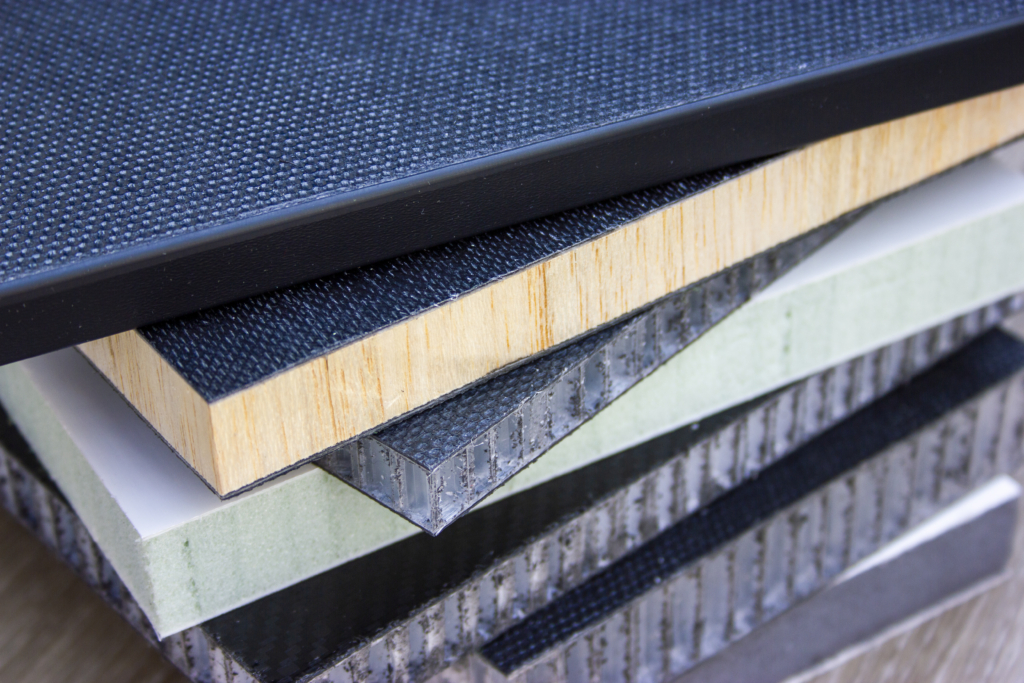
PP honeycomb is significantly lighter than aluminium honeycomb at comparable structural densities, making it the preferred core material for weight-sensitive transport applications. For truck body builders and trailer manufacturers, that weight difference translates directly into payload capacity and, in 2026, into battery range for electric vehicles. The sections below answer the most common questions buyers ask when choosing between these two core types.
Note: This article covers the broader sandwich panel market. Our range at Compoform is limited to PP honeycomb and PET foam cores for commercial vehicles and scaffolding.
Which core material is lighter — PP honeycomb or aluminium honeycomb?
PP honeycomb is lighter than aluminium honeycomb. Polypropylene has a base material density of roughly 0.9 g/cm³, while aluminium sits at approximately 2.7 g/cm³. Even accounting for the open cell geometry of both structures, a PP honeycomb core at a given panel thickness will consistently deliver a lower areal weight than an equivalent aluminium honeycomb core — often meaningfully so at the densities used in transport flooring and sidewall panels.
For transport manufacturers, this difference is not just a materials specification. Every kilogram saved in the body structure is a kilogram that can carry revenue-generating cargo. In a trailer floor or truck body sidewall, switching from aluminium honeycomb to a thermoplastic alternative can reduce structural weight by a substantial margin, depending on panel thickness and skin specification.
The EV dimension makes this argument sharper in 2026. Lighter body structures extend battery range in electric trucks and vans. Every kilogram of structural dead weight reduces range per charge, making weight reduction a range argument, not just a payload argument. This is now a standard procurement question from EV fleet buyers, and it applies directly to core material selection.
How do PP and aluminium honeycomb cores differ in structural performance?
Aluminium honeycomb generally offers higher compressive strength and stiffness per unit of core thickness than PP honeycomb at the same density. However, PP honeycomb combined with glass-fibre-reinforced thermoplastic skins produces sandwich panels that meet the structural requirements of most commercial vehicle and scaffolding applications — often with a better strength-to-weight ratio when the full panel system is considered rather than the core alone.
The key distinction is how each core behaves within a complete sandwich panel system. Aluminium honeycomb is strong in compression and shear, but the structural performance of a sandwich panel depends on the skin-to-core bond, the skin stiffness, and the overall panel geometry. A well-engineered PP honeycomb panel with high-glass-content thermoplastic skins can achieve the bending performance and load-bearing capacity that transport applications demand, without the weight penalty of metal cores.
Thermoplastic sandwich panels also benefit from the way the skin and core interact under impact. PP honeycomb absorbs energy through controlled deformation rather than brittle fracture, which is relevant for panels exposed to loading dock impacts, forklift contact, or road debris. Continuous fibre-reinforced thermoplastic skins further improve impact resistance compared to conventional composite materials — a property that matters in daily transport use.
For scaffolding applications, structural requirements are defined by EN 12811 load classifications. A 10.5 mm thermoplastic composite panel can achieve EN 12811 load class 4 with no support underneath — a concrete benchmark that demonstrates the structural capability of PP honeycomb panels in demanding load conditions.
What happens to each core material when exposed to moisture and corrosion?
PP honeycomb does not corrode and absorbs virtually no moisture. Polypropylene is chemically inert to water, road salts, cleaning chemicals, and most substances encountered in transport and industrial environments. Aluminium honeycomb, by contrast, is susceptible to galvanic corrosion, particularly when in contact with dissimilar metals or when protective coatings are damaged — a real risk in the wash-down environments of truck bodies and trailers.
In practice, this means that a PP honeycomb sandwich panel maintains its structural integrity over years of exposure to moisture without the degradation risk that affects metal cores. Aluminium honeycomb panels require careful edge sealing and surface protection to prevent moisture ingress into the cell structure, and any damage to the protective layer creates a corrosion pathway that can compromise the panel over time.
For transport applications where panels are regularly washed down, exposed to road spray, or used in refrigerated bodies with condensation cycles, the corrosion resistance of PP honeycomb is a practical durability advantage. Thermoplastic panels with properly sealed edges resist moisture ingress at the panel perimeter — the most common failure point in any sandwich panel used in wet environments.
Over a 15-year vehicle life, this durability difference has a direct cost implication. Thermoplastic composite floors last significantly longer than alternatives that degrade under moisture exposure, eliminating replacement cycles and the associated installation labour and vehicle downtime. Once you account for panel cost, labour, and lost operational days, the thermoplastic option is cheaper per year of service — even at a higher unit price.
Which honeycomb core is easier and cheaper to process and repair?
PP honeycomb panels are generally easier and cheaper to process than aluminium honeycomb panels. Thermoplastic sandwich panels can be cut with standard CNC routing equipment, drilled without specialist tooling, and formed using heat — all without the dust, chip management, or tooling wear associated with machining aluminium. This reduces processing time and cost for body builders and trailer manufacturers working at production scale.
Joining and fastening also differ between the two materials. Aluminium honeycomb panels typically require bonded inserts or specialist fasteners to achieve reliable pull-out strength, because the thin aluminium cell walls offer limited thread engagement. PP honeycomb panels with thermoplastic skins can be fastened using standard methods appropriate to the skin material, and the panel edges can be sealed or bent to protect the core without specialist processes.
Repair in the field is another practical consideration. Aluminium honeycomb panels that suffer impact damage are difficult to repair without specialist equipment and materials. A damaged cell structure in an aluminium core is not easily restored on-site. PP honeycomb panels, while also not trivially repaired, are more forgiving in terms of the tools and skills required for field intervention, and replacement panels can be cut to exact dimensions without the precision metalworking that aluminium demands.
Panels are available in custom dimensions cut to your exact specification — up to 13,500 mm × 2,900 mm — which removes the need for on-site cutting of oversized stock and reduces waste in the manufacturing process.
When should transport manufacturers choose PP honeycomb over aluminium?
Transport manufacturers should choose PP honeycomb when weight reduction, corrosion resistance, processing simplicity, and total cost of ownership over the vehicle’s life are the primary decision criteria. This covers the majority of truck body, trailer, and cargo box applications where panels are exposed to moisture, require custom dimensions, and need to perform reliably for 12 or more years without replacement.
Aluminium honeycomb retains advantages in applications where maximum compressive strength in a very thin panel is the overriding requirement and weight is a secondary concern — a profile that applies more to aerospace and specialist structural applications than to mainstream commercial vehicle manufacturing.
For European truck body builders and trailer manufacturers in 2026, the decision framework looks like this:
- Payload and range: PP honeycomb delivers lower structural weight, increasing payload capacity and extending battery range in electric vehicles — both of which have direct revenue implications for fleet operators.
- Durability: PP honeycomb does not corrode, absorbs no moisture, and maintains structural performance in wash-down and road-spray environments without protective coatings.
- Processing cost: Standard CNC routing and drilling equipment handles thermoplastic panels without specialist tooling, reducing production cost per unit.
- Lifespan: Thermoplastic composite panels last 3 to 4 times longer than plywood in heavy transport — typically 12 or more years versus 3 to 5 years for wood-based alternatives — eliminating multiple replacement cycles over a vehicle’s working life.
- Regulatory alignment: Thermoplastic PP honeycomb panels are fully recyclable, supporting compliance with the EU End-of-Life Vehicles (ELV) Directive — a compliance requirement for many European OEMs, not just a preference.
- Self-supporting floor construction: A 30 mm PP honeycomb sandwich panel floor is self-supporting, removing the need for an aluminium subframe. This eliminates a production step and reduces both material cost and assembly time for truck body builders.
How Compoform Helps with PP Honeycomb Panel Selection
We manufacture PP honeycomb sandwich panels for commercial vehicle and scaffolding applications from our production facilities in Beek and Ospel, the Netherlands. Every panel is 100% European-made, and our production line handles panels up to 13,500 mm × 2,950 mm × 150 mm — covering the full dimensional range that truck body builders and trailer manufacturers typically require.
When you bring us a project, we do not simply ship panels to a generic specification. We review your structural requirements, assembly process, and application environment, then recommend the panel configuration — core density, skin architecture, thickness, and edge treatment — that delivers the performance you need at the lowest total cost of ownership. Specifically, we can help you with:
- Selecting the right PP honeycomb density and skin layup for your load requirements, based on tested panel data rather than generic material properties
- Specifying custom panel dimensions that eliminate on-site cutting and reduce waste in your production line
- Advising on edge sealing and edge bending to protect the core in wash-down and moisture-exposed environments
- Supporting integration into your existing assembly process, including fastening methods and subframe elimination where a self-supporting floor construction is viable
- Providing documentation to support your compliance obligations under the EU ELV Directive and CSRD sustainability reporting requirements
If you are evaluating PP honeycomb panels for a truck body floor, trailer sidewall, or scaffolding board application, bring us your design and load requirements. We will review the configuration with you, identify any issues before production begins, and make sure the panel you receive performs as intended in your specific application — not just on paper.
Related Articles
- How are sandwich panel manufacturers reducing waste in production?
- Why does material choice affect resale value of commercial vehicles?
- What weight savings do sandwich panel scaffold boards offer over timber?
- What are the best sandwich panels for truck body construction?
- How to evaluate a sandwich panel datasheet?