

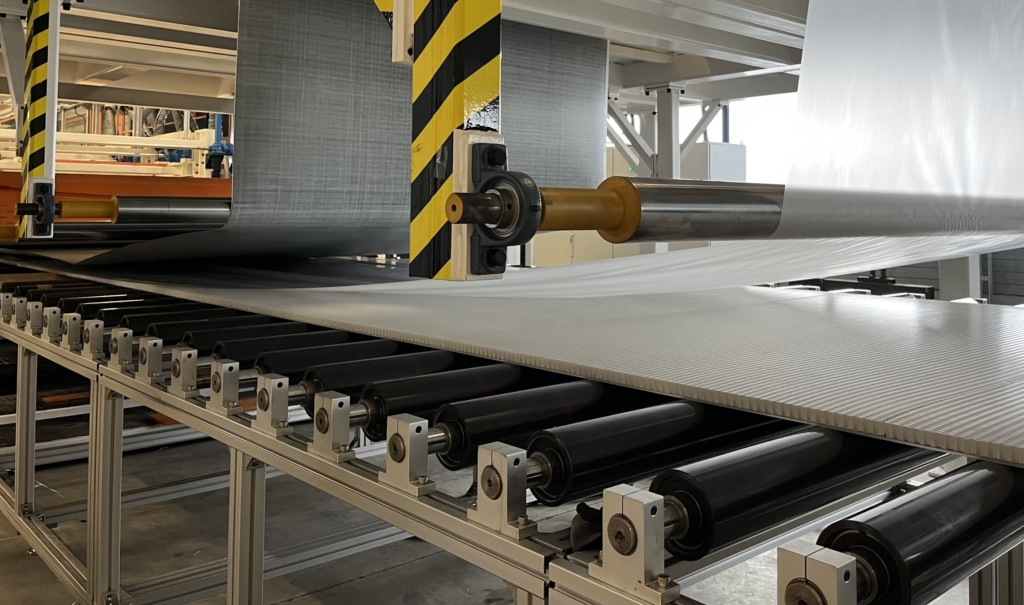
Lightweight composite formwork panels typically weigh 40 to 60% less than comparable wooden formwork panels, depending on panel thickness, core material and skin construction. For a manufacturer or contractor who moves large quantities of formwork material every day, that weight difference translates directly into lower transport costs, more panels per truck and less physical strain on the construction site. The questions below work out each of these benefits in concrete terms.
How much weight do you save with composite formwork panels?
Composite sandwich panels with a PP foam core or PP honeycomb core are considerably lighter than traditional plywood at a comparable thickness and stiffness. Where a standard 18 mm plywood formwork sheet easily weighs 12 to 14 kg per square metre, composite alternatives with an oriented PP foam core come in significantly lower. The exact weight saving depends on the chosen core thickness, core density and skin construction, but a weight reduction of 40 to 60% is realistic for comparable applications.
That saving is not just a number on a datasheet. On a project where hundreds of square metres of formwork are deployed, the total weight difference quickly adds up to several tonnes. This has a direct impact on transport, handling and the load on lifting equipment on site. Composite panels also retain their structural properties over multiple use cycles, so the weight advantage repeats with every repositioning and every transport.
An additional benefit is tailorability: by adjusting the core density, you can balance the weight and stiffness of a composite panel for your specific application. PP foam is available in several density classes, which leaves room to optimise the panel without adding unnecessary weight.
Which transport costs fall with lighter formwork?
Lighter formwork panels reduce transport costs in several ways at once: lower fuel consumption per trip, fewer trips for the same quantity of material, and lower costs for road tax and vehicle wear. For carriers and contractors who regularly move formwork over longer distances, these are structural savings that count on every project.
Trucks are limited by weight or volume, depending on which limit is reached first. Traditional plywood formwork is heavy enough to hit the weight limit before the load volume is full. With lightweight composite panels, that balance shifts: you make better use of the available load volume without exceeding the permitted axle load. That means fewer trips for the same amount of formwork, and therefore less fuel, less driver time and less wear on the vehicle.
For fleet managers making the switch to electric trucks, the weight argument is even stronger. A lighter load extends the range per charge. Every kilogram of structural dead weight you eliminate contributes directly to more kilometres per charging cycle. In 2026, this is a standard purchasing question among EV fleet managers: weight reduction is not only a payload argument, but a range argument.
How many more panels fit on one truck?
With lightweight composite formwork panels, considerably more panels fit on a single truck with a 24-tonne payload than with traditional plywood. If composite panels are 50% lighter, you can theoretically transport twice as many square metres of formwork per trip before reaching the weight limit.
In practice, the exact number depends on the dimensions of the panels, their stackability and the available loading space. Composite sandwich panels can be produced in large formats, which makes stacking more efficient and makes better use of the space in the trailer. Fewer trips for the same quantity of material mean lower logistics costs per project and a smaller CO₂ footprint per square metre of formwork delivered.
For formwork rental companies that move material between depots and construction sites every day, this advantage is particularly relevant. Fewer trips per day not only reduce direct transport costs, but also improve planning capacity and reduce pressure on the fleet.
What is the effect on CO₂ emissions and sustainability?
Fewer trips and lower fuel consumption per trip directly reduce the CO₂ emissions of transport. But the sustainability benefit of composite formwork panels goes beyond transport emissions: the longer service life of the material reduces the total production demand over the lifecycle of a project.
Plywood formwork panels typically last three to five years in intensive use before being replaced. Thermoplastic composite panels perform considerably longer under comparable conditions, which reduces the number of replacement cycles and the associated production and transport emissions. Less replacement means less raw material consumption, less production energy and less waste transport.
Thermoplastic panels also have a recycling advantage over thermosets: the materials can be reprocessed at the end of their service life. For European OEMs and contractors reporting under the CSRD, this is a relevant compliance argument, not just a sustainability preference. The EU ELV Directive imposes similar requirements on materials used in vehicles, which further increases the pressure on recyclability.
What logistical benefits does lightweight formwork offer on site?
On the construction site itself, lightweight formwork offers advantages in handling, placement time and safety. Panels that weigh less can be moved by fewer people, require less heavy lifting equipment and reduce the physical strain on site workers.
Concrete benefits include:
- Faster placement and dismantling: Lighter panels are easier to handle, which shortens the cycle time per formwork round.
- Less lifting equipment needed: With smaller panels or lower weights, manual handling may suffice where a crane or forklift would otherwise be required.
- Lower labour costs: Faster handling with fewer people reduces labour costs per formwork cycle.
- Less damage during on-site transport: Composite panels are more robust than plywood when exposed to impacts and wet conditions, which reduces the risk of damage during internal transport.
- Better dimensional stability: Composite panels do not shrink or swell with moisture, which improves the accuracy of the formwork assembly.
For contractors who reposition formwork multiple times per project, these benefits add up again with every cycle. The total time saving over a project can be considerable, especially on large-scale projects with a high repetition frequency.
How does Compoform help with lightweight formwork panels?
We develop and produce thermoplastic sandwich panels with PP honeycomb or PP foam cores that are suitable as an alternative to traditional formwork materials. Our panels combine low weight with the structural performance needed for repeated industrial use in concrete and formwork applications.
What we offer specifically for formwork applications:
- Custom panels in sizes up to 13,500 mm × 2,900 mm, cut to your specification
- A choice of several core density classes to balance weight and stiffness for your application
- Glass fibre reinforced thermoplastic skins for high impact resistance and a long service life
- 100% European production from our facilities in the Netherlands
- Technical support in evaluating panel configurations for your specific formwork design
We do not operate as a commodity supplier that ships panels to order. Instead, we review the design together with you, optimise the panel configuration for your production process and flag technical points of attention before production starts. This way you avoid costly modifications afterwards and ensure that the end product meets your customers’ requirements.
Want to know whether composite formwork panels are suitable for your application? Get in touch to discuss the possibilities with our technical team.
Related Articles
- Which formwork material lasts longer: composite or plywood?
- How do composite and plywood panels compare in dimensional stability?
- Which is easier to clean: composite or plywood formwork?
- How to spot early signs that your sandwich panels are failing prematurely?
- What is the best lightweight sandwich panel for a campervan build?