

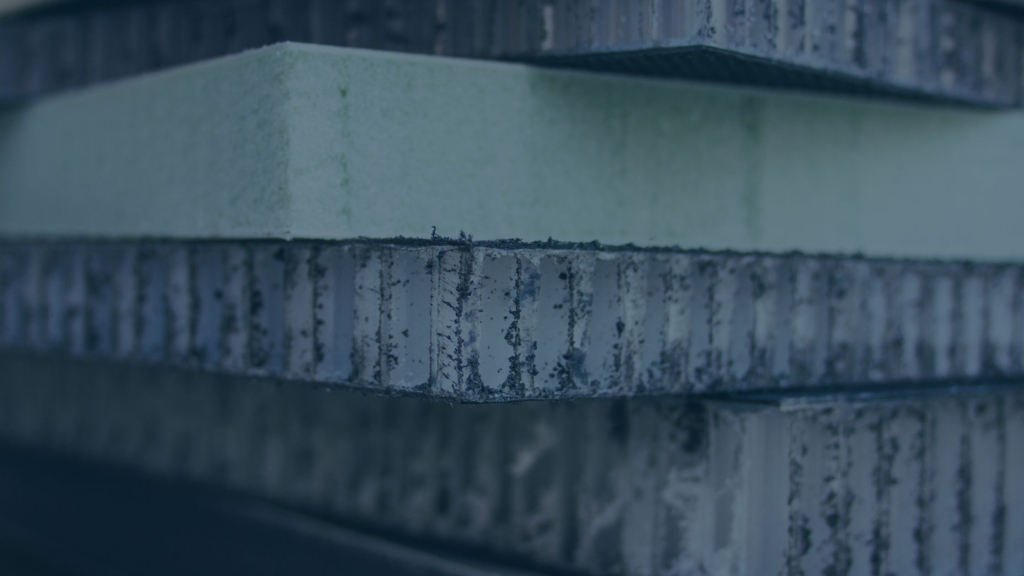
Early signs of panel failure include visible surface changes like bubbling, discoloration, or edge separation, along with structural indicators such as unexpected flex, soft spots underfoot, or hollow sounds when tapped. Catching these signs early matters because composite sandwich panels rarely fail suddenly; degradation builds gradually, and the damage accelerates once moisture or delamination takes hold. The questions below unpack each warning sign in detail, from what causes premature failure to when replacement becomes unavoidable.
What are the most common causes of premature panel failure?
The most common causes of premature sandwich panel failure are moisture ingress, mechanical overload, poor edge protection, and mismatched panel specification for the application. Each of these weakens the bond between skin and core, reduces structural integrity, or accelerates surface degradation, often in combination rather than isolation.
In transport applications — truck bodies, trailers, cargo boxes — the dominant failure drivers are repeated mechanical loading beyond the panel’s design capacity and inadequate edge sealing that allows wash-down water or road spray to penetrate the core. Panels specified for wall applications but installed as flooring are a frequent culprit: the bending and compressive demands are fundamentally different, and a panel optimized for one role will degrade faster in the other.
In scaffolding, the failure pattern shifts. Directional loading across the plank width is the primary stress, and panels without the correct fiber orientation in the transverse direction lose stiffness faster under repeated foot traffic and point loads. UV exposure compounds this in outdoor environments, gradually degrading surface films and weakening the skin-to-core bond over time if the surface is not rated for prolonged outdoor use.
Installation errors also contribute significantly. Panels cut without proper edge treatment, fastened incorrectly, or stored flat in humid conditions before installation can arrive on-site already compromised. The failure then appears to happen in service, but the damage started earlier.
What does delamination look like in a composite sandwich panel?
Delamination in a composite sandwich panel appears as a visible or tactile separation between the outer skin and the core material. Early-stage delamination often shows as a slight bulge, blister, or ripple on the panel surface. In more advanced cases, the skin lifts away from the core, creating a hollow void that you can feel by pressing the surface or hear by tapping it — a dull, drum-like sound instead of a solid response.
The progression typically follows a pattern:
- Stage 1: Micro-separation at the bond line, invisible to the eye but detectable by tapping — the sound changes from solid to slightly hollow
- Stage 2: Visible surface distortion, often a subtle ripple or raised area, sometimes accompanied by discoloration at the edges
- Stage 3: Full skin separation over a measurable area, with the skin moving independently of the core under hand pressure
- Stage 4: Structural compromise — the panel can no longer distribute loads across both skins, and localized failure becomes likely under normal service loads
Delamination is particularly dangerous in floor panels because it is not always visible from above. A floor panel that looks intact from the surface may have lost its bond integrity underneath, meaning the compressive and bending performance has dropped significantly without any obvious warning. In a 30 mm PP honeycomb floor panel, for example, the structural performance depends on both skins working together — once one skin separates, the load-bearing capacity drops sharply.
Edge zones and fastener points are where delamination typically initiates. These are the areas of highest stress concentration and, in poorly sealed panels, the entry points for moisture that weakens the adhesive bond over time.
How can you tell if moisture has entered your panel core?
Moisture ingress into a sandwich panel core shows through a combination of weight gain, surface staining, edge discoloration, and reduced stiffness. A panel that has absorbed water into its core will feel noticeably heavier than a comparable dry panel of the same specification. In cold conditions, moisture-laden panels may also show frost patterns or condensation on the surface that dry panels do not exhibit.
Practical indicators to check include:
- Edge staining: Brown or dark discoloration along cut edges, particularly at the bottom of vertical panels or around fastener holes, signals water tracking into the core
- Surface bubbling: Moisture trapped between the skin and core expands under heat, creating small blisters or bubbles on the panel face
- Soft spots: Areas where the core has degraded from prolonged moisture contact feel softer underfoot or under hand pressure than the surrounding panel
- Odor: In panels with organic core materials, moisture ingress can produce a musty smell — less relevant for thermoplastic cores, but a useful indicator in mixed-material assemblies
- Weight comparison: If you have access to a dry reference panel of the same specification, a significant weight difference in a used panel of the same size points to moisture absorption
Thermoplastic cores — PP honeycomb and PET foam — are inherently more moisture-resistant than organic alternatives, but they are not immune. Moisture enters primarily through unprotected cut edges, damaged surface films, or failed fastener seals. Once inside a honeycomb core, water migrates through the cell structure and is very difficult to remove without replacing the panel entirely. This is why edge sealing at the time of installation is not optional — it is the primary defense against moisture-driven failure.
Why do panels fail faster in some applications than others?
Panels fail faster when the application imposes loads, environmental conditions, or mechanical stresses that exceed what the panel was specified to handle. The same panel that lasts over a decade in a protected wall application may degrade within a few years as a floor panel in a heavy transport vehicle — not because the panel is defective, but because the application demands are fundamentally different.
Load type and frequency
Floor panels in trailers and truck bodies face repeated compressive and bending loads from forklift traffic, pallet drops, and dynamic road vibration. These cyclic loads fatigue the skin-to-core bond over time. Wall panels in the same vehicle carry far lower structural demands and degrade much more slowly as a result. Scaffolding panels face a different challenge: transverse bending across the plank width under concentrated point loads from foot traffic and equipment. A panel without the correct fiber orientation in the transverse direction — such as the 90-0-90 layup used in scaffolding applications — will lose stiffness faster under this specific load pattern.
Environmental exposure
Outdoor applications accelerate UV degradation of surface films and adhesive bonds. Panels without adequate UV resistance ratings will show surface chalking, color shift, and eventual skin embrittlement. White PET-film wall panels, for instance, are rated for over 22,000 hours of UV resistance — a specification that reflects the demands of long-term outdoor exposure. Panels without equivalent ratings will fail faster in the same environment. Chemical exposure — cleaning agents, road salts, fuel spillage — adds another degradation pathway that varies significantly by application.
Installation quality
Two identical panels installed differently will have very different service lives. Panels with unprotected cut edges, over-torqued fasteners that crack the skin, or inadequate support at span midpoints will fail faster regardless of their inherent material quality. The application environment and the installation method together determine real-world service life — not the panel specification alone.
When should a failing panel be repaired versus replaced?
A failing sandwich panel should be repaired when the damage is localized, the core remains structurally sound, and the skin bond is intact in the surrounding area. Replacement becomes necessary when delamination covers a significant portion of the panel, moisture has penetrated the core, or the panel no longer meets the load requirements of the application. Attempting to repair a panel with widespread core degradation typically delays rather than prevents replacement.
Use these criteria to guide the decision:
- Repair is appropriate when: Surface damage is cosmetic, a small edge zone has separated but the core is dry, or a fastener point has cracked the skin locally without affecting the bond across the panel
- Replacement is necessary when: Delamination covers more than a small fraction of the panel area, moisture has entered the core, the panel has visibly deflected beyond its design tolerance, or structural testing shows load capacity has dropped below the application requirement
- Replacement is urgent when: The panel is in a load-bearing application — a scaffold board, a truck floor, a trailer deck — and shows any sign of core compromise. In these cases, the risk of sudden failure under service load makes continued use unsafe
From a total cost perspective, early replacement of a genuinely compromised panel is almost always cheaper than a delayed replacement after a structural failure. Downtime, secondary damage, and liability exposure from a panel failure in service far exceed the cost of a planned panel swap. Over a 15-year vehicle life, thermoplastic composite floors typically eliminate two to three plywood replacement cycles — but only when the panel specification matches the application from the outset. A misspecified panel replaced twice in that period loses most of its lifecycle cost advantage.
How does panel quality at the manufacturing stage affect long-term durability?
Manufacturing quality directly determines how long a sandwich panel performs in service. The consistency of the skin-to-core bond, the uniformity of core density, the accuracy of fiber orientation, and the quality of surface films all influence how the panel responds to load, moisture, and UV exposure over its service life. Panels produced with inconsistent bonding or variable core density will show earlier delamination and uneven load distribution in service.
Several manufacturing factors have a measurable impact on durability:
- Bond line consistency: A uniform, void-free bond between skin and core is the foundation of panel durability. Variations in bonding pressure, temperature, or adhesive application during production create weak zones that initiate delamination under load
- Fiber orientation accuracy: In directionally optimized panels — such as scaffolding boards using a 90-0-90 layup — precise fiber placement determines transverse strength. Deviations from the specified layup reduce performance in exactly the direction the application demands
- Core density uniformity: PP honeycomb and PET foam cores must maintain consistent density across the panel to distribute loads evenly. Density variation creates soft spots that concentrate stress and fail earlier
- Surface film quality: UV resistance, color stability, and moisture barrier performance all depend on the surface film specification and how consistently it is applied. A white PET film with a whiteness index of 84 and over 22,000 hours of UV resistance delivers predictable outdoor performance — but only if applied uniformly and bonded correctly to the skin
- Edge treatment: Panels that leave the production line with properly sealed edges arrive on-site with their primary moisture defense already in place. Panels that require field edge sealing introduce a variable that depends entirely on installation quality
ISO-certified manufacturing with batch-level quality control reduces the variability that causes early failure. When every production batch is tested against the same mechanical and dimensional standards, the panels that arrive on-site perform as specified — not as a statistical average with outliers at either end.
How Compoform Helps You Identify and Prevent Panel Failure
We work with truck body builders, trailer manufacturers, and scaffolding companies to specify panels that match the actual demands of the application — before production begins, not after the first failure appears in the field.
Here is what that looks like in practice:
- Application review: We review your design and loading conditions to confirm the correct panel specification — core type, skin layup, thickness, and surface film — for your specific use case. A 30 mm PP honeycomb floor panel that is self-supporting eliminates the aluminium subframe from your build process entirely, which removes a production step and reduces cost
- Edge sealing guidance: We advise on edge protection methods suited to your assembly process, whether that is factory-applied edge banding or field sealing for panels cut to custom dimensions on-site
- Dimensional accuracy: Panels are available cut to your exact specification, reducing the field cutting that creates unprotected edges and increases moisture risk
- Long-term performance data: Our panels are tested to European standards including EN 13501-1 for fire classification and ISO 4892-2 for UV resistance, giving you documented performance data to support procurement decisions and compliance requirements
- EV fleet compatibility: For electric truck and van body builders, every kilogram saved in panel weight extends battery range per charge. In 2026, this is a standard procurement question from EV fleet buyers — and a lighter composite floor answers it directly
Thermoplastic composite floors last three to four times longer than plywood in heavy transport applications — typically 12 or more years versus three to five for plywood, based on Compoform’s own field experience. Over a 15-year vehicle life, that eliminates two to three replacement cycles. Once you factor in panel cost, installation labor, and vehicle downtime, the composite floor is cheaper per year of service even at a higher unit price.
If you are seeing early signs of failure in your current panels, or specifying panels for a new build and want to avoid the failure modes described above, speak with our engineering team about your application. We will review your application, identify where your current specification may be creating risk, and recommend a configuration that performs for the full service life of your vehicle or structure.