

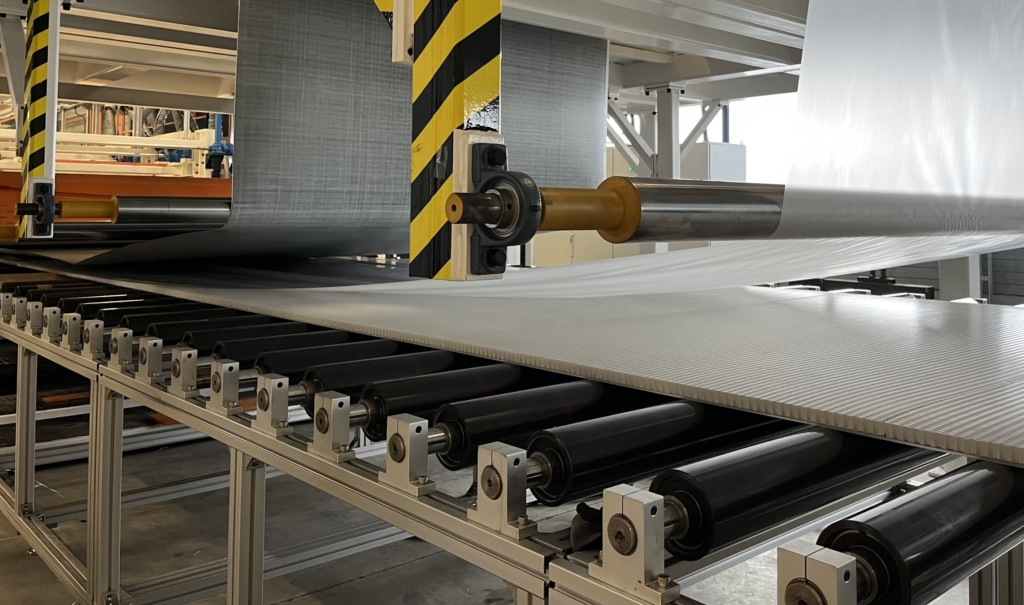
Moisture exposure significantly reduces the durability of formwork materials. Traditional materials such as plywood absorb moisture, swell, lose strength and warp after repeated use. Composite panels offer an alternative that remains structurally stable in wet construction conditions. The questions below cover the most relevant aspects of moisture damage and when switching to composite formwork makes financial sense.
What damage does moisture cause in traditional formwork materials?
In traditional formwork materials such as plywood, moisture causes a range of problems: swelling, delamination, mould growth and loss of load-bearing capacity. When water penetrates the wood layers, the adhesive bonds between the veneer layers break down. The result is a panel that loses its flatness, can bear less load and fails sooner with repeated use.
In practice, this means that plywood formwork panels measurably weaken after exposure to rain, concrete water and cleaning procedures. The surface layer roughens, which directly affects the quality of the concrete finish. Mould and bacteria that settle in the damp wood accelerate the deterioration further. At freezing temperatures, water freezing in the wood pores increases the damage even more, as the material splits open from the inside.
For manufacturers of formwork systems and contractors who reuse panels intensively, this moisture damage translates directly into higher replacement costs and unexpected downtime on site.
How does moisture absorption affect the dimensional stability of formwork panels?
Moisture absorption causes dimensional changes in formwork panels because the material expands as it absorbs moisture and shrinks as it dries. With plywood, this can amount to several millimetres per cycle. This dimensional instability is a direct problem for formwork systems that require precise fit and repeatability.
Dimensional stability in formwork is not a cosmetic matter but a technical requirement. Panels that do not stay flat or that change size no longer fit the formwork structure properly. This leads to concrete leakage along the joints, uneven concrete surfaces and additional finishing work. In precast concrete production, where dimensional accuracy directly determines the quality of the end product, this is a particularly costly problem.
Repeated wet-dry cycles aggravate the effect. Every use on site brings a new cycle of moisture absorption and drying. Plywood that initially falls within tolerances can be significantly deformed after ten or twenty use cycles.
How many reuse cycles does plywood lose due to moisture exposure?
In practice, plywood formwork panels typically achieve ten to twenty use cycles before the quality of the concrete finish becomes unacceptable. In intensive or wet conditions, this number can be lower. The exact service life depends on the quality of the plywood, the coating used and the way the panels are cleaned and stored.
Every cycle in which the panel gets wet and dries again affects the surface coating and the adhesive bonds. Over time, the surface becomes porous, concrete adheres to the panel and the likelihood of cracking increases. This means more time spent on cleaning, greater wear on the formwork structure and, ultimately, replacement of the panel.
For companies that rent out formwork panels or use them intensively on large projects, this loss of cycles counts directly towards total costs. A panel that is rejected five cycles earlier represents a concrete loss of return per panel.
Are composite panels moisture-resistant as a formwork material?
Thermoplastic composite panels are inherently moisture-resistant because the materials used, such as polypropylene and glass-fibre-reinforced thermoplastic skin layers, do not absorb water the way wood does. There is no adhesive bond that moisture can attack and no organic material that rots or grows mould.
Composite panels based on thermoplastic sandwich constructions combine a rigid core with reinforced skin layers that protect the panel against moisture, alkaline conditions and mechanical loads. In well-designed composite panels, moisture absorption stays well below the threshold that causes mechanical degradation. Our panels are tested according to ISO 62 and achieve a water absorption of less than 1.5%, which does not affect the structural properties.
Concrete water is also strongly alkaline, which causes additional degradation for many materials. Thermoplastic composites are resistant to alkaline conditions. Compoform tests panels for alkaline ageing for 500 hours at 50 °C in lime water, a condition comparable to prolonged contact with fresh concrete. The test results show no mechanical deterioration that compromises their suitability as a formwork material.
Edge sealing plays an important role here. Properly sealed panel openings and edges prevent moisture from reaching the core via cut edges, which extends the service life further.
When does switching to composite formwork make financial sense?
Switching to composite formwork makes financial sense when the total cost over the usage period is lower than with plywood. That point is reached when the higher purchase price of composite is offset by fewer replacements, lower labour costs for maintenance and less downtime on site.
A concrete calculation example illustrates this. Suppose a plywood panel achieves ten to fifteen use cycles and a composite panel achieves fifty or more. Over a project period of five years, that means three to five replacements of the plywood panel versus a single purchase of the composite panel. Added to this are the labour costs of replacement, transport costs for disposing of discarded panels and the production loss caused by unplanned replacement.
Factors that determine the payback period
The payback period differs per situation. The following factors determine how quickly composite formwork pays for itself:
- Frequency of use: the more often panels are used, the sooner the difference in service life shows up in the costs
- Site conditions: wet, dirty or aggressive environments accelerate the wear of plywood disproportionately
- Labour costs for replacement: in markets with high labour costs, every avoided replacement counts heavily
- Quality requirements for the concrete finish: higher requirements mean plywood is rejected sooner, which shortens its effective service life
When the business case is strongest
The business case for composite formwork is strongest for formwork system rental companies, precast concrete producers with high dimensional accuracy requirements and contractors who use panels across multiple projects. For single use on a small project, the higher investment is less quickly recovered. For intensive, repeated use, composite is in most cases cheaper per use cycle than plywood.
How we help with durable formwork panels
We develop and produce thermoplastic sandwich panels suitable for concrete formwork applications. Our approach does not start with a standard catalogue but with an analysis of your specific application: what loads must the panel absorb, how many use cycles are you aiming for, what dimensions are required and how will you integrate the panel into your existing formwork structure?
What we can do for manufacturers of formwork systems and precast concrete producers:
- Custom panel construction: core, skin material and thickness are tailored to your load requirements and weight targets
- Moisture-resistant construction: thermoplastic materials with a water absorption below 1.5% (ISO 62) that are resistant to alkaline conditions
- Large dimensions: panels up to 13,500 mm × 2,950 mm, produced at our facilities in the Netherlands
- Technical support: we review your design, flag risks for production and optimise the panel construction before production starts
We do not supply panels on the basis of a specification sheet alone. We work as a technical partner who understands your application and thinks along with you about integration into your product or process. Get in touch via our contact page to discuss your formwork application and explore which composite solution fits your situation.
Related Articles
- How do lightweight sandwich panels help manufacturers meet EU emissions targets?
- Can sandwich panels be used for both walls and floors in a campervan?
- Why are motorhome manufacturers switching to sandwich panel walls?
- What is the difference between a warm dak and a cold dak core structure?
- What is a sandwich panel?