

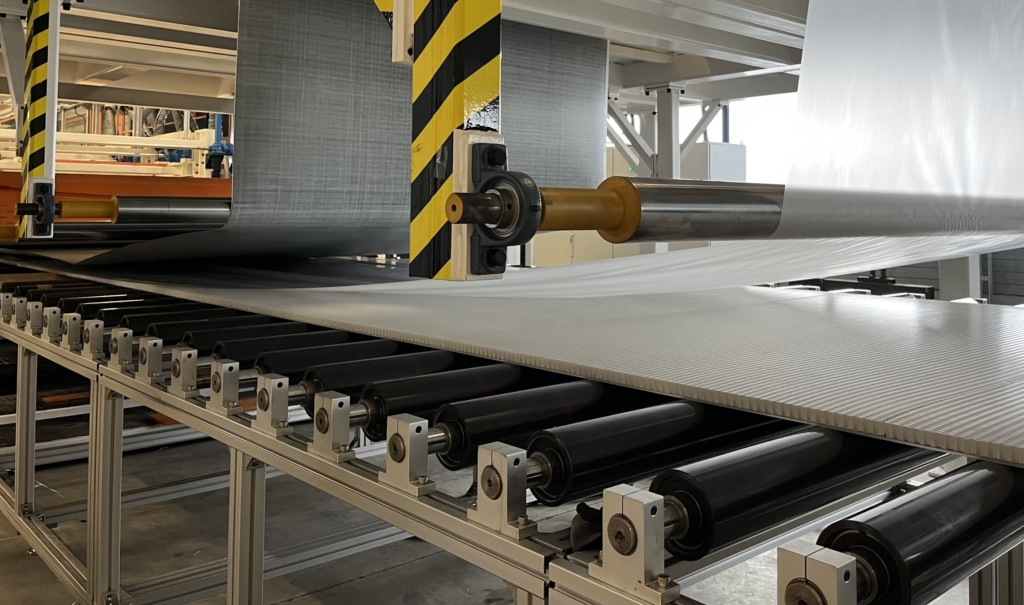
The weight of formwork panels has a direct impact on labour costs on the construction site. Heavier panels require more time per handling operation, more often need two people for the same task, and increase the risk of fatigue and injury. Lightweight composite formwork panels can reduce those costs structurally, both per project and over the full service life of the material. The questions below work this through, from practical handling time to the financial payback period.
How much time does lifting and placing heavy formwork panels take?
A heavy plywood formwork panel requires on average two to three times as much handling time as a comparable lightweight panel. Not because the operation itself is different, but because the weight slows every step: positioning, securing, moving and stacking all take more time when a panel weighs 30 to 40 kilograms instead of 15 to 20 kilograms.
In practice, this means a team of two is needed for operations that one person could perform with a lighter panel. That extra person does not stand idle: they are available for other tasks. When you calculate this across a full formwork cycle, with dozens or hundreds of panels per day, the time difference adds up quickly.
Fatigue also plays a role. At the start of a shift, placing goes quickly. After several hours with heavy panels, the pace drops, the likelihood of errors increases, and the risk of damage to both the panels and the workers rises. Lightweight panels keep the working pace more stable throughout the day.
What are the ergonomic risks of heavy formwork panels on the construction site?
Heavy formwork panels increase the risk of musculoskeletal disorders, particularly in the back, shoulders and wrists. Repeatedly lifting panels above the recommended lifting limit of 25 kilograms per person, combined with awkward postures on the construction site, is one of the most common causes of work-related injury in the construction sector.
The consequences are both human and financial. Absence due to back problems or muscle injuries leads to the loss of experienced workers, higher sickness absence costs and possible replacement by less experienced staff. In some cases, repeated heavy lifting leads to long-term or permanent absence.
Under occupational health and safety policy and risk assessment requirements, employers are obliged to assess lifting risks and reduce them where possible. Using lighter panels is a direct measure that structurally lowers the lifting risk, without requiring changes to working methods or additional aids. That makes panel weight not just a logistical choice, but also an occupational health and safety issue.
How much lighter are composite formwork panels compared with plywood?
Depending on the specification, composite formwork panels are up to 65% lighter than comparable plywood panels. The exact weight difference depends on the thickness, the core material and the skin build-up of the composite panel. At greater thicknesses, the relative weight saving is generally largest.
By way of illustration: a 17 mm wall panel with a PP foam core has a surface weight of approximately 2,763 g/m², whereas a comparable plywood panel of the same thickness is considerably heavier because of the higher density of the wood. For larger formats, such as the panels up to 13,500 mm × 2,900 mm that we produce, that weight difference translates directly into a significant difference in lifting weight per panel.
It is important to assess the specifications for each application. A composite panel optimised for wall formwork has a different build-up from a panel for floor formwork or for reuse in precast concrete production. The weight saving is real, but the right configuration depends on the load requirements of your specific application.
How does panel weight affect the total cost of ownership of formwork?
Panel weight affects the total cost of ownership of formwork in four ways: labour costs per cycle, transport costs, replacement frequency and risk of damage. Together, these factors determine whether a cheaper panel on the purchase invoice is also cheaper over the full period of use.
Labour costs make up the largest share. Every extra minute per panel per cycle adds up over hundreds of formwork cycles per year. A team that spends less time each day on lifting and positioning can handle more cycles per day or carry out the same amount of work with fewer people.
Transport and logistics also benefit from lower weight. Lighter panels increase the load density per trip, which reduces the number of transports required. For large projects or rental fleets with frequent transport, this is a measurable cost advantage.
Service life and replacement are the third element. Thermoplastic composite panels last considerably longer than plywood under intensive use. Where plywood formwork panels have to be replaced after three to five years, a composite panel lasts twelve years or more with proper use. Over a project life of fifteen years, you thereby eliminate two to three replacement cycles, including the associated material costs, installation labour and downtime.
Damage and maintenance are the fourth element. Heavier panels are harder to handle and are damaged more often during transport and storage. Composite panels are waterproof, rot-free and delamination-resistant, which limits maintenance costs and premature write-off.
When is switching to lightweight formwork panels financially worthwhile?
Switching to lightweight composite formwork panels is financially worthwhile when the savings on labour, transport and replacement outweigh the higher purchase price. For most intensive applications, this break-even point is reached within two to four years, depending on frequency of use and hourly labour costs.
A concrete calculation helps. Suppose a team moves 200 panels per day and lighter panels save an average of one minute per panel. That is 200 minutes per day, well over three working hours. At an hourly rate of 40 euros, that is 120 euros per working day. Over 200 working days per year, that yields a labour saving of 24,000 euros, from handling time alone.
Add to that the avoided replacement costs. If composite panels eliminate two plywood replacement cycles over a period of twelve years, and each cycle costs material plus installation, then the total saving over the service life is substantial, even if the composite panels cost two to three times more to purchase.
The payback period is shortest in:
- High frequency of use, such as rental fleets or large contractors with continuous projects
- Applications where two people are needed to lift standard plywood panels
- Projects with high transport costs or limited loading capacity
- Environments with high humidity or chemical exposure, where plywood degrades quickly
- Organisations with high labour costs or an active occupational health and safety policy
For low frequency of use or one-off applications, the payback period is longer and a detailed cost-benefit analysis for each project is advisable.
How we help with the switch to lightweight formwork panels
We develop and produce composite sandwich panels for formwork applications, as an alternative to plywood and other conventional materials. We do this not as a supplier delivering made-to-measure panels, but as a technical partner who thinks along with you about the configuration that best fits your application, production process and cost targets.
What we can do for you in concrete terms:
- Tailor the panel build-up to the load requirements of your formwork system, so you do not pay for more strength than necessary
- Balance weight and mechanical performance: a lighter panel does not have to compromise on stiffness or compressive strength when the core choice and skin build-up are properly matched
- Supply custom sizes up to 13,500 mm × 2,900 mm, including edge finishing that protects the core against moisture and UV exposure
- Provide the technical documentation and test results that your R&D or purchasing team needs for the evaluation
- Review your design for manufacturability and flag potential bottlenecks before production starts
Our panels are 100% European-made in Ospel, the Netherlands. We work with thermoplastic cores based on PP foam and PP honeycomb, combined with glass-fibre-reinforced skin layers. That combination delivers panels that last twelve years or longer under intensive use, without painting, drying or structural repairs.
Want to know whether composite formwork panels are financially viable for your application? Get in touch for a technical conversation. Together we will review the specifications, the usage profile and the expected cost savings, so that you can make a well-founded decision.
Related Articles
- How do thermoplastic sandwich panels compare to thermoset on sustainability?
- How do sandwich panels hold up in outdoor and off-road RV use?
- How do sandwich panels reduce the tare weight of a motorhome?
- How do sandwich panels reduce payload dead weight in freight vehicles?
- What face sheet materials are used on composite sandwich panels?