

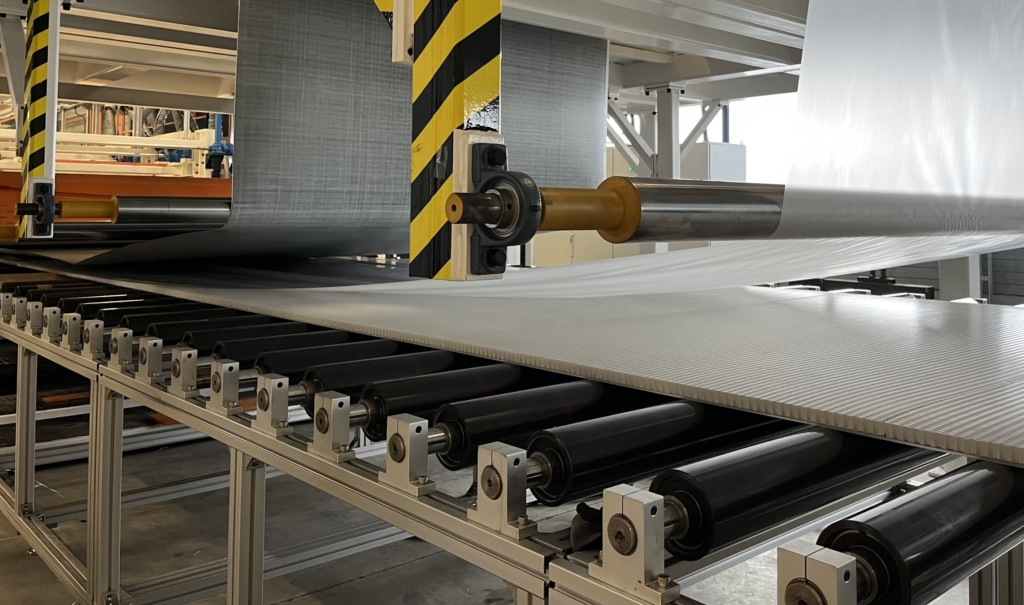
You choose the right composite formwork system by first defining your technical requirements: the number of use cycles, the concrete pressure, the desired weight and the dimensions. Compared with plywood, composite panels offer a longer service life, lower maintenance costs and a more consistent surface quality. The questions below help you work through the key selection criteria step by step.
What are the advantages of composite over plywood formwork?
Composite formwork panels outperform plywood on several points. They are water-resistant, rot-proof and dimensionally stable under varying humidity and temperature. As a result, they retain their flatness and strength across more use cycles, whereas plywood delaminates, warps and loses its load-bearing capacity over time.
The practical benefits are concrete. Composite panels do not need to be painted, dried or repaired after each use. A rinse or a wipe-down is enough. This saves time on site and lowers labour costs per cycle. In addition, a lighter panel offers a direct advantage when assembling and dismantling the formwork: less physical strain for the worker and faster turnaround times.
From a total cost perspective, the difference is most convincing. Plywood formwork panels last an average of three to five years in intensive use. A composite alternative lasts twelve years or more in comparable conditions. Over the lifetime of a project or fleet, that eliminates two to three replacement cycles, including the associated panel costs, assembly labour and downtime. Even with a higher purchase price, composite is cheaper per year of use.
Composite also delivers a better and more consistent concrete surface. Because the material does not absorb moisture and does not deform, the imprint on the concrete remains uniform, even after repeated use. This is relevant for precast concrete producers who set high standards for dimensional accuracy and finish quality.
Which technical properties determine the suitability of a composite formwork panel?
The suitability of a composite formwork panel for concrete formwork depends on four main technical properties: flexural strength, stiffness, surface hardness and dimensional stability. Together they determine whether a panel can withstand the concrete pressure, retain its flatness and produce a smooth imprint without deforming or failing.
Mechanical strength and stiffness
Formwork panels are under considerable pressure while concrete is being poured. The flexural strength and flexural stiffness of the panel, measured in accordance with ISO 14125, determine how much it deflects under a given load and support spacing. A panel with insufficient stiffness visibly bends and produces an uneven concrete surface. The core construction of a sandwich panel, whether PP foam or PP honeycomb, plays a decisive role here: a thicker core increases stiffness without adding proportional weight.
Surface quality and moisture resistance
The surface of the panel determines the quality of the concrete imprint. A smooth, non-absorbent surface produces an even concrete finish and allows the panel to release easily. Composite panels with a PET film finish or a coated glass fibre surface do not absorb water and do not swell, which is a risk with plywood. Moisture resistance is also relevant to service life: a panel that does not delaminate or rot retains its mechanical properties throughout its entire period of use.
Weight and dimensions
The weight per square metre determines how quickly a formwork system can be assembled and moved. Lighter panels reduce physical strain and make it possible for one person to handle a panel without help. The maximum dimensions are equally relevant: for large formwork surfaces, larger panels are more efficient because they create fewer joints and can be placed faster. Composite panels are available in considerably larger dimensions than standard plywood.
How many times can a composite formwork panel be reused?
In practice, a composite formwork panel achieves considerably more use cycles than plywood. Whereas plywood needs replacing after twenty to fifty cycles in intensive use, composite panels are designed for hundreds of cycles, depending on the construction, the usage and the conditions on site.
The exact number of cycles depends on several factors: the concrete pressure to which the panel is exposed, the way the panel is stripped and cleaned, the storage conditions and the quality of the panel construction itself. A glass fibre-reinforced thermoplastic sandwich panel with a hard outer skin is considerably more robust than a panel with a softer core or a thin finishing layer.
It is also important that composite panels retain their properties consistently over the period of use. Plywood gradually loses stiffness and surface quality as it goes through more cycles. Composite shows this deterioration to a much lesser extent, which means that concrete quality remains reliable even after many cycles. For precast concrete producers who require high dimensional accuracy, this is a relevant advantage.
What is the difference between thermoplastic and thermoset composite panels for formwork?
The key difference between thermoplastic and thermoset composite panels lies in the matrix resin: thermoplastic panels use a plastic that can be melted and reshaped again, such as polypropylene (PP). Thermosets, such as polyester or epoxy, cure chemically and cannot be reshaped afterwards. This difference has direct consequences for recyclability, repairability and production flexibility.
Thermoplastic composite panels
Thermoplastic panels are fully recyclable at the end of their service life. This is relevant for European manufacturers that fall under the EU ELV Directive or reporting obligations under the CSRD. Because the material can be reprocessed, it fits better with circular procurement strategies. Thermoplastic panels are also more resistant to impact loads: the matrix absorbs energy without breaking immediately, which reduces the risk of damage during transport and assembly.
Thermoset composite panels
Thermoset composites, such as glass fibre-reinforced polyester, have been used in the formwork sector for longer. They offer high stiffness and are relatively inexpensive to produce in large series. The drawback is that they are difficult to recycle at the end of their service life and that damaged panels generally cannot be repaired. Under impact loads, thermosets can crack or break, whereas thermoplastic alternatives tend to deform without failing.
For manufacturers who weigh sustainability and recyclability in their purchasing decisions, thermoplastic panels offer a clear advantage. For applications where the lowest initial price is decisive and recyclability plays no role, thermosets can still be an option.
When is customisation necessary when choosing a composite formwork system?
Customisation is necessary when standard panel dimensions do not match your formwork system, when specific mechanical requirements deviate from standard configurations, or when your production process requires special surface properties or connection details. For most industrial formwork applications, customisation is the rule rather than the exception.
Concrete situations in which customisation is needed:
- Non-standard dimensions: Your formwork system requires panels in a specific length, width or thickness that falls outside the standard range.
- Specific load requirements: The concrete pressure or support spacing in your application calls for an adapted core thickness or skin build-up to keep deflection within tolerance.
- Surface finish: You need a specific surface texture for the concrete imprint, or an anti-stick coating that is compatible with your release agent.
- Connection details: Your system uses specific fasteners, rebates or edge finishes that must be integrated into the panel.
- Precast concrete moulds: Complex geometries or repeated production of identical concrete shapes require panels that are produced precisely to size.
Customisation is also relevant when you want to improve an existing formwork product. If you currently work with plywood and switch to composite, it is rarely sensible to simply order a composite panel in the same size. The mechanical properties of composite differ from those of plywood, which means that support spacing, fixing points and wall thicknesses need to be reassessed to get the most out of the material.
How we help you choose the right composite formwork system
We develop and produce thermoplastic sandwich panels for formwork system manufacturers and precast concrete producers who are looking for a durable alternative to plywood and other conventional materials. Our approach is that of a technical partner: we assess your application, optimise the panel configuration for your assembly procedure and flag potential bottlenecks before production starts.
What we offer in concrete terms:
- Custom panel dimensions up to 13,500 mm × 2,950 mm, tailored to your formwork system
- Choice of PP foam and PP honeycomb cores in various densities, matched to your load requirements
- Glass fibre-reinforced thermoplastic skins with a PET film finish or anti-slip surface, depending on the application
- Technical evaluation of your current formwork design and advice on the transition to composite
- Production in the Netherlands, 100% European-made, with a production capacity of 1.5 million square metres per year
Thermoplastic panels are fully recyclable, which aligns with the CSRD reporting obligations and circular procurement strategies of European manufacturers. That makes the choice for composite not only a technical decision, but also a strategic one.
Would you like to know whether composite panels are suitable for your formwork application? Contact us for a technical assessment of your project. Together we will look at your requirements, discuss the options and determine which panel configuration best fits your system and production process.