

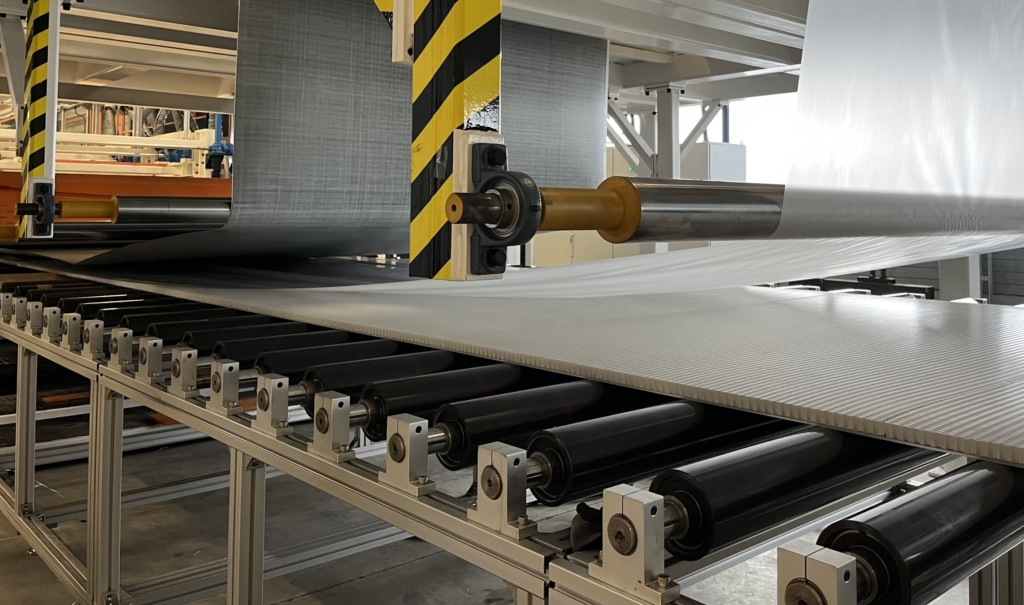
Composite formwork works by using glass-fibre-reinforced thermoplastic sandwich panels as the mould for liquid concrete. The panels form a rigid, smooth shell that supports the concrete while it cures and is easily released afterwards. Because composite does not rot, swell or warp on contact with water and cement, it delivers a more consistent surface quality than plywood and lasts considerably longer. The questions below go deeper into the benefits, reuse, materials and applications of composite formwork.
What are the advantages of composite formwork over plywood?
Composite formwork is lighter, more durable and more dimensionally stable than plywood. Whereas plywood swells, delaminates and warps with repeated contact with water and cement, a composite formwork panel retains its shape and dimensions throughout its entire service life. This results in better concrete surface quality and fewer rejects per project.
The practical advantages are concrete:
- Weight: Composite sandwich panels are considerably lighter than plywood of comparable thickness. This makes manual placing and moving faster and less physically demanding for workers.
- Water resistance: Composite does not absorb moisture. Plywood swells with prolonged contact with water and cement, leading to dimensional deviations and a rougher concrete surface.
- Surface quality: A smooth, non-absorbent composite surface produces a more consistent concrete finish, which requires less finishing work.
- Service life: Composite formwork panels last considerably longer than plywood. Whereas plywood needs replacing after a few dozen use cycles, composite can be used many times more often.
- Maintenance: Composite requires no painting, drying or structural repairs. Rinsing off or wiping down with a dry cloth is enough.
From a cost perspective, the higher purchase price of composite formwork is easy to justify in the longer term. Over a period of several years, composite eliminates two to three plywood replacement cycles. When you add up panel costs, assembly labour and downtime, composite is cheaper per year of use, even with a higher unit price.
How does composite formwork work in practice?
Composite formwork works in the same way as traditional formwork: the panels are assembled into a mould, liquid concrete is poured, and after curing the panels are released and reused. The difference lies in the material properties that make this process more efficient and reliable.
In practice, the process runs as follows:
- Assembly: The composite panels are placed in the formwork system. Thanks to the lower weight, this goes faster and a single worker can handle larger panels independently.
- Pouring: Concrete is poured into the mould. The composite surface is smooth and non-absorbent, so the concrete cures evenly and achieves a clean finish.
- Stripping: After curing, the panels are released. Composite adheres less to concrete than plywood, which makes stripping easier and reduces the risk of damage to the panel.
- Cleaning and reuse: The panels are rinsed clean and put straight back into use. No drying time or restorative treatment is needed.
The dimensional stability of composite plays a major role here. Plywood can shrink or expand depending on temperature and humidity, causing dimensional deviations in the concrete structure. Composite sandwich panels retain their dimensions under changing conditions, which benefits the accuracy of the concrete structure.
How many times can composite formwork be reused?
Composite formwork panels can be reused considerably more often than plywood. Whereas plywood formwork typically needs replacing after a few dozen cycles due to delamination, surface damage or moisture absorption, composite is designed for a much longer service life under intensive use.
The exact number of reuse cycles depends on the panel configuration, the application conditions and the way the panels are handled. Composite is fully waterproof, does not rot, does not delaminate and is resistant to the chemical environment of cement and concrete cleaning agents. These are precisely the conditions that quickly degrade plywood.
From a total-cost perspective, a longer service life means that you need fewer replacement panels over the lifetime of a formwork system. This lowers not only material costs, but also the labour costs of replacement and the logistics costs of delivering and removing panels at the construction site.
Which composite materials are used for formwork panels?
Composite formwork panels are built up as a sandwich construction: two rigid skin layers on the outside with a lightweight core in between. The skin layers usually consist of glass-fibre-reinforced thermoplastic material, such as glass-PP (glass fibre in a polypropylene matrix) or glass-PET. The core consists of PP foam or PP honeycomb.
The choice of core material determines the mechanical properties of the panel:
- PP foam (oriented polypropylene foam): Available in various densities. Offers a good combination of stiffness, weight and compressive strength. Suitable for applications where high bending stiffness is required.
- PP honeycomb: Offers high stiffness at low weight. Particularly suitable for applications where weight must be kept as low as possible without compromising load-bearing capacity.
The skin layers contain glass fibre as a reinforcing material, embedded in a thermoplastic matrix. This gives the panels their high tensile strength and impact resistance. Thermoplastic composites also have the advantage of being recyclable, which is relevant in the context of European regulations such as the EU ELV Directive and CSRD reporting obligations for OEM manufacturers.
An important distinction from traditional composites based on polyester or epoxy is that thermoplastic panels can be reshaped and reprocessed at the end of their service life. This makes them more attractive to manufacturers pursuing sustainability objectives.
Is composite formwork suitable for precast concrete production?
Yes, composite formwork is well suited to precast concrete production. In a precast environment, formwork panels are used intensively and repeatedly under controlled conditions. This is precisely the situation in which the advantages of composite come to the fore most strongly: consistent dimensions, smooth surfaces, no moisture absorption and minimal maintenance.
Precast concrete producers set high requirements for the dimensional accuracy of their moulds. A panel that swells or shrinks due to changing temperatures or humidity disrupts the tolerances of the end product. Composite sandwich panels are dimensionally stable across a wide temperature range and under varying air humidity, which improves the reproducibility of precast elements.
In addition, composite formwork offers logistical advantages in a precast setting. Lighter panels are easier to move around the production hall, which shortens the cycle time per mould. And because composite needs no drying time after cleaning, moulds can be put back into use more quickly.
For precast producers working with complex shapes or specific dimensions, it is also possible to have composite panels produced to size. Panels can be supplied in the exact dimensions the production process requires, including specific edge finishing or surface texture.
How we help with composite formwork solutions
We develop and produce thermoplastic sandwich panels for companies looking for an alternative to plywood and other conventional formwork materials. Our production line in the Netherlands is capable of producing panels up to 13,500 mm × 2,950 mm, which means we can also supply large formwork panels and moulds for precast concrete production.
What we can do for you in concrete terms:
- Match the panel configuration to your application: We assess the load requirements, the desired service life and the assembly method of your formwork system, and advise on the right core and skin combination.
- Produce custom sizes: Panels are supplied in the exact dimensions your production process requires, including edge finishing and surface treatment.
- Provide technical support: We help think through the integration of composite panels into existing formwork systems and flag potential bottlenecks before production starts.
- Supply prototypes and samples: Before moving on to series production, you can validate the performance of the panel in your specific application.
We approach every project as a collaboration, not as a standard supplier relationship. That means we review your design, optimise the panel configuration for your assembly process and discuss any technical risks before production begins. Get in touch to discuss which composite formwork solution suits your application.
Related Articles
- Can composite formwork be used for both walls and slabs?
- Does repeated concrete pouring affect composite panel performance?
- Can sandwich panels be used as formwork in concrete construction?
- What are the weight savings of switching to sandwich panels in a trailer?
- How to evaluate panel materials for weight-sensitive applications?