

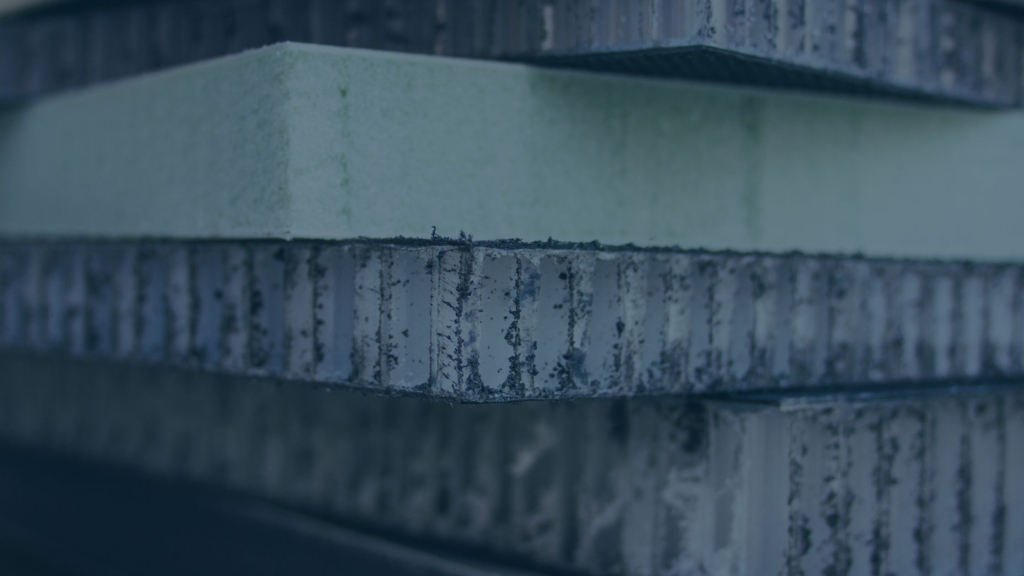
Sandwich panels handle temperature changes well within their rated operating range, but material choice determines exactly how well. Thermoplastic sandwich panels — the type used in commercial vehicle bodies, trailer walls, and scaffolding boards — typically operate reliably between -40°C and +80°C, covering the full range of conditions European transport and construction applications encounter. The sections below unpack how that performance breaks down across heat, cold, material type, and specific applications.
How do temperature changes affect sandwich panel structural integrity?
Temperature changes affect sandwich panels primarily through thermal expansion and contraction, changes in material stiffness, and — at extremes — softening or embrittlement of the core or skin. Within the rated operating range, a well-engineered thermoplastic sandwich panel maintains its structural integrity without delamination, warping, or significant loss of load-bearing capacity.
The key mechanism to understand is differential thermal movement. The skin and core materials in a sandwich panel expand and contract at slightly different rates as temperature shifts. If the bond between skin and core is strong and the materials are well-matched, this movement is absorbed without damage. If the bond is weak or the materials are poorly matched, repeated thermal cycling can cause delamination over time.
Glass-fibre-reinforced thermoplastic skins have a relatively low coefficient of thermal expansion compared to metals, which is one reason composite panels outperform steel and aluminium in applications where temperature swings are frequent. A steel truck body panel expands and contracts significantly between a cold winter morning and a sun-exposed summer afternoon. A composite panel moves far less, reducing stress on fixings, joints, and seals across the vehicle’s service life.
Stiffness is also temperature-dependent. Polypropylene-based cores become slightly more flexible at elevated temperatures and slightly stiffer at low temperatures. Within the normal operating range, this variation is modest and does not compromise structural performance. It only becomes a concern at temperatures outside the rated limits.
What temperature range can sandwich panels withstand?
Thermoplastic sandwich panels with PP honeycomb or PP foam cores are rated for continuous operation between -40°C and +80°C (per ISO 75). PP foam cores alone can handle continuous exposure up to +100°C. These ranges cover the full spectrum of European outdoor conditions and the interior environments of refrigerated trailers, sun-exposed vehicle bodies, and outdoor scaffolding structures.
It is worth distinguishing between short-term peak exposure and continuous operating temperature. A panel surface in direct summer sunlight in Southern Europe can briefly exceed +60°C. This is within the rated range for thermoplastic panels, but it is worth accounting for in design — particularly for dark-coloured surfaces that absorb more radiant heat than light ones.
At the upper end of the thermoplastic range, thermoforming of PP-based panels becomes possible at 130°C to 170°C. This is a manufacturing advantage — it means panels can be shaped under heat — but it also defines the ceiling beyond which the material begins to lose dimensional stability under load. For standard transport and scaffolding applications, this ceiling is never approached in service.
At the lower end, thermoplastic materials retain toughness well into sub-zero temperatures, which is one reason they are preferred over thermoset composites in applications where cold-weather impact resistance matters.
How do sandwich panels perform in high-heat environments?
Within their rated range, thermoplastic sandwich panels perform reliably in high-heat environments. Durability testing at 80°C for 2,000 hours — the equivalent of sustained heat ageing — produces no measurable mechanical degradation in well-engineered panel configurations. This means a panel used in a sun-exposed truck body or a warm industrial environment retains its load-bearing properties throughout a normal service life.
The practical concern in high-heat environments is not structural failure within the rated range, but surface behaviour. Light-coloured PET-film surfaces reflect more heat than dark surfaces, keeping panel temperatures lower in direct sunlight. For sandwich panel transport and construction applications where panels face prolonged solar exposure — roof panels on cargo boxes, for example — surface colour and finish are worth specifying carefully.
Fire performance is a separate consideration from operating temperature. Thermoplastic panels can incorporate flame retardants in the skin formulation to meet fire classification requirements under EN 13501-1. This is relevant for vehicle body applications where fire safety regulations apply, and the specific fire class achieved depends on the panel configuration specified.
How do sandwich panels behave in freezing or sub-zero conditions?
Thermoplastic sandwich panels perform well in sub-zero conditions. The rated lower limit of -40°C covers the coldest operating environments encountered in European transport and construction. At low temperatures, PP-based cores and glass-fibre skins retain their structural properties without becoming brittle in the way that some thermoset materials or unreinforced plastics do.
Impact resistance at low temperatures is a practical concern for scaffolding boards and truck floor panels, both of which face mechanical loading in cold conditions. Glass-fibre-reinforced thermoplastic skins maintain toughness across the operating range, which is why they are preferred over alternatives that may crack or delaminate when struck in cold weather.
Moisture behaviour in freeze-thaw cycles is also relevant. Sandwich panels with water absorption below 1.5% (per ISO 62) resist moisture ingress effectively, which means freeze-thaw cycling does not cause internal damage through ice expansion. Edge sealing further protects the core from moisture entry at cut edges — important for scaffolding boards and truck floors that are regularly washed down or exposed to rain and road spray.
What’s the difference between thermoplastic and thermoset sandwich panels in thermal performance?
The key distinction is how each material type responds to heat over time. Thermoplastic panels soften reversibly when heated — they can be reshaped and recycled. Thermoset panels cure permanently and cannot be remelted, which gives them a higher heat deflection temperature but makes them non-recyclable and more brittle at low temperatures.
Thermoplastic panels
Thermoplastic sandwich panels — using PP honeycomb or PP foam cores with glass-fibre-reinforced skins — operate reliably up to +80°C continuously, with short-term tolerance somewhat higher. They are tougher at low temperatures, absorb less moisture, and are fully recyclable at end of life. For European OEMs subject to the EU End-of-Life Vehicles (ELV) Directive, recyclability is a compliance requirement, not just a preference. Thermoplastic panels meet this requirement; thermoset panels do not.
Thermoset panels
Thermoset composites — typically using epoxy or polyester resin systems — generally achieve higher heat deflection temperatures, which makes them relevant for aerospace or high-performance motorsport applications. However, they are more brittle in cold conditions, cannot be recycled, and are harder to repair in the field. For commercial vehicle bodies and scaffolding operating within normal European temperature ranges, the thermal advantage of thermoset materials offers no practical benefit, while the recyclability disadvantage is increasingly a procurement issue.
Which sandwich panel materials are best for temperature-critical applications?
For most temperature-critical applications in European commercial transport and construction, glass-fibre-reinforced thermoplastic skins over a PP honeycomb or PP foam core offer the best combination of thermal stability, impact resistance, moisture resistance, and recyclability. The specific configuration — core density, skin ply count, surface finish — should be matched to the thermal and mechanical demands of the application.
For applications where the panel faces sustained heat exposure, a higher-density core and a light-coloured or reflective surface finish reduce thermal stress. For cold-weather impact resistance, multi-ply glass-fibre skins with continuous fibre reinforcement provide the toughness needed to handle mechanical loading at low temperatures without cracking.
For scaffolding applications specifically, panels must maintain their load-bearing capacity across outdoor temperature ranges year-round. A 10.5 mm Compoform panel achieves EN 12811 load class 4 with no support underneath — a performance benchmark that holds across the full operating temperature range, not just under laboratory conditions.
For truck body floors and trailer walls, the combination of thermal stability, low weight, and long service life makes thermoplastic sandwich panels the practical choice. Over a 15-year vehicle life, a composite floor eliminates two to three plywood replacement cycles. Once you factor in panel cost, installation labour, and vehicle downtime, the composite delivers a lower cost per year of service — even at a higher unit price. For electric truck operators, the weight saving also extends battery range per charge, which is a direct operating cost argument that EV fleet procurement teams are raising as a standard question in 2026.
How We Help with Sandwich Panel Thermal Performance
We engineer thermoplastic sandwich panels for the specific thermal and mechanical conditions your application faces — not to a generic datasheet. Before production, we review your operating environment, load requirements, and assembly process to recommend the right core density, skin architecture, and surface finish for your conditions.
- Temperature range confirmation: We verify that the panel configuration you specify performs within your application’s actual temperature range, including heat ageing and UV exposure testing results from our own facilities.
- Surface finish selection: For heat-exposed applications, we advise on surface colour and finish to manage panel temperatures in direct sunlight.
- Edge protection: Edge sealing and edge bending are available to protect the core from moisture ingress in freeze-thaw environments — relevant for scaffolding boards and truck floors washed down regularly.
- Custom dimensions: Panels are available in custom dimensions cut to your exact specification, up to 13,500 mm × 2,950 mm, so you are not working around standard sizes that don’t fit your design.
- Recyclability compliance: All our thermoplastic panels are fully recyclable, supporting your compliance with the EU ELV Directive and CSRD reporting requirements.
If you are specifying panels for a truck body, trailer, or scaffolding application and want to confirm the right configuration for your thermal environment, talk to our panel engineering team. We review your design, flag potential issues before production, and support you through integration — not just the initial order.