

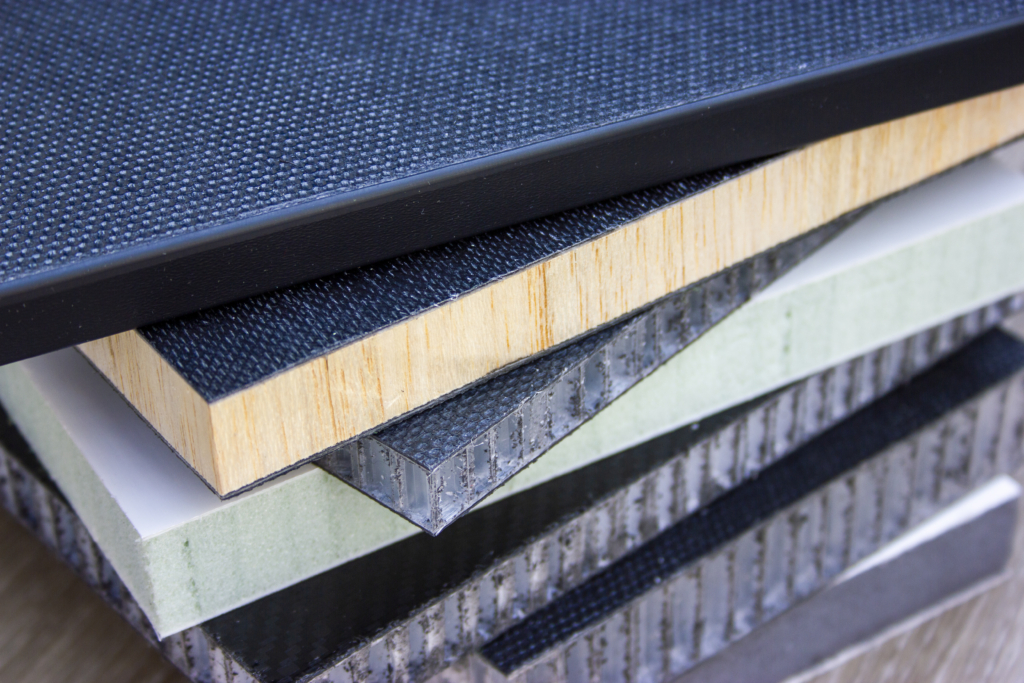
Biobased sandwich panels differ from conventional sandwich panels primarily in the origin of their materials: biobased panels use skins, cores, or resins derived from renewable biological sources, while conventional panels rely on petroleum-derived polymers and synthetic fibres. In practice, the two types often overlap in structure and performance, but they differ meaningfully in sustainability profile, material maturity, and commercial availability. The questions below unpack those differences across strength, weight, recyclability, and real-world application fit.
Note: This article covers the broader sandwich panel market. Our range at Compoform is limited to PP honeycomb and PET foam cores for commercial vehicles and scaffolding.
What materials are biobased sandwich panels actually made from?
Biobased sandwich panels use at least some materials sourced from renewable biological feedstocks rather than fossil fuels. Common biobased components include natural fibre skins made from flax, hemp, or jute woven into a composite laminate, biobased polymer matrices such as polylactic acid (PLA) or bio-polyamide, and core materials derived from cork, recycled cellulose, or bio-based foams. The proportion of biobased content varies widely between products.
In a conventional sandwich panel, the skins are typically glass-fibre or carbon-fibre reinforced thermoplastics such as polypropylene (PP) or polyethylene terephthalate (PET), bonded to a core of PP foam, PP honeycomb, or similar synthetic materials. These materials are well-characterised, produced at industrial scale, and available in tightly controlled grades.
Biobased panels can take several forms depending on which component is replaced:
- Natural fibre skins with conventional core: Flax or hemp fibre laminates bonded to a PP or PET foam core. This is the most commercially mature configuration.
- Conventional skins with biobased core: Glass-fibre skins over a cork or bio-foam core. Less common but used in some construction and transport panel applications.
- Fully biobased panels: Natural fibre skins combined with a biobased resin matrix and a renewable core. These exist but remain limited in commercial availability and consistent performance data.
The distinction matters because a panel described as “biobased” may still contain a significant proportion of synthetic materials. Buyers should ask for the biobased content percentage and which specific components carry that designation before drawing conclusions about sustainability or performance.
How do biobased and conventional sandwich panels compare in strength and weight?
Conventional sandwich panels, particularly those with glass-fibre reinforced thermoplastic skins, generally outperform biobased alternatives in tensile strength and bending stiffness at equivalent thickness. Natural fibres such as flax and hemp have lower stiffness and strength than glass fibre on a per-weight basis, though they offer a better stiffness-to-weight ratio than many people expect. For most structural transport and scaffolding applications, glass-fibre panels remain the stronger option.
Strength comparison
Glass-fibre reinforced thermoplastic skins achieve high tensile modulus values, tested under EN ISO 527, that natural fibre laminates typically cannot match at the same skin thickness. Cross-ply glass-fibre laminates also distribute load more evenly in both directions, which is important for panels installed in either orientation. Natural fibre laminates tend to be more anisotropic, meaning their properties differ more noticeably depending on load direction.
That said, natural fibre composites are not structurally weak. In lower-load applications such as interior wall cladding, lightweight partitions, or non-structural panels in modular environments, flax or hemp laminates can meet the requirement while reducing the fossil-derived material content of the assembly.
Weight comparison
Natural fibres have a lower density than glass fibre, so biobased skins can be lighter at equivalent thickness. However, because natural fibre laminates are less stiff, achieving the same structural performance often requires a thicker skin or a denser core, which can offset the weight advantage. In practice, the weight difference between a well-specified biobased panel and a glass-fibre panel designed to the same load requirement is often smaller than the raw material density figures suggest.
For applications where every kilogram of structural weight matters, such as truck body floors or trailer sidewalls, this trade-off deserves careful engineering review rather than a simple material substitution.
Are biobased sandwich panels more sustainable than conventional ones?
Biobased sandwich panels generally carry a lower embodied carbon footprint in their production phase compared to fully synthetic panels, because renewable feedstocks absorb CO2 during growth. However, the full sustainability picture depends on end-of-life recyclability, production energy, and how the panel performs over its service life. A panel that lasts half as long is not automatically more sustainable, even if its raw materials are greener.
Several factors shape the sustainability comparison:
- Embodied carbon: Natural fibres typically require less energy to produce than glass fibre, reducing the carbon intensity of the skin. Biobased resins can further reduce fossil-derived content.
- Recyclability: Thermoplastic sandwich panels, whether biobased or conventional, are more recyclable than thermoset alternatives. Under the EU End-of-Life Vehicles (ELV) Directive, recyclability is a compliance requirement for many European OEMs, not just a preference. Thermoplastic panels can be remelted and reprocessed; thermoset panels cannot.
- Service life: A panel that requires replacement every five years generates more material waste and production emissions over a vehicle’s life than one lasting twelve or more years. Durability is a sustainability argument, not just a cost argument.
- CSRD reporting: Under the EU Corporate Sustainability Reporting Directive, European manufacturers increasingly need to document the environmental impact of their supply chain. Biobased content and recyclability data from panel suppliers become part of that reporting chain.
The honest answer is that neither category is categorically more sustainable. The right comparison is between specific products, with full lifecycle data, not between broad material families.
What are the main limitations of biobased sandwich panels?
The main limitations of biobased sandwich panels are lower mechanical performance at equivalent thickness, greater variability in material properties, limited availability in large custom dimensions, and less established long-term durability data in demanding transport and industrial environments. These limitations do not disqualify biobased panels from all applications, but they are relevant for structural and high-cycle-load uses.
Specific limitations worth understanding before specifying biobased panels include:
- Moisture sensitivity: Natural fibres absorb moisture more readily than glass fibre, which can affect dimensional stability and long-term mechanical properties in wet or washdown environments such as truck floors or scaffolding boards exposed to weather.
- UV resistance: Natural fibre composites may require additional surface protection to achieve the UV resistance that glass-fibre panels with PET-film finishes provide. UV weathering resistance, tested under ISO 4892, is a standard requirement for exterior transport panels.
- Dimensional availability: Most biobased panel products are available in standard sheet formats. Custom dimensions up to the large panel sizes used in truck body and trailer construction are less commonly available from biobased suppliers.
- Fire classification: Achieving fire classifications such as Bfl-S1 under EN 13501-1 with biobased materials requires careful formulation. Conventional glass-fibre thermoplastic panels have a more established track record in meeting European fire standards for transport applications.
- Cost and supply chain maturity: Biobased panels generally cost more per square metre than conventional thermoplastic panels at equivalent performance, and the supplier base is smaller, which can affect lead times and production continuity.
When should manufacturers choose biobased over conventional panels?
Manufacturers should consider biobased sandwich panels when the application has moderate structural demands, sustainability reporting requirements drive material selection, and the end product benefits from a lower embodied carbon profile that can be documented and communicated. For high-load structural applications in commercial vehicles and scaffolding, conventional thermoplastic panels currently offer more reliable performance data and greater dimensional flexibility.
Biobased panels are a reasonable choice when:
- The load requirements fall within the proven performance range of natural fibre laminates, such as interior wall cladding or lightweight partitions.
- The customer or end user has sustainability commitments that require documented biobased content or reduced embodied carbon.
- CSRD or other regulatory reporting creates commercial value in demonstrating lower fossil-derived material content.
- The application does not expose the panel to sustained moisture, chemical washdown, or heavy impact cycles.
Conventional glass-fibre thermoplastic panels remain the stronger choice when:
- Structural performance, long service life, and consistent mechanical properties are non-negotiable, as in truck body floors, trailer sidewalls, and scaffolding boards.
- Custom large-format dimensions are required that biobased suppliers cannot reliably produce.
- The panel must meet specific European fire, UV, or load standards with documented test evidence.
- Total cost of ownership over a 12-plus year vehicle life is the primary procurement metric.
In 2026, EV fleet procurement adds another dimension to this decision. Lighter body structures extend battery range in electric trucks and vans. Every kilogram of structural dead weight reduces range per charge, making weight reduction a range argument, not just a payload argument. This is a standard procurement question from EV fleet buyers in 2026. Whether biobased or conventional panels deliver the better weight outcome depends on the specific configuration, not the material category alone.
How Compoform Helps with Sandwich Panel Selection
We manufacture thermoplastic sandwich panels using PP honeycomb and PET foam cores, with glass-fibre reinforced thermoplastic skins, for commercial vehicles and scaffolding. Our panels are engineered for applications where structural performance, long service life, and dimensional precision are the deciding factors.
Here is what working with us looks like in practice:
- Application review before specification: We review your design and load requirements before recommending a panel configuration. A 30 mm PP sandwich floor panel, for example, is self-supporting with no aluminium subframe required, which removes a production step and reduces cost for truck body builders.
- Custom dimensions: Panels are available in custom dimensions up to 13,500 mm x 2,950 mm, cut to your exact specification. Standard sheet formats are not the limit.
- Durability you can calculate: Thermoplastic panels last three to four times longer than plywood in heavy transport, typically 12 or more years versus three to five for plywood. Over a 15-year vehicle life, that eliminates two to three replacement cycles. Once you factor in panel cost, installation labour, and vehicle downtime, the composite is cheaper per year of service, even at a higher unit price.
- Scaffolding performance with test data: An 11 mm Compoform panel achieves EN 12811 load class 4 with no support underneath, based on our own testing. That is a concrete reference point, not a general claim.
- Edge protection for demanding environments: Edge sealing and edge bending protect the core from UV and moisture, which matters for scaffolding boards and truck floors washed down regularly.
If you are evaluating panel options for a truck body, trailer, or scaffolding application and want an engineering review of your current specification, speak with our application team. We will assess your design, identify where panel configuration can reduce weight or cost, and flag any integration issues before production starts.
Related Articles
- How does a lightweight sandwich panel reduce vehicle emissions over time?
- How thick should sandwich panels be in a motorhome build?
- What are the slip resistance properties of sandwich panel scaffold boards?
- Why are motorhome manufacturers switching to sandwich panel walls?
- What is the strength-to-weight ratio of a sandwich panel?