

Yes, lightweight formwork significantly speeds up assembly. When a panel weighs less, workers can move, position and secure it faster without mechanical aids. The direct result is fewer handling steps per panel and shorter cycle times per formwork round. The questions below go deeper into the ergonomic benefits, the comparison with plywood and which project types benefit most.
How much faster is assembly with lightweight formwork?
Lightweight formwork panels reduce assembly time because a single worker can lift, carry and place a panel independently. With traditional plywood formwork, large panels often require two people. That extra handling step disappears entirely, measurably shortening the turnaround time per formwork cycle.
The time savings occur at several points in the process. During erection, placement is faster because panels are handled without crane support or extra manpower. During stripping, the same advantage applies in reverse. In addition, composite panels do not need to dry or be reworked after use before they are deployed again, which shortens the turnaround time between two formwork cycles.
For Compoform scaffolding panels, such as the CompoDeck line, the weight reduction compared with equivalent plywood is up to 65%, depending on specification and thickness. That is not a marginal difference: it fundamentally changes how a crew organises its work. Less weight per panel also means workers tire less quickly, so the working pace remains more consistent throughout the day.
What are the ergonomic benefits of lighter formwork panels?
Lighter formwork panels reduce the physical load per handling step, lower the risk of musculoskeletal complaints and make it possible for one worker to handle a panel safely on their own. This is a direct ergonomic benefit that improves both safety and productivity.
Lifting and carrying heavy materials is one of the most common causes of work-related injury in construction. When a panel that previously required two people is now handled by one, not only does the risk of acute injuries fall, but so does the cumulative load over a working day. Workers can remain productive for longer without overexertion.
In addition, lower weight simplifies logistics on the construction site. Panels can be transported by hand to locations where a forklift or crane cannot reach, such as narrow spaces, upper floors or temporary structures. This increases the flexibility of the crew without deploying additional equipment.
How does composite formwork compare with plywood in terms of weight?
Composite formwork panels are considerably lighter than plywood panels of comparable thickness. Depending on composition and thickness, the weight difference can reach up to 65% in favour of composite, with the relative weight saving increasing as the panels get thicker.
Plywood absorbs moisture, which further increases its weight during use. A wet plywood panel weighs noticeably more than the same panel when dry. Composite panels are fully waterproof and do not absorb moisture, so their weight remains constant regardless of weather conditions or contact with fresh concrete.
Besides weight, dimensional stability also differs. Plywood can shrink, swell or warp with changing humidity and temperature. Composite panels remain dimensionally stable throughout their service life, which enables consistent working and makes the quality of the concrete surface easier to control.
Which project types benefit most from lightweight formwork?
Projects where panels are moved frequently, work is carried out at height or available manpower is limited benefit most from lightweight formwork. Think of high-rise projects, infrastructure works at hard-to-reach locations and projects with tight schedules where fast cycle times are decisive.
Specifically, the benefits are greatest in:
- High-rise and vertical construction, where panels are transported floor by floor and the lifting load per handling step counts heavily
- Precast concrete production, where formwork panels are placed and stripped daily and the repeated handling determines productivity
- Infrastructure projects at locations without heavy lifting equipment, such as bridges, tunnels or underground structures
- Projects with small crews, where each worker must be able to work independently without relying on a colleague for lifting
On projects with large, flat concrete floors at ground level and ample machine access, the weight advantage is less decisive, because mechanical aids are already in use. There, the longer service life of composite panels plays a greater role in the overall cost assessment.
Does lightweight formwork also affect reusability?
Yes, lightweight composite formwork is generally more reusable than plywood. The composite construction is resistant to moisture, chemicals and mechanical stress, so panels can withstand several years of intensive use without structural deterioration. After repeated use, plywood often shows delamination, cracking and moisture damage that make replacement necessary.
The service life of composite formwork panels in heavy industrial use is at least 12 years with proper maintenance. By comparison, plywood formwork lasts an average of three to five years in intensive use. Over a project lifetime of 15 years, that means two to three replacement cycles for plywood, each with associated material costs, labour costs for replacement and downtime.
Composite panels require no painting, drying time or structural repairs between use cycles. Cleaning consists of rinsing or wiping down. This lowers maintenance costs and shortens the time between two deployments, which increases the effective availability of the formwork equipment.
Reusability also has a logistical dimension. Because composite panels remain dimensionally stable and do not deform, they are interchangeable within a formwork system. Plywood that has warped or swollen no longer fits modular systems accurately and causes fitting problems that cost extra processing time.
How we help you with lightweight formwork panels
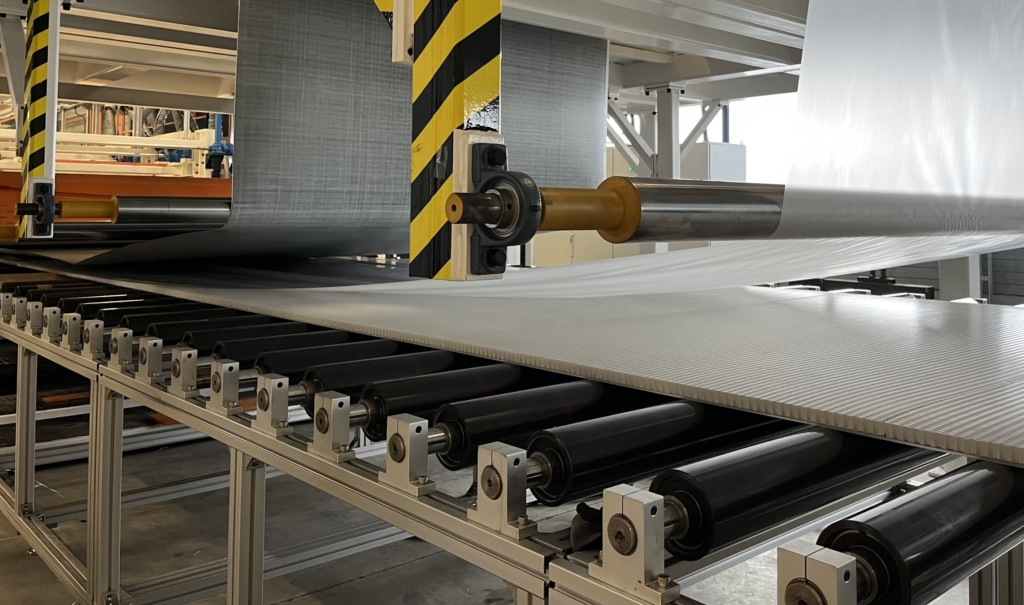
We develop and produce thermoplastic sandwich panels tailored to the specific requirements of formwork applications. Our panels combine low mass with proven mechanical performance, and are available in custom dimensions up to 13,500 mm x 2,900 mm. This makes them suitable as a direct replacement for plywood in both standard and specialised formwork systems.
What we concretely offer for formwork applications:
- Custom-sized panels, cut to your exact specification for seamless integration into your formwork system
- A choice of core materials (PP honeycomb or PP foam in multiple density classes) matched to the required stiffness, compressive strength and weight
- Technical guidance in selecting the right panel configuration for your application, including assessment of load requirements and the assembly process
- OEM capabilities such as edge finishing, private labelling and logo printing for high-volume programmes
We work as a development partner, not as a supplier who ships panels to specification. That means we review your design, optimise the panel configuration for your assembly procedure and flag potential bottlenecks before production starts. View our composite panel applications or get in touch to discuss your project.
Related Articles
- How much does aluminium really cost over its lifetime?
- What makes thermoplastic sandwich panels 100% recyclable?
- What sandwich panels are used in modular building construction?
- Why are contractors replacing plywood scaffold boards with sandwich panels?
- How do sandwich panel scaffold boards reduce on-site injuries?