

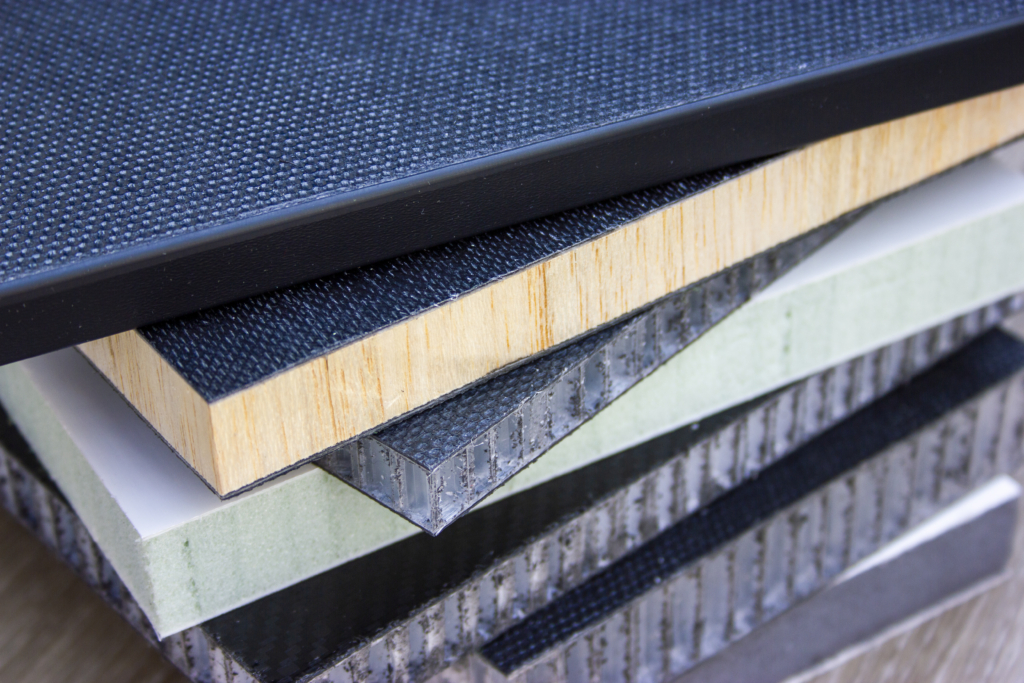
Thermoplastic sandwich panels are 100% recyclable because every layer, the glass-fibre-reinforced thermoplastic skins and the polypropylene core, belongs to the same polymer family. Unlike thermoset composites, thermoplastics can be remelted and reprocessed without chemical degradation, meaning the material retains value at end of life rather than becoming landfill waste. The sections below answer the most common questions European manufacturers ask about thermoplastic recyclability, from material chemistry to regulatory compliance.
What materials make thermoplastic sandwich panels fully recyclable?
Thermoplastic sandwich panels are fully recyclable because both the skins and the core are made from compatible thermoplastic polymers, primarily polypropylene (PP), that can be melted, reshaped, and reused. There are no cross-linked resins, no epoxy binders, and no adhesive layers that would contaminate the melt stream or prevent reprocessing.
In a typical thermoplastic sandwich panel, the structure consists of three main material groups:
- Thermoplastic skins: Glass-fibre-reinforced PP laminates, often in cross-ply or multi-ply configurations, where the glass fibres are held in a PP matrix. The fibre content typically runs at 66 to 67% by weight, with the remainder being the PP binder.
- Thermoplastic core: Either oriented PP foam, available across a range of densities, or a PP honeycomb structure. Both are pure polypropylene with no added thermoset resins.
- Surface finishes: PET film or anti-skid coatings, which are also thermoplastic materials compatible with standard polymer recycling streams.
The critical factor is material compatibility. Because the skins, core, and surface films are all thermoplastics, the entire panel can enter a single recycling stream without requiring chemical separation. The glass fibres recovered during reprocessing can be used as reinforcement filler in secondary applications, and the PP matrix can be remoulded into new components. This is fundamentally different from panels that use thermoset resins or mixed-material adhesive bonding.
How does thermoplastic recycling differ from thermoset composite recycling?
The core difference is reversibility. Thermoplastics soften and flow when heated, which means they can be remelted and reshaped multiple times without breaking down chemically. Thermoset composites, such as those made with epoxy, polyester, or vinyl ester resins, cure through an irreversible chemical reaction. Once set, they cannot be remelted. Recycling a thermoset composite requires energy-intensive mechanical grinding, pyrolysis, or chemical dissolution, and the recovered material is typically lower in quality than the original.
For manufacturers sourcing panels for truck bodies, trailers, and scaffolding applications, this distinction has direct commercial consequences. A thermoset panel at end of life is largely a disposal problem. A thermoplastic panel is a recoverable material asset. The PP matrix can re-enter a polymer processing line, and the glass fibres can be recovered for use in secondary composite or construction applications.
From a processing standpoint, thermoplastic recycling is also simpler to integrate into existing industrial waste streams. The material does not require specialist chemical handling, and it can often be processed by standard polymer recyclers without dedicated infrastructure. This lowers the practical cost of end-of-life management for OEMs and fleet operators who need to account for disposal in their total cost of ownership calculations.
What happens to thermoplastic sandwich panels at end of life?
At end of life, thermoplastic sandwich panels can follow one of two main recycling routes: mechanical recycling or thermal recovery. In mechanical recycling, panels are shredded or granulated, and the resulting material is sorted by polymer type. The PP granulate re-enters manufacturing as a secondary raw material, while the glass fibres can be separated and used as reinforcement filler in lower-grade composite or construction products.
In practice, the end-of-life pathway depends on the condition of the panel and the infrastructure available to the recycler. Panels that are structurally intact and free from contamination are strong candidates for mechanical recycling. Panels that have been chemically treated, painted with non-compatible coatings, or heavily soiled may be directed toward thermal recovery, where the energy content of the polymer is recovered through controlled combustion, a lower-value outcome but still preferable to landfill.
For European truck body builders and trailer manufacturers, the practical implication is that thermoplastic panels do not create a disposal liability at vehicle decommissioning. The material can be handed to a certified polymer recycler, and in some cases the recovered PP has residual commercial value. This contrasts sharply with plywood floors, which are typically treated with preservatives and classified as contaminated wood waste, or with thermoset composite panels that have no viable recycling route and go directly to landfill.
Do thermoplastic sandwich panels meet European recycling regulations?
Yes. Thermoplastic sandwich panels are well positioned to meet the requirements of the EU End-of-Life Vehicles (ELV) Directive, which sets mandatory recycling and recovery targets for vehicles placed on the European market. The Directive requires that 85% of a vehicle’s weight be reusable or recyclable, and that 95% be recoverable overall. Panels made entirely from thermoplastic materials contribute directly to the recyclable fraction of a vehicle’s weight.
For OEMs and body builders supplying fleet operators or public procurement clients, this is increasingly a compliance requirement rather than a preference. Procurement specifications for commercial vehicles in 2026 routinely include material recyclability documentation, and the Corporate Sustainability Reporting Directive (CSRD) requires larger European companies to report on the recyclability of materials used in their products and supply chains. Specifying thermoplastic panels over thermoset or mixed-material alternatives simplifies this reporting and reduces compliance risk.
It is worth noting that recyclability claims must be supported by material documentation. Panels with a clearly defined, single-polymer-family composition are straightforward to document. Panels that combine thermoplastic and thermoset elements, or that use adhesive bonding with non-compatible resins, create ambiguity in recyclability declarations that can complicate ELV compliance reporting.
Can thermoplastic sandwich panels be recycled without disassembly?
In most cases, yes, thermoplastic sandwich panels can be recycled as a whole unit without manual layer separation. Because the skins and core are made from compatible PP-based materials, the entire panel can be fed into a shredder or granulator together. The resulting mixed granulate is predominantly PP, with glass fibre distributed through it, and this blend is usable as a secondary composite material without requiring the layers to be separated beforehand.
This is a meaningful practical advantage. Disassembly of composite panels is labour-intensive and often not economically viable at scale. The fact that thermoplastic sandwich panels do not require it removes a significant barrier to actual recycling, as opposed to theoretical recyclability that never gets implemented because the process is too costly.
There are limits to this. Surface finishes such as PET film or anti-skid coatings are also thermoplastic and generally compatible with the PP stream, but panels that have been bonded to dissimilar materials, aluminium frames, steel inserts, or thermoset adhesives, may require partial disassembly before recycling. For this reason, the design of the joint and fixing system matters as much as the panel material itself when planning for end-of-life recyclability. Designing panels with mechanical fixings rather than structural adhesives makes the recycling pathway cleaner and more reliable.
How Compoform Supports Recyclable Panel Specification
We build our sandwich panels entirely from thermoplastic materials, PP honeycomb or PET foam cores combined with glass-fibre-reinforced PP skins, so recyclability is built into the product from the start, not added as a claim. Every panel we produce is made from a compatible polymer family with no thermoset resins, no epoxy binders, and no mixed-material adhesive layers that would compromise end-of-life recovery.
For truck body builders, trailer manufacturers, and scaffolding companies working toward ELV compliance or CSRD reporting requirements, we can provide:
- Material composition documentation that supports recyclability declarations under the EU ELV Directive
- Panel configurations optimised for your application — including fixing and edge sealing designs that keep the end-of-life recycling pathway clean
- Technical review of your assembly design to identify any joining or bonding methods that could complicate recyclability at decommissioning
- Lifecycle cost analysis that accounts for disposal costs alongside panel price and service life — thermoplastic panels that last 12 or more years in heavy transport eliminate two to three plywood replacement cycles, and the absence of a disposal liability at end of life adds further value over a 15-year vehicle life
We work with you as an application partner, not a panel supplier. That means reviewing your design before production, flagging integration issues early, and making sure the panel configuration you specify actually performs in your assembly process and meets your compliance obligations. If you are specifying panels for a truck body floor, a trailer sidewall, or a scaffolding board and need material documentation or a technical review, contact our engineering team directly to start that conversation.
Related Articles
- What are the thermal properties of a PP honeycomb core?
- What are the fire and smoke requirements for aerospace sandwich panels?
- How are sandwich panels used in raised access flooring systems?
- What are the weight savings of switching to sandwich panels in a trailer?
- What fire ratings do sandwich panels carry?