

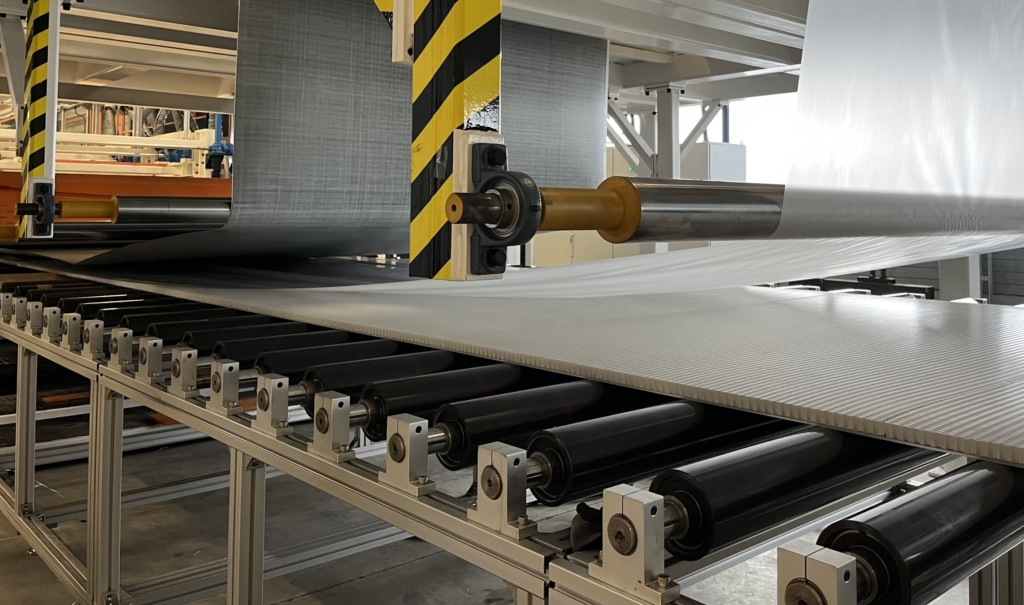
Panel weight has a direct impact on labor costs, safety and total project costs in concrete construction. Lightweight formwork panels reduce the physical strain on construction workers, shorten assembly time and make it possible to place larger panels without crane support. The questions below look at each of these aspects in more depth, from safety risks to reuse and material choice.
How much does panel weight affect labor costs?
Panel weight has a major impact on labor costs in concrete formwork. Heavier material requires more manpower per operation, slows down assembly and increases the likelihood of fatigue-related errors. Lightweight formwork panels reduce the time per placement and allow smaller teams to form larger areas in the same working time.
In practice, a weight reduction of thirty to forty percent per panel means that one worker can perform tasks that would otherwise require two people. On projects with hundreds of square meters of formwork, this adds up quickly. Fewer lifting movements per panel also reduce the likelihood of placement errors, which prevents rework and the associated costs.
Assembly speed also plays a role. Lighter panels are easier to position, secure and move to the next section. On large construction sites, where formwork is reset several times a week, this delivers a measurable time advantage per cycle.
What safety risks does heavy formwork material pose?
Heavy formwork material increases the risk of musculoskeletal disorders, falls and fatigue-related errors on the construction site. When workers repeatedly lift, carry and position heavy panels, the likelihood of back injuries, muscle damage and loss of concentration increases. These are the most common causes of construction-related absenteeism in Europe.
In many European countries, occupational health and safety regulations limit the maximum lifting weight per person. Large-format plywood formwork panels regularly exceed this limit, which means that lifting aids or additional personnel are mandatory. This not only increases costs but also introduces additional handling steps that raise the risk of accidents.
Working at height with heavy material adds another layer of risk. A panel that is difficult to handle on scaffolding or at a wall at height increases the risk of a fall, both for the panel itself and for the worker. Lightweight alternatives reduce this risk structurally, without compromising the load-bearing capacity of the formwork.
How does panel weight affect total project costs?
Panel weight affects total project costs through four channels: labor costs, transport costs, crane costs and the service life of the material. Lightweight formwork panels reduce costs at each of these points, while heavy panels generate additional expenses at every point that accumulate over the duration of a project.
Transport and logistics
Heavier material means higher transport costs per trip and a lower load capacity per truck. On large projects, where formwork is delivered several times or moved between locations, this difference is significant. Lightweight panels make it possible to carry more material per shipment, which reduces the number of trips and the associated costs.
Crane use and mechanical aids
When panels are too heavy for manual placement, a crane or other lifting mechanism is needed. Crane hours are expensive and often form a bottleneck on the construction site. Lightweight panels that can be placed by hand eliminate this dependency and give planners more flexibility in execution.
What is the weight difference between plywood and composite formwork panels?
Composite formwork panels are generally considerably lighter than plywood panels of comparable thickness and stiffness. A standard eighteen-millimeter plywood formwork sheet weighs approximately twelve kilograms per square meter. Thermoplastic sandwich panels can achieve a weight of three to seven kilograms per square meter with comparable or better mechanical performance, depending on the configuration.
This weight difference results from the sandwich construction: a lightweight core of PP foam or PP honeycomb is fitted on both sides with glass-fiber-reinforced thermoplastic skin layers. The core contributes to stiffness without adding much weight, while the skin layers absorb the mechanical loads. The result is a panel that is structurally strong but weighs significantly less than solid wood or plywood.
By way of illustration: a seventeen-millimeter wall panel with a PP foam core has an areal weight of approximately 2,763 g/m² (technical datasheet from Compoform). This contrasts sharply with plywood of comparable thickness, which easily weighs double. This weight difference translates directly into less lifting strain per operation and lower labor costs per square meter of formwork.
When is lightweight formwork the better choice?
Lightweight formwork is the better choice when manual placement is a requirement, when formwork is reset frequently, or when total costs over multiple use cycles outweigh the initial purchase price. In most projects with repeated use, lightweight material is financially more advantageous in the medium term.
Specific situations where lightweight formwork panels are clearly preferable:
- Projects with high turnover frequency: the more often formwork is moved, the greater the time advantage per cycle.
- Work at height or in confined spaces: where crane use is not possible or impractical.
- Small crews: where each panel must be placed by one or two people.
- Precast concrete production: where molds are used daily and must be changed quickly.
- Projects with strict occupational health and safety requirements: where the lifting weight per worker is legally limited.
When formwork is used only once and the purchase price is the dominant factor, cheap plywood can still be a pragmatic choice. But as soon as reuse, labor efficiency or safety come into play, the balance shifts quickly toward lightweight composite alternatives.
How often can lightweight composite panels be reused?
Lightweight thermoplastic composite panels can be reused considerably more often than plywood. Whereas plywood formwork panels last an average of five to twenty use cycles before they need to be replaced, well-designed composite panels achieve a multiple of that in comparable applications. The exact service life depends on the load, maintenance and the specific panel construction.
Plywood degrades through moisture absorption, delamination and mechanical damage. Thermoplastic composite panels do not absorb moisture, are resistant to chemicals in concrete mix and retain their dimensional stability over a longer period. This makes them structurally better suited to intensive reuse in industrial formwork applications.
In the transport sector, a comparable application in terms of mechanical load, thermoplastic sandwich panels show a service life of twelve years or more, compared with three to five years for plywood. Over a period of fifteen years, this eliminates two to three replacement cycles. When you add up the panel costs, installation labor and downtime per cycle, the composite panel is cheaper per year of use, even with a higher purchase price.
The reusability of composite panels also has a sustainability dimension. Thermoplastic materials are recyclable at the end of their service life, which is relevant for European manufacturers subject to CSRD reporting obligations or the EU ELV Directive.
How we help you with lightweight formwork panels
We develop and produce thermoplastic sandwich panels for companies looking for an alternative to plywood and other conventional formwork materials. Our panels combine a low areal mass with the mechanical performance needed for repeated industrial use in formwork applications.
What we can do for you in concrete terms:
- Matching the panel construction to your application: we select the right core material, skin thickness and fiber orientation based on the loads in your formwork system.
- Custom sizes: panels are available in custom dimensions, cut to your exact specification.
- Technical evaluation upfront: we review your current design, identify bottlenecks and advise on the most suitable composite configuration before production starts.
- Prototypes and test panels: for new applications, we supply test panels so you can validate performance under your own conditions.
We work as a development partner, not as a catalog supplier. That means we review your design, optimize the panel configuration for your assembly procedure and flag potential problems before they occur in production. Get in touch to discuss which composite solution fits your formwork application.
Related Articles
- How does lightweight formwork affect transport efficiency?
- Why is steel no longer the default choice for vehicle body construction?
- What are the best sandwich panels for truck body construction?
- How to calculate the true lifetime cost of your panel materials?
- What is the maximum size of a sandwich panel?