

Switching from plywood to composite formwork panels does come with real drawbacks, notably a higher purchase price per panel and a different technical approach during initial integration. Whether those drawbacks are decisive depends heavily on your frequency of use, your procurement process, and the extent to which your systems are already suited to alternative panel materials. The questions below address the most common objections that procurement and engineering teams encounter when evaluating composite versus plywood formwork.
Are composite formwork panels more expensive than plywood?
Composite formwork panels have a higher purchase price than comparable plywood panels. The price difference per panel is real and can seem substantial at the time of the first purchase. Even so, the purchase price on its own is an incomplete measure: the total cost structure over the panel’s service life differs fundamentally from that of plywood.
Plywood formwork has a limited service life under intensive use. Depending on the application and the number of use cycles, replacement is necessary after a relatively short time. Composite panels are designed for a considerably longer service life, so a single purchase replaces multiple rounds of plywood replacement. When you add up panel costs, installation labor, and downtime during replacement, the composite panel is often cheaper per year of use over the service period, even at a higher unit price.
Additional cost advantages that factor into the TCO calculation:
- Less maintenance: composite panels require no painting, drying, or structural repairs
- Higher freight density: lighter panels mean more panels per shipment and lower transport costs per unit
- Less waste disposal: less frequent replacement reduces the cost of disposing of treated timber
The higher purchase price is therefore a real drawback at the time of the first purchase, but not over the full service period. For organizations that steer purely on procurement budget without factoring in lifetime costs, the initial price remains a barrier.
How difficult is the technical integration of composite panels?
In most cases, the technical integration of composite formwork panels is simpler than expected. Composite panels designed as a direct replacement for plywood fit into existing formwork systems without changes to hardware, fasteners, or work instructions. Any system that accepts plywood will accept a well-designed composite panel without modification.
That said, there are technical points of attention during the transition:
- Machinability: composite panels behave differently from plywood when sawing, drilling, and milling. The right tools and cutting parameters are needed to ensure clean edges and a good finish.
- Fastening techniques: screws and nails behave differently in a fiber-reinforced composite construction than in wood. In some applications, different fastening methods or edge finishing are required.
- Weight behavior: composite panels are considerably lighter, which improves handling but also affects balance and stacking on site.
For most standard formwork applications, no redesign of the system is needed. The integration challenge lies more in adapting working methods on the shop floor than in a fundamental technical revision of the product.
Which mechanical properties differ from plywood?
Composite formwork panels differ from plywood in a number of mechanical properties, and not always to the disadvantage of composite. The main differences lie in stiffness, the way the material distributes load, and behavior under point loads or damage.
Stiffness and deflection
Plywood naturally has a high bending stiffness in the grain direction of the wood. Composite sandwich panels achieve comparable or higher stiffness through their construction, but the behavior under load differs. In sandwich panels, the core plays a major role in compressive resistance, while the skin layers absorb the bending forces. This results in a different deflection profile that must be taken into account in the formwork design.
Impact resistance and local damage
Plywood absorbs local impacts relatively well thanks to its layered wood structure. Composite panels with a fiber-reinforced core can offer higher impact resistance, but local damage, such as a deep indentation, does not recover on its own. With plywood, a damaged spot can sometimes be touched up; with composite, the damage is more visible and requires a different approach.
In addition, composite panels are fully waterproof and dimensionally stable under varying humidity and temperature, whereas plywood can swell, shrink, or delaminate under intensive use in humid environments. For outdoor applications or precast concrete production, this is a relevant advantage of composite.
What are the challenges in procurement and supply security?
Composite formwork panels come from a smaller supplier market than plywood. Plywood is a commodity with worldwide production capacity and a large network of distributors. Composite panels for formwork applications are supplied by a limited number of specialized manufacturers, which makes procurement more complex.
Specific challenges when procuring composite formwork panels:
- Longer lead times: composite panels are often produced to order or supplied in smaller batches, which requires a longer planning horizon than standard plywood.
- Minimum order volumes: some manufacturers work with minimum orders, which can be a barrier for smaller projects or pilots.
- Technical specification: composite panels are not a standard product. The right configuration, thickness, core material, and skin build-up must be determined per application, which requires more technical coordination in the procurement process.
- Price volatility: raw material prices for glass fiber and thermoplastic materials can fluctuate, which affects price stability.
For organizations accustomed to the simple procurement of standard plywood sheets, switching to composite requires an adjustment of the procurement process and closer collaboration with the supplier.
How does the switch affect panel maintenance and repair?
Composite formwork panels require considerably less regular maintenance than plywood. They do not need to be painted, dried, or structurally repaired after use. Cleaning consists of rinsing or wiping down. This lowers maintenance costs and the labor required per use cycle.
The drawback lies in repairability after serious damage. Plywood can be patched up on site, trimmed, or temporarily repaired with relatively simple means. With composite panels, local repair is technically possible but requires specific knowledge and materials. In practice, a heavily damaged composite panel is replaced more often than repaired.
For organizations with their own refurbishment process for formwork panels, the procedure for composite differs from that for plywood, but is not necessarily more complicated. Retraining of maintenance staff is limited, because the basic tasks, such as cleaning, inspection, and storage, remain largely the same. The panels are resistant to moisture, UV radiation, and chemical cleaning agents, which keeps their condition stable over multiple use cycles.
When is switching to composite formwork not the right choice?
Switching to composite formwork panels is not the right choice in every situation. There are circumstances in which plywood or another conventional material is a better match for the user’s operational reality.
Composite formwork is less suitable when:
- Usage volume is low: with occasional use or small projects, the higher purchase price is not recovered through a longer service life.
- The application is one-off: for one-off formwork that is discarded after use, the durability of composite offers no economic advantage.
- The procurement process leaves no room for technical coordination: composite panels call for made-to-measure specification. Organizations that buy purely from standard catalog products struggle with the selection procedure.
- Existing systems require fundamental modifications: in rare cases, the fastening or support methods are not compatible with the properties of composite, requiring adjustments that weaken the business case.
- The budget is driven solely by purchase price: without a TCO perspective, the higher unit price is difficult to justify within the procurement organization.
The switch makes the most sense for organizations that deploy panels intensively and repeatedly, that value lower maintenance costs, and that are willing to adapt their procurement process to a more specialized product.
How do we help with the switch to composite formwork?
We assess your specific formwork application before recommending a panel configuration. That means we look at your frequency of use, the loads in your system, your fastening methods, and your maintenance procedures, so that the composite panel fits your way of working rather than you having to adapt your way of working to the panel.
What we offer in concrete terms for formwork applications:
- Technical evaluation of your current system: we assess whether your existing formwork system is directly compatible with composite panels or whether adjustments are needed.
- Customized panel configurations: core material, skin build-up, thickness, and dimensions are matched to the mechanical requirements of your application, including relevant European standards such as EN 12811.
- Prototypes and test panels: through our in-house R&D team, we can quickly produce prototypes for technical validation before you proceed to series production.
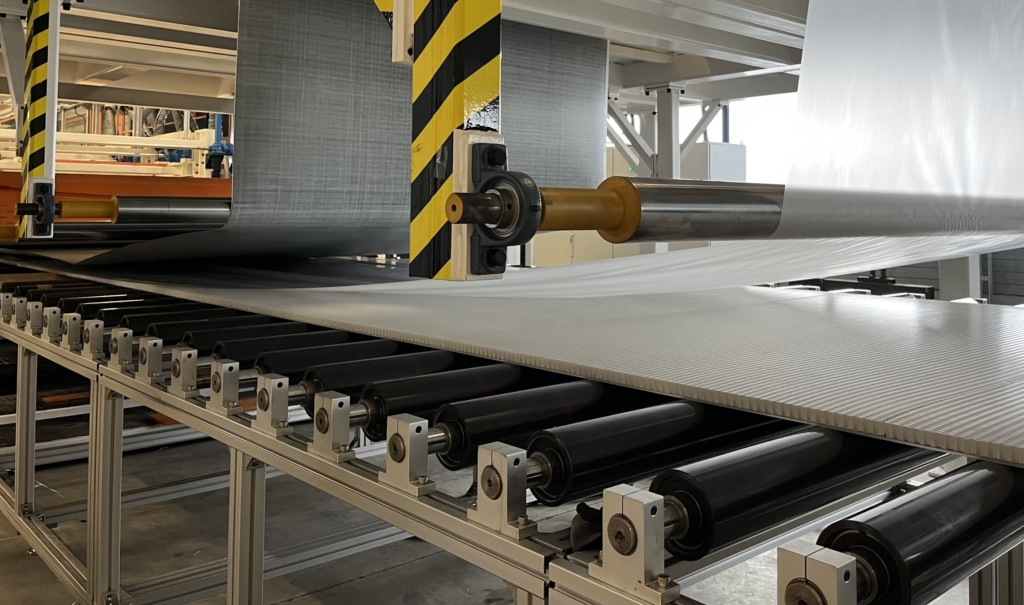
- Production in the Netherlands: our production line in Ospel produces panels up to 13,500 mm × 2,950 mm, fully manufactured in Europe with ISO-certified quality control on every batch.
Are you exploring whether composite panels are a viable alternative for your formwork application? Get in touch to discuss your project. Together we will look at the technical feasibility, the business case, and the steps toward a first prototype or pilot.