

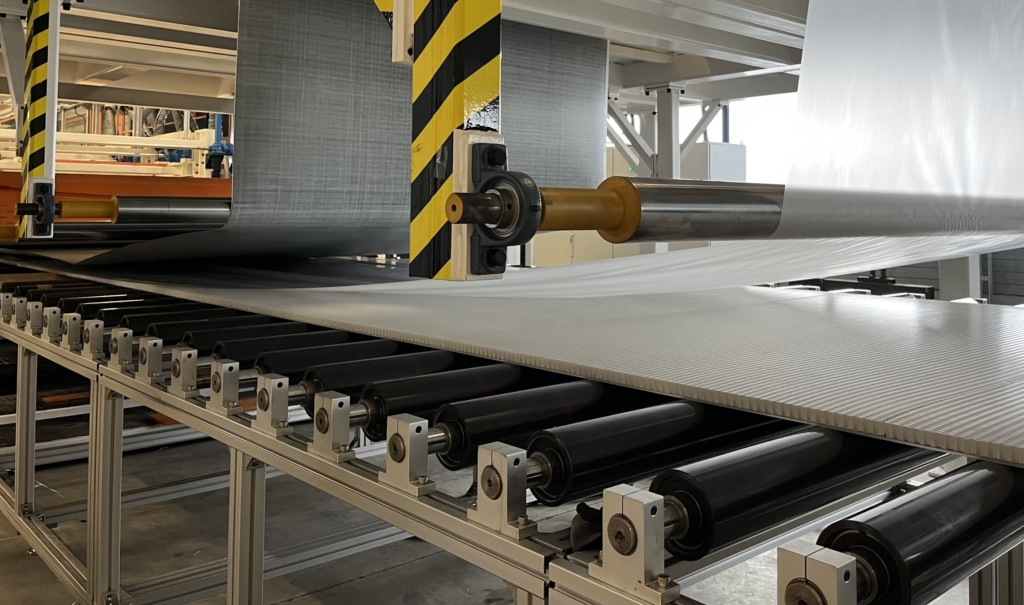
Composite formwork offers significant advantages over plywood in terms of weight, service life and reusability. Where plywood needs replacing after a limited number of use cycles, composite panels last structurally longer and deliver a more consistent concrete surface quality. The questions below go deeper into the specific performance, applications and trade-offs of composite formwork.
How do composite formwork panels compare with plywood?
Composite formwork panels outperform plywood on almost every technical criterion. They are lighter, moisture-resistant, more dimensionally stable and last considerably longer. Plywood absorbs moisture, swells and loses strength after repeated use. Composite panels retain their shape and mechanical properties even after dozens of use cycles.
The fundamental difference lies in the material construction. Plywood consists of wood layers that are vulnerable to water, mould and mechanical damage. A composite sandwich panel combines a lightweight core, such as PP foam or PP honeycomb, with glass-fibre-reinforced thermoplastic skins. That combination produces a panel that is waterproof, rot-free and resistant to the chemical environment of concrete and release agents.
On site, this translates into fewer rejected panels, fewer repairs and a more reliable concrete surface quality from panel to panel. Over time, plywood shows delamination and surface damage, which becomes visible in the concrete surface. Composite panels deliver a more consistent imprint, which is particularly relevant for architectural concrete or precast concrete production, where dimensional accuracy and surface quality are strictly specified.
How often can composite formwork be reused?
Composite formwork panels are designed for intensive reuse and achieve considerably more use cycles than plywood in practice. Where standard plywood formwork needs replacing after 10 to 20 cycles, quality composite panels can last dozens to hundreds of cycles when used correctly, depending on the panel configuration and the application.
Service life depends on several factors: the quality of the skin layer, the core construction, the cleaning and storage methods, and the load conditions on site. Thermoplastic composite panels are fully waterproof and resistant to the alkaline environment of fresh concrete. They do not need to be painted, dried or repaired between cycles. Cleaning consists of rinsing or wiping down.
For formwork rental companies and precast concrete producers, this is a direct financial argument. Over a period of fifteen years, a composite panel eliminates multiple plywood replacement cycles. When you add up panel costs, installation labour and downtime, composite is cheaper per year of use, even if the purchase price per panel is higher.
What are the benefits of lightweight formwork on site?
Lightweight formwork panels speed up assembly, reduce the physical strain on workers and lower the total structural load of the formwork system. A composite panel weighs significantly less than a comparable plywood panel, which means one person can handle a panel without help from a colleague or lifting equipment.
On a busy construction site, that adds up quickly. Faster placement and dismantling mean shorter cycle times per concrete floor or wall. This has a direct impact on project scheduling and staffing. Less weight per panel also reduces the cumulative load on scaffolding and support structures, which increases the safety margin or allows a lighter support structure.
For formwork systems that are moved or transported frequently, such as serial housing construction or infrastructure projects at multiple locations, weight reduction also brings logistical benefits. More panels fit on each truck, which lowers transport costs and reduces the CO2 footprint of logistics.
What concrete surfaces are possible with composite formwork?
Composite formwork panels can produce both smooth and textured concrete surfaces, depending on the surface finish of the panel. A panel with a smooth skin, such as a PET film surface, produces a sleek, even concrete surface suitable for architectural concrete. Textured surfaces can be achieved by adapting the panel finish.
Surface consistency is a major advantage over plywood. Over time, plywood shows wood grain, knots and surface damage that become visible in the concrete. Composite panels retain their surface geometry over multiple cycles, resulting in reproducible concrete quality from panel to panel. This is particularly valuable in precast concrete production, where dimensional accuracy and surface quality are subject to strict requirements.
The chemical resistance of composite also plays a role here. Release agents, alkaline concrete water and cleaning agents do not attack the surface layer, which keeps the finish durable and therefore maintains concrete quality over the entire life of the panel.
Is composite formwork more sustainable than traditional materials?
Composite formwork is more sustainable than plywood in several respects. The longer service life means less material consumption over time. Fewer replacement cycles result in less waste and less production energy per square metre of formwork actually used. Thermoplastic composite panels are also recyclable at the end of their life.
Plywood formwork almost always ends up as waste after use, because damaged wood is difficult to recycle and has little residual value. Thermoplastic panels can be returned to the material chain. For European contractors and producers reporting under the CSRD, the recyclability of construction materials is a compliance consideration, not just a preference.
The production location also matters. Panels produced entirely in Europe have a shorter supply chain and a lower transport footprint than materials imported from outside Europe. For procurement teams that weigh sustainability criteria in supplier selection, origin is a relevant differentiator.
When is composite formwork the right choice for a project?
Composite formwork is most suitable when reusability, weight, surface quality or service life play a decisive role in the project economics. For projects where panels are used only a few times and then discarded, the higher purchase price of composite is harder to justify. But as soon as reuse is structural, the calculation tips in its favour.
Specific situations in which composite formwork is the preferred choice:
- Formwork rental: high usage frequency makes the longer service life directly visible in the operating account
- Precast concrete production: consistent surface quality and dimensional accuracy over hundreds of cycles
- Architectural concrete: smooth, reproducible surfaces without wood grain or surface damage
- Projects with tight logistics: lighter panels speed up assembly and lower transport costs
- Environments with moisture or chemicals: composite is fully waterproof and chemically resistant
For one-off projects or those with a very low budget per square metre of formwork, plywood remains a pragmatic choice. The assessment always comes down to this: how many cycles are expected, what does replacement cost including labour and downtime, and what surface quality is required? Once those three factors are weighed seriously, composite is in most cases the better investment.
How we help with composite formwork panels
We develop and produce thermoplastic sandwich panels for companies looking for an alternative to plywood and other conventional formwork materials. Our panels combine a PP foam core or PP honeycomb core with glass-fibre-reinforced skins, tailored to the specific loads and surface requirements of formwork applications.
What we offer for formwork applications:
- Custom panel configurations tailored to the structural and dimensional requirements of your formwork system
- Technical evaluation of your current panel specification, including advice on core type, skin construction and dimensions
- Prototypes and test panels for validation in your production process or on site
- Production volumes of up to 1.5 million square metres per year, fully produced in Europe, in the Netherlands
- OEM collaboration for formwork manufacturers looking for a reliable long-term production partner
We approach every project as a technical partnership. That means we review your design, optimise the panel configuration for your assembly process and flag potential bottlenecks before production starts. Want to know whether composite panels are suitable for your formwork application? Contact us for a technical evaluation of your project.
Related Articles
- Can composite formwork be used for both walls and slabs?
- Does lightweight formwork make installation faster?
- How do sandwich panels contribute to a circular economy in manufacturing?
- What is GRP and when is it used as a sandwich panel face sheet?
- What are the best sandwich panels for truck body construction?