

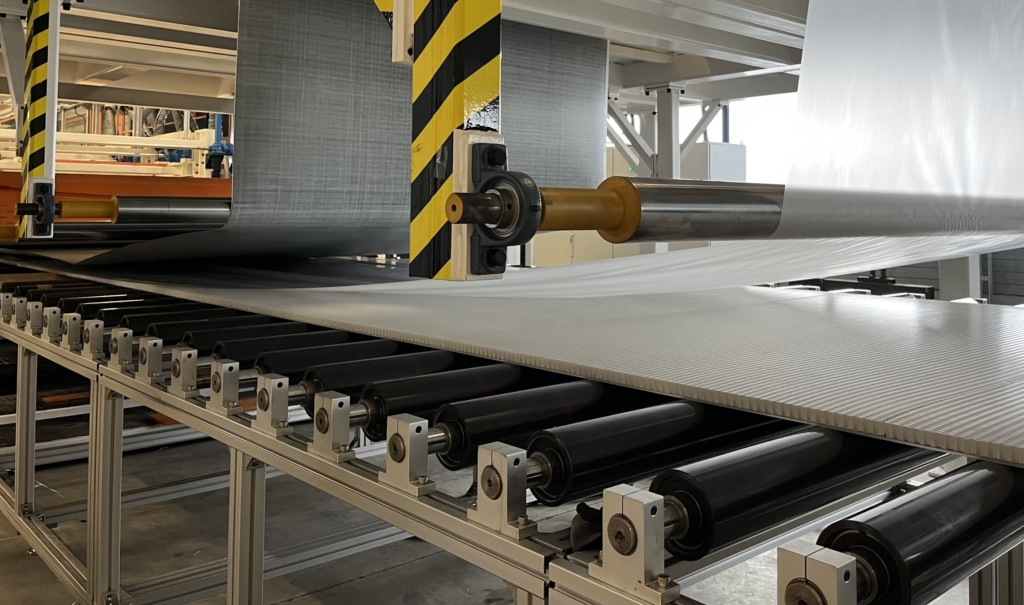
Composite formwork differs from traditional formwork in that it is built from fibre-reinforced thermoplastic sandwich panels instead of plywood or steel. This difference in material delivers direct advantages in weight, service life and reusability. The questions below explore each aspect in more detail, from material composition to application suitability and custom production.
What materials are used in composite formwork?
Composite formwork panels consist of a sandwich construction with a lightweight core, typically PP foam (oriented polypropylene) or PP honeycomb, surrounded by fibre-reinforced thermoplastic skin layers. The skin layers contain glass fibre as reinforcement, bonded in a polypropylene or PET matrix. This gives the panel its load-bearing capacity and its resistance to mechanical stress.
The choice of core largely determines the mechanical properties of the finished panel. PP foam is available in various densities, which makes it possible to tune stiffness and weight to the specific load requirements of a formwork application. At equal thickness, PP honeycomb offers high compressive strength, which is useful in applications with high point loads.
The skin layers are produced in different laminate architectures. A cross-ply construction distributes forces in multiple directions, while a multilayer unidirectional construction maximises strength in a single direction. Depending on the application, the surface can be finished with a PET film for a smooth concrete imprint or with an anti-slip texture for safe use on the working floor.
How does the weight of composite formwork compare to plywood?
Composite formwork panels are considerably lighter than comparable plywood panels. Depending on thickness and configuration, the weight difference can amount to several tens of percent, with the largest relative weight saving occurring at greater thicknesses. This makes a direct difference to handling on the construction site.
With traditional plywood formwork, heavy panels often require two people to place and remove. A lighter composite panel can be handled by a single worker, which shortens assembly time and reduces the physical workload. This effect becomes stronger as panels get larger, because the weight difference per square metre then comes fully into play.
Beyond direct handling, the lower weight also has consequences for transport and logistics. More panels fit on each truck, which lowers the transport cost per unit. For companies that rent out formwork systems or deploy them at multiple locations, this advantage adds up across the entire fleet.
How often can composite formwork be reused?
Composite formwork panels are designed for intensive reuse over a considerably longer period than plywood. Whereas plywood formwork in practice needs replacing after three to five years due to moisture absorption, delamination or mechanical wear, a well-constructed thermoplastic composite panel lasts twelve years or longer under comparable conditions of use.
This difference in service life is the direct result of the material properties. Composite panels do not absorb moisture, do not rot and do not delaminate when exposed to water, frost or UV radiation. They also retain their dimensional stability under varying temperature and humidity conditions, which is a known cause of deformation and loss of quality in plywood.
For formwork systems that are cleaned regularly or exposed to chemicals, such as release agents, the chemical resistance of thermoplastic composites offers an additional advantage. The panel does not need to be painted, dried or structurally repaired between use cycles. Simple cleaning is enough to make the panel ready for its next deployment.
What are the advantages of composite formwork for overall cost efficiency?
The overall cost efficiency of composite formwork is higher than that of plywood when you take the full period of use into account. The purchase price per panel is typically higher, but over a service life of twelve years or more, a composite panel eliminates the two to three replacement cycles that are necessary with plywood. When you add up panel costs, installation labour and downtime, composite is cheaper per year of use.
In addition to the direct replacement costs, there are indirect savings. Lower weight means less load on the formwork structure itself, which reduces wear on load-bearing components. Faster assembly and dismantling lower the labour costs per formwork cycle. And because composite panels need no drying time after cleaning, they can be redeployed more quickly at the next location.
For rental companies and contractors who use formwork intensively, a longer service life translates directly into higher fleet availability. Panels that are not replaced also do not need to be scheduled for replacement, which simplifies logistics planning and reduces unexpected costs.
Which formwork applications are most suitable for composite panels?
Composite panels are most suitable for formwork applications where reuse, weight and dimensional stability determine performance. Think of reusable wall formwork, floor formwork, precast concrete moulds and modular formwork systems that are deployed on multiple projects.
In precast concrete production, the smooth PET film finish of composite panels allows you to achieve consistent concrete surface quality over many use cycles. Over time, plywood develops surface variations through moisture absorption and wear, which leads to irregularities in the concrete surface. A composite panel retains its geometry and surface texture considerably longer.
Applications with high loads, such as floor formwork for heavily poured concrete, benefit from the combination of low mass and high bending strength that a sandwich construction offers. The core absorbs compressive loads while the fibre-reinforced skin layers take up tensile stresses, resulting in a panel that is stiffer than solid plywood at equal thickness.
Less suitable are applications where the panel is used once and then discarded, or where purchase price is the only deciding factor. In those cases, the benefit of the longer service life does not outweigh the higher initial investment.
How is composite formwork produced and customised?
Composite formwork panels are produced through a continuous lamination process in which the core and skin layers are joined under heat and pressure into a homogeneous sandwich panel. This process makes it possible to produce large panels with consistent material properties across the entire surface, without the variations that can occur in manual lamination processes.
After basic production, panels are cut to size, milled or fitted with edge finishing, depending on the requirements of the application. CNC milling enables precise cut-outs, connection profiles and complex geometries needed for modular formwork systems. Edge finishing protects the core against moisture ingress and mechanical damage at the edges, which further extends the service life of the panel.
Customisation is possible in terms of dimensions, thickness, core material, skin architecture and surface finish. Panels can be produced in sizes up to 13,500 mm by 2,900 mm, which allows large formwork surfaces with minimal seams. For OEM applications and large volumes, private labelling and specific technical configurations are available in consultation with the manufacturer.
How we help you with composite formwork
We develop and produce thermoplastic sandwich panels for companies looking for an alternative to plywood and other conventional formwork materials. Our approach does not begin with a standard product catalogue, but with your specific application.
- Technical evaluation: We review your formwork design and advise on the most suitable panel configuration, including core material, skin architecture and thickness.
- Custom production: Panels are produced to your exact specifications, including dimensions, edge finishing and surface finish.
- Prototyping and sampling: Before moving to series production, you can have panels tested in your own production environment or formwork system.
- Production scale: Our production line has a capacity of 1.5 million square metres per year, which guarantees continuity of supply for large volumes.
- Engineering support: We identify potential problems in your design before production starts, so you do not have to make costly adjustments afterwards.
We work as a partner, not as a supplier who delivers panels to specification and has no further involvement. That means we go through your design, optimise the panel configuration for your assembly procedure and actively inform you about opportunities that improve the performance or cost efficiency of your formwork system. Contact us to discuss which composite panel solution fits your formwork application.
Related Articles
- How does formwork panel weight affect labor costs?
- How do lightweight sandwich panels improve driver safety through better handling?
- Can sandwich panels be used as formwork in concrete construction?
- How do sandwich panels perform in refrigerated vehicle bodies?
- How to evaluate panel materials for weight-sensitive applications?