

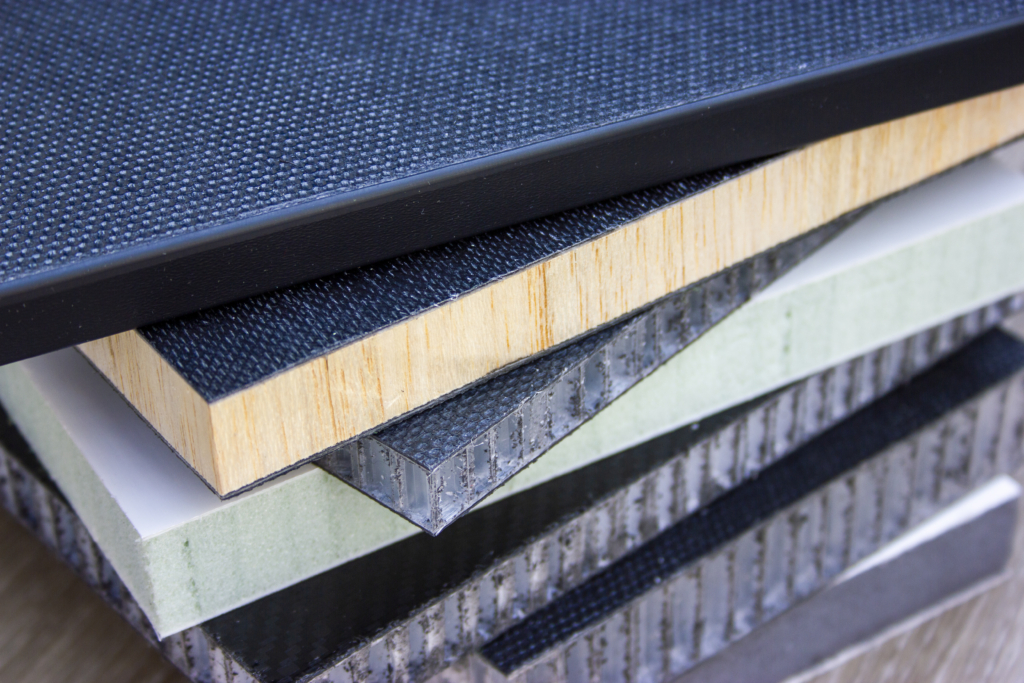
Face sheets on sandwich panels are most commonly made from glass-fibre-reinforced thermoplastic, steel, aluminium, or fibre-reinforced polyester. The right choice depends on the application: structural load requirements, weight targets, surface finish needs, and whether the panel must be recycled at end of life. The questions below unpack each of these factors in practical terms.
What are the most common face sheet materials for sandwich panels?
The most common face sheet materials for sandwich panels are glass-fibre-reinforced thermoplastic (such as glass-fibre-PP or glass-fibre-PET), steel, aluminium, and fibre-reinforced polyester. In transport and construction panel applications, glass-fibre-reinforced thermoplastic skins dominate where weight saving is a priority, while steel and aluminium remain common where impact resistance or cost drives the specification.
Each material brings a distinct set of trade-offs:
- Glass-fibre-reinforced polypropylene (glass-fibre-PP): High stiffness-to-weight ratio, good impact resistance, and fully thermoplastic, making it weldable and recyclable. Widely used in truck body panels, trailer walls, and scaffolding boards.
- Glass-fibre-PET: Similar structural profile to glass-fibre-PP but with a PET matrix, often chosen where surface finish or specific thermal behaviour is required.
- Carbon-fibre-PP: Higher stiffness and lower weight than glass-fibre variants, but at a higher material cost. Used where maximum weight reduction justifies the premium.
- Steel: High strength and low cost per unit, but adds significant dead weight. Common in heavy-duty industrial panels where weight is not a constraint.
- Aluminium: Lighter than steel with good corrosion resistance, but heavier than composite skins and more difficult to recycle in a mixed-material panel.
- Fibre-reinforced polyester (FRP/GRP): Durable and weather-resistant, but thermoset, meaning it cannot be remelted or easily recycled at end of life.
- Plain polypropylene (PP) film or PET film: Used as decorative or protective surface layers laminated over structural skins, providing UV resistance and a finished appearance without adding structural contribution.
In commercial vehicle and scaffolding applications specifically, glass-fibre-reinforced thermoplastic skins are increasingly the default choice because they combine structural performance with low weight and end-of-life recyclability.
How does the face sheet material affect sandwich panel performance?
The face sheet material directly determines a sandwich panel’s tensile strength, bending stiffness, impact resistance, surface durability, and weight. Because the face sheets carry the tensile and compressive loads generated by bending, their stiffness and thickness govern how the panel performs under real-world loading, far more than the core material alone.
Several performance dimensions shift significantly depending on which skin material you specify:
Bending stiffness and load capacity: Stiffer face sheets, such as multi-ply glass-fibre-PP laminates, increase the panel’s resistance to deflection under load. A thicker or higher-ply skin pushes the neutral axis further from the core, amplifying the structural efficiency of the sandwich geometry. For floor panels in truck bodies or trailers, this directly affects whether the panel can span between supports without an aluminium subframe underneath.
Impact resistance: Thermoplastic skins absorb and redistribute impact energy more effectively than brittle thermoset skins. Cross-ply laminate architectures, where fibre layers run in alternating directions, equalise mechanical properties across both panel orientations and improve resistance to localised impact.
Surface finish and UV stability: A PET film laminated onto the outer face provides a controlled decorative surface with measurable UV resistance. In scaffolding and vehicle body applications exposed to outdoor weathering, this matters for both appearance and long-term structural integrity. Surface finishes such as anti-skid textures are built into the skin itself rather than applied as a coating, making them inherent to the panel rather than a layer that can wear away.
Weight: Composite skins are substantially lighter than steel or aluminium at equivalent stiffness. In transport applications, every kilogram saved in the body structure is a kilogram available for payload, or, in electric trucks and vans, a kilogram that extends battery range per charge. In 2026, EV fleet procurement teams treat weight reduction as a range argument as much as a payload argument, and face sheet material selection sits at the centre of that calculation.
What is the difference between thermoplastic and thermoset face sheets?
Thermoplastic face sheets can be remelted and reformed after manufacture, while thermoset face sheets cure into a permanently cross-linked structure that cannot be reprocessed. This fundamental difference affects how panels are manufactured, joined, repaired, and disposed of at end of life.
Thermoplastic face sheets
Thermoplastic skins, such as glass-fibre-PP or glass-fibre-PET, are produced by consolidating fibre layers within a polymer matrix that softens when heated. This allows panels to be thermoformed into curved shapes, welded to other thermoplastic components, and recycled by remelting the material. In production environments, thermoplastic skins also support faster cycle times because they do not require a chemical curing stage. For truck body builders and trailer manufacturers, the ability to cut, route, and join thermoplastic panels without specialist adhesives or curing equipment simplifies assembly significantly.
Thermoset face sheets
Thermoset skins, such as fibre-reinforced polyester or epoxy-based composites, are formed through an irreversible chemical reaction. Once cured, they cannot be remelted or reshaped. They offer good chemical resistance and can achieve high fibre volume fractions, but they generate waste that is difficult to recycle. In European markets, this is increasingly a compliance issue: the EU End-of-Life Vehicles (ELV) Directive requires manufacturers to demonstrate recyclability targets, and thermoset panels complicate that calculation for vehicle body builders.
Which face sheet material is best for lightweight structural panels?
Glass-fibre-reinforced polypropylene (glass-fibre-PP) is the most practical face sheet material for lightweight structural sandwich panels in transport and industrial applications. It delivers high tensile stiffness and strength at low areal weight, bonds reliably to thermoplastic cores, and keeps the entire panel within a recyclable material family.
The structural efficiency of a glass-fibre-PP skin comes from its cross-ply laminate architecture. By orienting fibre layers at 0° and 90° to each other, the skin carries load effectively in both directions, meaning the panel performs consistently regardless of which orientation it is installed. This matters in practice: a truck body builder fitting wall panels does not need to track panel orientation during assembly.
For applications demanding even lower weight at higher cost, carbon-fibre-PP skins offer a step up in stiffness-to-weight ratio. However, for the majority of commercial vehicle and scaffolding applications, glass-fibre-PP provides the right balance of performance, cost, and availability.
It is worth noting that “best” depends on the specific load case. A floor panel in a heavy-duty trailer needs a different skin specification than a wall panel in a cargo box or a scaffolding board spanning between ledgers. The number of plies, the fibre architecture, and the skin thickness all need to be matched to the actual load the panel will carry, not selected from a generic datasheet.
Can different face sheet materials be combined on a single panel?
Yes. Sandwich panels can be built with different face sheet materials on each side, a configuration known as an asymmetric panel. This approach allows each face to be optimised for its specific function: one side for structural load, the other for surface finish, wear resistance, or weight reduction.
A practical example is a wall panel with a 2-ply glass-fibre-PP skin on the interior face and a 4-ply skin on the exterior face. The heavier outer skin carries higher bending loads or provides greater impact resistance, while the lighter inner skin keeps total panel weight down. The two faces share the same core, so the weight penalty of the asymmetric design is modest relative to the performance gain on the loaded face.
Surface films are another form of face combination. A structural glass-fibre-PP skin can be laminated with a PET film on the outer surface to provide UV resistance, a controlled colour finish, and a smooth appearance, without changing the structural skin specification. Anti-skid surface finishes work the same way: the texture is integrated into the skin during manufacture rather than applied separately.
The key constraint with asymmetric panels is that the different stiffness on each face creates a tendency to bow or warp under temperature changes. Panel design needs to account for this, particularly in applications where the panel is exposed to significant temperature gradients, such as the outer wall of a refrigerated trailer or a scaffolding board in direct sunlight.
How do face sheet materials affect sandwich panel recyclability?
Face sheet material is the single biggest factor in whether a sandwich panel can be recycled at end of life. Thermoplastic skins, glass-fibre-PP, glass-fibre-PET, carbon-PP, can be remelted and reprocessed. Thermoset skins cannot. In European markets, this distinction is increasingly a regulatory requirement, not just a preference.
The EU End-of-Life Vehicles (ELV) Directive sets recyclability targets for vehicles placed on the European market. For truck body builders and trailer manufacturers, panels that use thermoset face sheets complicate compliance because the material cannot be separated and reprocessed through standard recycling streams. Thermoplastic panels, by contrast, can be ground down and remelted, keeping the material in productive use rather than sending it to landfill or energy recovery.
Beyond regulatory compliance, the Corporate Sustainability Reporting Directive (CSRD) requires larger European manufacturers to report on material circularity as part of their sustainability disclosures. Specifying thermoplastic sandwich panels with recyclable face sheets gives procurement teams a documentable answer when auditors or customers ask about end-of-life material flows.
One practical nuance: a panel is only as recyclable as its least recyclable component. A glass-fibre-PP skin laminated to a PP honeycomb core creates a panel where both materials share the same polymer family, simplifying end-of-life processing. Mixing thermoplastic skins with thermoset adhesives or incompatible core materials undermines the recyclability argument even if the skins themselves are thermoplastic.
How Compoform Helps You Specify the Right Face Sheet
We manufacture thermoplastic sandwich panels with glass-fibre-PP, carbon-PP, PP, and glass-fibre-PET face sheets, laminated onto PP honeycomb or PET foam cores. Every panel we produce is 100% European-made at our facilities in the Netherlands, and our production line handles panels up to 13,500 mm × 2,950 mm, custom dimensions that most European suppliers cannot match off the shelf.
When you bring us a panel specification, we do not simply confirm whether we can produce it. We review the actual load case, the assembly process, and the end-use environment, then recommend the skin configuration that delivers the performance you need at the lowest total weight. Specific things we work through with you:
- Ply count and fibre architecture: Whether a 2-ply or 4-ply skin is appropriate, and whether a symmetric or asymmetric layup suits your application.
- Surface finish: PET film for decorative wall panels, anti-skid skins for floor panels, or plain skins where you apply your own finish in assembly.
- Core pairing: PP honeycomb for high-load floor and scaffolding panels, PET foam for wall panels where thermal performance and surface quality matter.
- Recyclability documentation: If your customers or auditors require end-of-life material declarations under the ELV Directive or CSRD, we can provide the material composition data you need.
A Compoform floor panel at 30 mm is self-supporting, no aluminium subframe required. That removes a production step from your assembly line and reduces the total weight of the finished vehicle body. Over a 15-year vehicle life, eliminating 2 to 3 plywood replacement cycles adds up to a lower cost per year of service than the unit price of the composite panel suggests.
If you are specifying face sheet materials for a truck body, trailer, or scaffolding application and want an engineering review before committing to a configuration, speak with our team about your project requirements.
Related Articles
- How much does aluminium really cost over its lifetime?
- What density of PP foam is used in structural sandwich panels?
- How do lightweight sandwich panels help manufacturers meet EU emissions targets?
- What happens to thermoplastic sandwich panels at end of life?
- How do lead times for custom sandwich panels compare to standard sheet materials?