

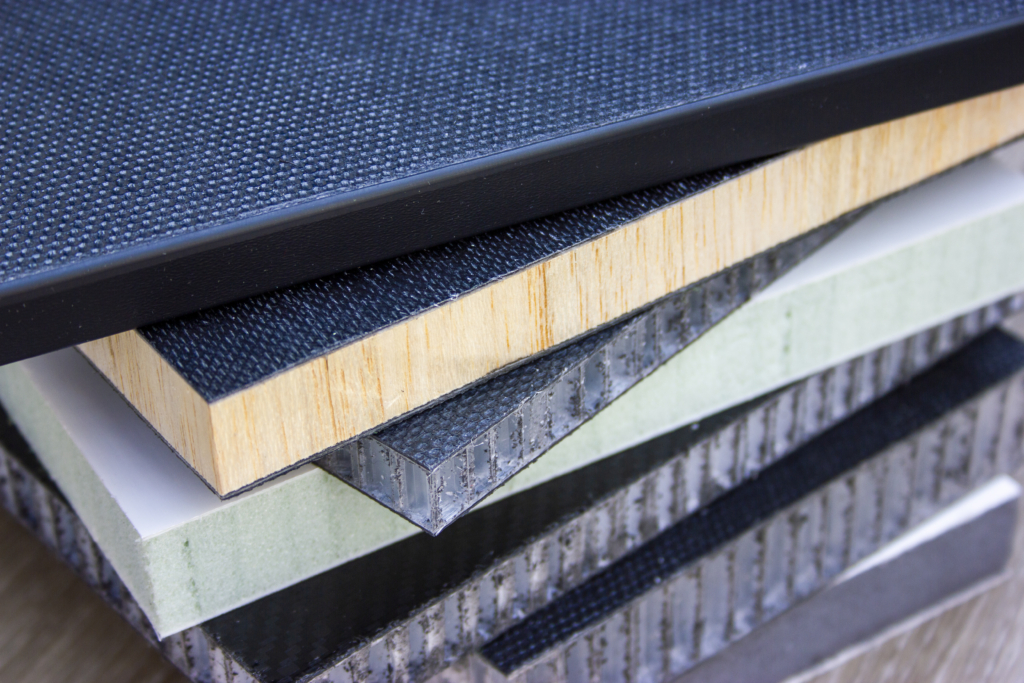
Lightweight sandwich panels help manufacturers meet EU emissions targets primarily by reducing vehicle body weight, which directly lowers fuel consumption and CO2 output per kilometre. For truck body builders and trailer manufacturers, replacing steel or plywood structures with thermoplastic composite panels is one of the most practical structural changes available within existing vehicle designs. The sections below work through the regulations, the weight mechanics, and the practical questions manufacturers ask before making the switch.
What EU emissions regulations actually require from vehicle manufacturers?
EU regulations set mandatory CO2 reduction targets for heavy-duty vehicles, requiring manufacturers to cut average fleet emissions against a 2019 baseline. Under the revised Heavy Duty Vehicles Regulation (EU 2019/1242, updated in 2023), new heavy trucks must achieve a 45% CO2 reduction by 2030, rising to 65% by 2035 and 90% by 2040. These are fleet-average targets, not per-vehicle limits, but they create direct pressure on every vehicle specification decision.
For truck body builders and trailer manufacturers, the regulation creates an indirect but real obligation. OEM customers and fleet operators increasingly specify body weight as part of procurement requirements, because a lighter body structure allows the powertrain to do less work per tonne of payload moved. In 2026, this pressure is no longer theoretical. Fleet operators transitioning to electric trucks treat body weight as a range variable, and procurement teams are asking for body weight declarations as a standard part of the tender process.
The regulation also intersects with the EU End-of-Life Vehicles (ELV) Directive, which requires that vehicle components meet recyclability thresholds. This makes material choice a compliance question, not just a performance one. Thermoplastic composite panels are fully recyclable, which positions them favourably against materials that create end-of-life disposal costs or compliance risk.
How does reducing vehicle weight lower CO2 emissions?
Reducing vehicle weight lowers CO2 emissions because a lighter vehicle requires less energy to accelerate, maintain speed, and climb gradients. In diesel-powered trucks, this translates directly into lower fuel consumption per kilometre. In electric trucks and vans, it translates into longer range per charge. Either way, the physics are the same: less mass means less energy demand, and less energy demand means lower emissions per tonne-kilometre of freight moved.
For commercial vehicles operating under EU weight limits, there is an additional mechanism. When a body structure is lighter, operators can either carry more payload within the same gross vehicle weight, or run the same payload with a smaller, more efficient powertrain. Both outcomes reduce the emissions intensity of each delivery.
The EV argument deserves specific attention in 2026. Electric truck adoption is accelerating across European fleets, and battery range remains the primary operational constraint. Every kilogram of structural dead weight in the body reduces the range available for cargo. For a fleet operator specifying new electric truck bodies, weight reduction is a range argument as much as a payload argument. Body builders who can demonstrate a measurable weight saving are answering a direct procurement question, not just offering a marginal improvement.
How much lighter are sandwich panels compared to steel or wood?
Thermoplastic sandwich panels are substantially lighter than steel and meaningfully lighter than plywood, though the exact saving depends on panel thickness, core type, and the steel or wood gauge being replaced. As a general reference point, a glass-fibre reinforced thermoplastic sandwich panel with a PP foam or PP honeycomb core typically weighs significantly less per square metre than a steel panel of equivalent structural performance, and less than the plywood it replaces in truck floors and trailer walls.
The more useful comparison for body builders is structural equivalence rather than raw weight per square metre. A sandwich panel achieves its stiffness through the separation of two thin, strong skins around a lightweight core, rather than through material mass. This means a composite panel can match or exceed the bending performance of a much heavier steel or plywood panel at a fraction of the weight.
For truck body floors specifically, the weight saving from switching to composite panels can be meaningful at the vehicle level. A full trailer floor replacement can remove a significant amount of dead weight from the tare, directly increasing the payload capacity available within the legal gross vehicle weight. Over a vehicle’s operating life, that payload gain compounds into measurable revenue or emissions efficiency, depending on how the operator uses the additional capacity.
What other properties make composite sandwich panels suitable for commercial vehicles?
Beyond weight, thermoplastic sandwich panels offer a combination of durability, moisture resistance, and dimensional stability that makes them well suited to the operating conditions of truck bodies and trailers. These properties reduce maintenance requirements and extend service life compared to traditional materials.
Durability and lifespan
Thermoplastic composite panels last significantly longer than plywood in heavy transport applications. Industry experience with composite truck floors points to service lives of 12 years or more, compared to 3 to 5 years for plywood before replacement is needed. Over a 15-year vehicle life, that difference eliminates two or three plywood replacement cycles. When you account for panel cost, installation labour, and vehicle downtime during replacement, the composite floor is cheaper per year of service even at a higher unit price. This is a concrete TCO argument, not a general claim about durability.
Moisture and chemical resistance
Truck bodies and trailer floors are regularly washed down, exposed to road salt, and subjected to loading and unloading cycles that introduce moisture at joints and edges. Plywood absorbs moisture, swells, and degrades at fixings. Steel corrodes. Thermoplastic composite panels do not absorb water and are chemically resistant to the cleaning agents and road contaminants typical in transport operations. Edge sealing and edge bending protect the core from UV and moisture ingress, which is particularly relevant for floors and scaffolding boards that face repeated wet exposure.
Recyclability and ELV compliance
Thermoplastic panels are fully recyclable, which matters for European OEMs subject to the EU ELV Directive. Unlike thermoset composites, thermoplastic materials can be reprocessed at end of life, supporting compliance with recyclability requirements and reducing disposal costs. For manufacturers whose customers are subject to the Corporate Sustainability Reporting Directive (CSRD) obligations, being able to document the recyclability of body components is increasingly a procurement requirement rather than a preference.
Are lightweight composite panels compatible with existing vehicle assembly processes?
Yes, thermoplastic sandwich panels are compatible with standard vehicle assembly processes. They can be cut, drilled, routed, and fixed using conventional workshop equipment, without specialist tooling or significant process changes. For most truck body builders and trailer manufacturers, the transition from plywood or steel panels to composite panels does not require capital investment in new machinery.
Panels are available in custom dimensions cut to your exact specification, which means they arrive ready to fit your assembly sequence rather than requiring on-site cutting to size. Maximum panel dimensions reach 13,500 mm x 2,900 mm, covering the full width and length of standard trailer and truck body applications without the need for joints.
One process advantage worth noting for floor applications is that a 30 mm PP sandwich panel floor is self-supporting, requiring no aluminium subframe beneath it. This removes a production step that is standard with plywood floors, reduces component count, and lowers the total installed weight further. For body builders running production at volume, eliminating a subframe assembly step has a real impact on throughput and cost per unit.
When should a manufacturer switch to sandwich panels for emissions compliance?
The right time to switch is when your customers are beginning to specify body weight in procurement requirements, or when you are losing tenders to competitors offering lighter body structures. In 2026, both signals are present in the European commercial vehicle market. Fleet operators transitioning to electric vehicles are asking body builders for weight declarations as a standard part of the specification process, and the regulatory trajectory under the Heavy Duty Vehicles Regulation makes this pressure structural rather than cyclical.
From a practical standpoint, the switch makes most sense when you are already facing a material change decision, such as a floor replacement programme, a new vehicle variant, or a customer requesting a lighter specification. Retrofitting composite panels into an existing design is possible, but the greatest efficiency gains come from designing the body around composite panels from the outset, allowing you to remove the subframe, optimise fixings, and specify the right panel configuration for your load requirements.
Manufacturers who wait until emissions compliance becomes a contractual requirement rather than a competitive advantage will face the transition under time pressure, with less opportunity to optimise the design. The manufacturers gaining ground in 2026 are those who have already qualified composite panels in their production process and can offer a documented weight saving to fleet customers asking the question.
How Compoform Helps You Reduce Vehicle Weight for Emissions Compliance
We work with truck body builders and trailer manufacturers across Europe to replace steel and plywood structures with thermoplastic sandwich panels engineered for their specific application. Our panels use PP honeycomb or PP foam cores, combined with glass-fibre reinforced thermoplastic skins, and are produced in custom dimensions up to 13,500 mm x 2,900 mm to fit your assembly process without modification.
Here is what working with us looks like in practice:
- Panel configuration review: We review your current body design and identify where composite panels deliver the greatest weight saving without compromising structural performance or load ratings.
- Custom dimensions: Panels are cut to your exact specification, arriving ready for your assembly line. No on-site cutting, no joints where they are not needed.
- Subframe elimination: For floor applications, our 30 mm PP sandwich panels are self-supporting, removing the aluminium subframe from your production process and reducing both weight and cost per unit.
- Documented performance: We provide technical data to support your weight declarations to fleet customers, including test results referenced to European standards such as EN 12811 for load performance.
- ELV compliance support: Our thermoplastic panels are fully recyclable, supporting your compliance with the EU ELV Directive and your customers’ CSRD reporting requirements.
We do not ship panels to spec and move on. We review your design, flag integration issues before production starts, and support you through the qualification process and beyond. If you are specifying composite panels for a new truck body or trailer variant, speak with our application engineers about the right panel configuration for your load requirements and assembly process.
Related Articles
- How much does aluminium really cost over its lifetime?
- What makes thermoplastic sandwich panels 100% recyclable?
- How do biobased sandwich panels compare to conventional sandwich panels?
- How thick should sandwich panels be in a motorhome build?
- What is the role of the core in a sandwich panel's structural performance?